
10 Key Benefits of Custom CNC Aluminum for Your Precision Parts
This page lists the ten benefits we see most often when engineers move a part from drawing to production in aluminum. It is written for design engineers and buyers who need to judge whether aluminum CNC is the right process for a given part, and where it is not. Read it and you can pick an alloy, set a realistic tolerance, and know which questions to ask a machine shop.
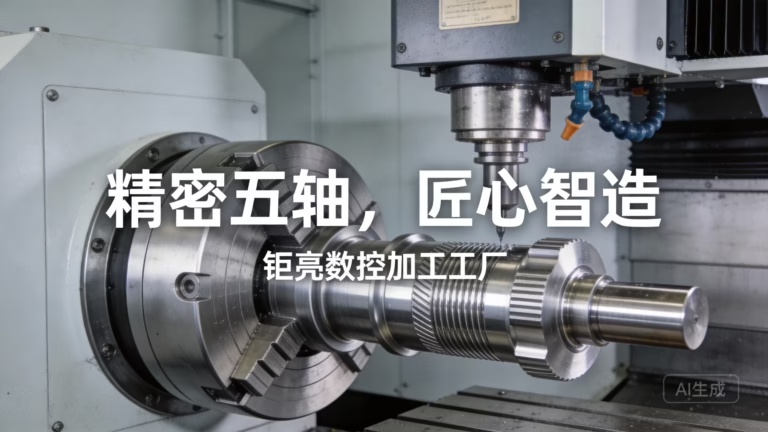
What These Ten Benefits Actually Cover
Aluminum is not automatically the right choice. These ten points are the ones that decide it.
Dimensional Accuracy and Strength-to-Weight
Aluminum cuts clean and stays stable under load, so it holds tight numbers without the spring-back you fight in stainless. On our 5-axis centers we hold ±0.005 mm on features that matter and still meet ±0.0002 in on a drawing callout when the geometry allows it. The catch is part stiffness: a thin wall 0.5 mm thick will move no matter what alloy you pick, so we add supports or leave stock for a finishing pass.
Strength-to-weight is the other reason aluminum shows up in moving parts. 6061-T6 and 7075-T6 carry more load per kilogram than mild steel at roughly one third the density. On a robot arm or an EV bracket, less mass means lower inertia and less energy spent accelerating the part itself.
Where it fails: if the part sees high cycle fatigue at high stress, or runs above roughly 150 °C in service, aluminum loses ground to steel or titanium. Tell us the load case and we will say so before quoting.
Design Freedom on 5-Axis Machines
Three-axis work needs the part accessible from one direction at a time. That rules out undercuts, helical ports and organic ribs unless you add setups. With simultaneous 5-axis machining, compound angles and internal channels come off in a single setup, and every extra setup you remove is one less fixture, one less datum shift and one less chance of a scrapped part.
Our shop runs 16 simultaneous 5-axis centers with a Ø400 mm rotary table, plus large-format machines with travel up to 4,000 × 400 × 150 mm. That covers everything from a 20 mm sensor housing to a 3 m frame rail.
One trade-off worth knowing: deep, narrow pockets still need long small-diameter tools, and those deflect. If a pocket is deeper than four times its width, expect us to slow down or split the cut. The geometry is possible; the cycle time goes up.
Common Aluminum Alloys and Where They Fit
Strength, finish and corrosion behavior vary a lot between grades.
| Alloy | Typical use | Notes |
|---|---|---|
| 6061-T6 | Brackets, housings, fixtures | Easiest to machine, welds well, anodizes evenly |
| 7075-T6 | Aerospace, high-load arms | Highest strength here, less corrosion resistance |
| 6082-T6 | Structural frames | Good strength, better corrosion than 7075 |
| 2024-T4 | Fatigue-loaded parts | Strong but prone to corrosion without coating |
| 5052 / 5083 | Panels, enclosures | Best corrosion resistance, lower strength |
| ADC12 | Die-cast housings | For volume casting, not CNC from billet |
Surface Finish and Corrosion Behavior
Aluminum takes almost any finish. As-machined parts come off at Ra 1.6–3.2 μm, a finishing pass gets to Ra 0.8–1.6 μm, and fine work reaches Ra 0.2–0.8 μm on a sealing face or a bearing bore. From there you can anodize, hardcoat, bead blast, brush or polish. Laser marking is available down to 1.5 mm character height.
Corrosion resistance is built in. Aluminum forms its own oxide layer, so a marine bracket or an under-hood sensor housing does not need paint to survive. Anodizing thickens that layer and adds a dye option; sulfuric acid anodizing holds up in salt spray far better than bare metal.
Two limits. Aluminum is not noble, so it will corrode fast if it sits against stainless in a wet joint without isolation. And it is soft, so a threaded hole in 6061 will strip if the bolt is cycled repeatedly. Use a thread insert or a steel fastener in a through-bolt.
Cost-Effective Prototyping and Low-Volume Runs
No tooling. That single fact drives the cost curve. Die casting and injection molding need a mold before the first good part exists, so they only pay off at volume. CNC needs a program and a billet, which is why 1 to 1,000 parts is usually the sweet spot where machining wins on total cost.
We run no minimum order quantity, so a one-piece prototype is fine, and the same program scales to a 10,000+ part run on the same machines. For simple geometry in high volume, die casting eventually becomes cheaper per part, and we say so when the numbers point that way.
Setup is the fixed cost. If your design shares a fixture or a family of sizes, we can nest parts and cut the per-part setup. That is where a small redesign saves more money than a supplier discount.
Thermal and Electrical Behavior, Plus Recyclability
Aluminum conducts heat about five times better than steel. That matters in two directions: a heat sink or LED housing pulls heat away from a source, and a spindle mount pulls heat out of the bearing. For electrical work, aluminum is conductive but forms a resistive oxide, so use it for shielding and grounding with a conductive anodize or a masked bare contact.
Recyclability is straightforward. Aluminum scrap remelts at a fraction of the energy needed to make primary metal, and chips from machining go back into that stream. For a product with an end-of-life or reporting requirement, an aluminum housing is one of the easier choices to document.
Lead Time and One Supply Chain
Quotation and a free DFM analysis come back within 12 hours, and production can start within 24 hours of approval. Parts ship in 3–5 days for standard work. That pace comes from keeping programming, machining, finishing and inspection under one roof rather than shipping parts between vendors.
Post-processing is the part of the chain that usually eats a week. Anodizing, plating, powder coating, blasting, brushing and laser marking all run in-house, so a part does not sit in a queue at an outside finisher. Our historical late-delivery probability is below 2%.
Inspection is included, not optional: raw material check, in-process monitoring and 100% inspection before shipment, with reports on request. We are certified to ISO 9001:2015, IATF 16949:2016, ISO 13485:2016 and ISO 27001:2022, and we work under NDA when a design is sensitive.
Aluminum CNC Questions Engineers Ask
What tolerance can you actually hold on an aluminum part?
We hold ±0.005 mm on controlled features, and ±0.0002 in on a drawing callout when the geometry allows it.
The limit is usually the part, not the machine. Thin walls, deep pockets and long unsupported sections deflect during cutting, so we either add support, leave stock for a light finishing pass, or tell you the number is not realistic for that shape.
Is 7075 always stronger than 6061 for a load-bearing part?
On paper yes, 7075-T6 has a higher yield strength than 6061-T6. In practice, 7075 is less corrosion resistant and harder to anodize evenly, and it costs more.
If the part is a bracket with moderate load, 6061-T6 is usually the better trade. Pick 7075 when the load is genuinely high and the part is weight critical.
When does aluminum CNC stop being cost-effective?
When the part is simple and the volume is high. A basic housing at 50,000 pieces per year is a die-casting job, and the tooling pays back quickly.
Between roughly 1 and a few thousand parts, machining usually wins because there is no mold. If your design is close to that boundary, send the drawing and we will compare both routes.
How do I stop a threaded aluminum hole from stripping?
Do not cycle a steel bolt directly in 6061. Use a thread insert, a through-bolt with a nut, or a larger thread with more engagement length.
As a rule, thread depth around twice the nominal diameter gives full strength in aluminum. Going deeper adds cost without adding much grip.
Can aluminum parts be used outdoors or in wet environments?
Yes, with the right grade and finish. 5052 and 5083 resist corrosion well on their own; 6061 and 6082 do better with anodizing.
Avoid direct contact with stainless steel in a wet joint unless you isolate the two, or the aluminum becomes the sacrificial anode and pits.
What do you need to quote an aluminum part?
A 3D file and a 2D drawing with tolerances, alloy, finish and quantity. If you do not have a drawing yet, send the model and note the critical features.
You get a quotation and a free DFM analysis within 12 hours. Uploads stay confidential and we can sign an NDA before you send anything.
Send an Aluminum Part and Get a Real Answer
Upload your model and we will return a quote, a DFM analysis and a realistic tolerance review within 12 hours.
12-hour quote100% inspectionNo minimum orderNDA on request









