
01
Tolerance drifts after the first article
The prototype fits. Production parts do not. Thermal growth, worn tooling, or a fixture that was never re-qualified pushes critical bores out of range. You find out at assembly, not at incoming inspection.
GreatLight machines custom parts from prototype to 10,000+ piece runs. Tolerances to ±0.005 mm, 127 machines, and 100% inspection before every shipment.
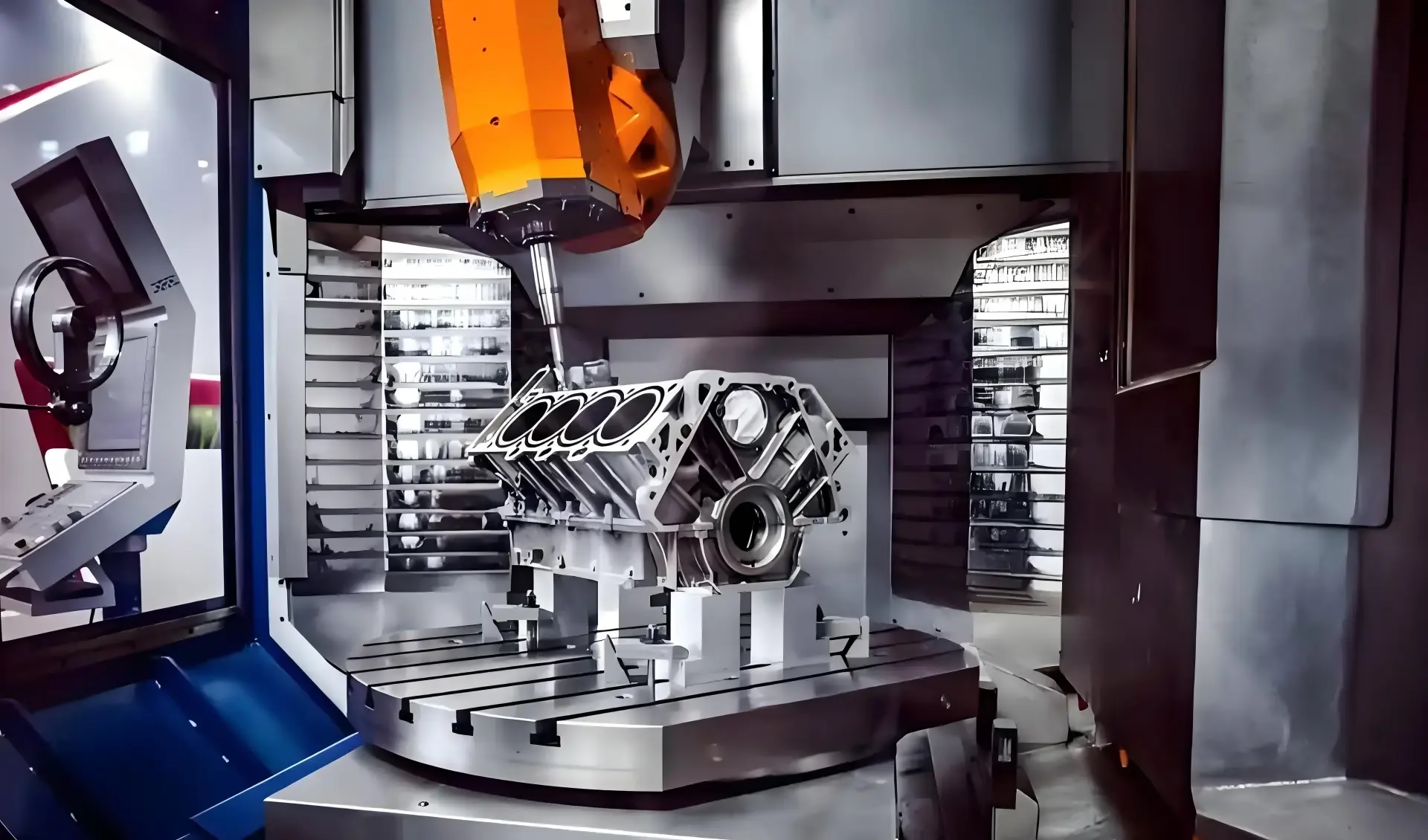
These are the failures we hear about most from engineering teams.
The prototype fits. Production parts do not. Thermal growth, worn tooling, or a fixture that was never re-qualified pushes critical bores out of range. You find out at assembly, not at incoming inspection.
You send a drawing and wait. Then a round of clarifying questions. By the time pricing lands, the program schedule has already moved and the design has changed twice.
Many shops quote 500 pieces or nothing. Your pilot build needs 20 parts to prove the design, and the volume order comes later. A refusal here costs you weeks of schedule.
Anodize color shifts between lots. A bead-blasted surface reads Ra 3.2 μm when the drawing says Ra 1.6 μm. Rework means shipping parts back across an ocean.
Machining strategy, material, and inspection plan are set before the spindle turns.
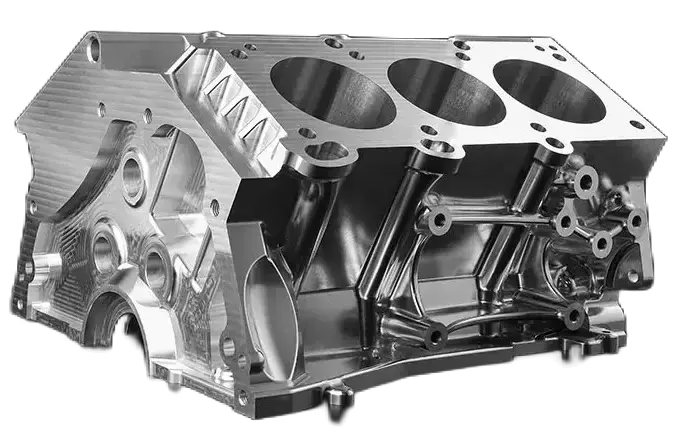
A three-axis cut is the cheapest way to make a plate with holes on one face. It stops being cheap when the part has features on five sides, because every extra setup adds fixture error and labor. We run 27 three-axis machines, 12 four-axis mills, and 16 simultaneous five-axis centers, so the process matches the geometry instead of forcing the geometry into one machine.
Five-axis work pays for itself on parts with compound angles, deep pockets, or tight true-position callouts between features on different faces. One setup holds the datum. That removes the stack-up you get from flipping a part four times.
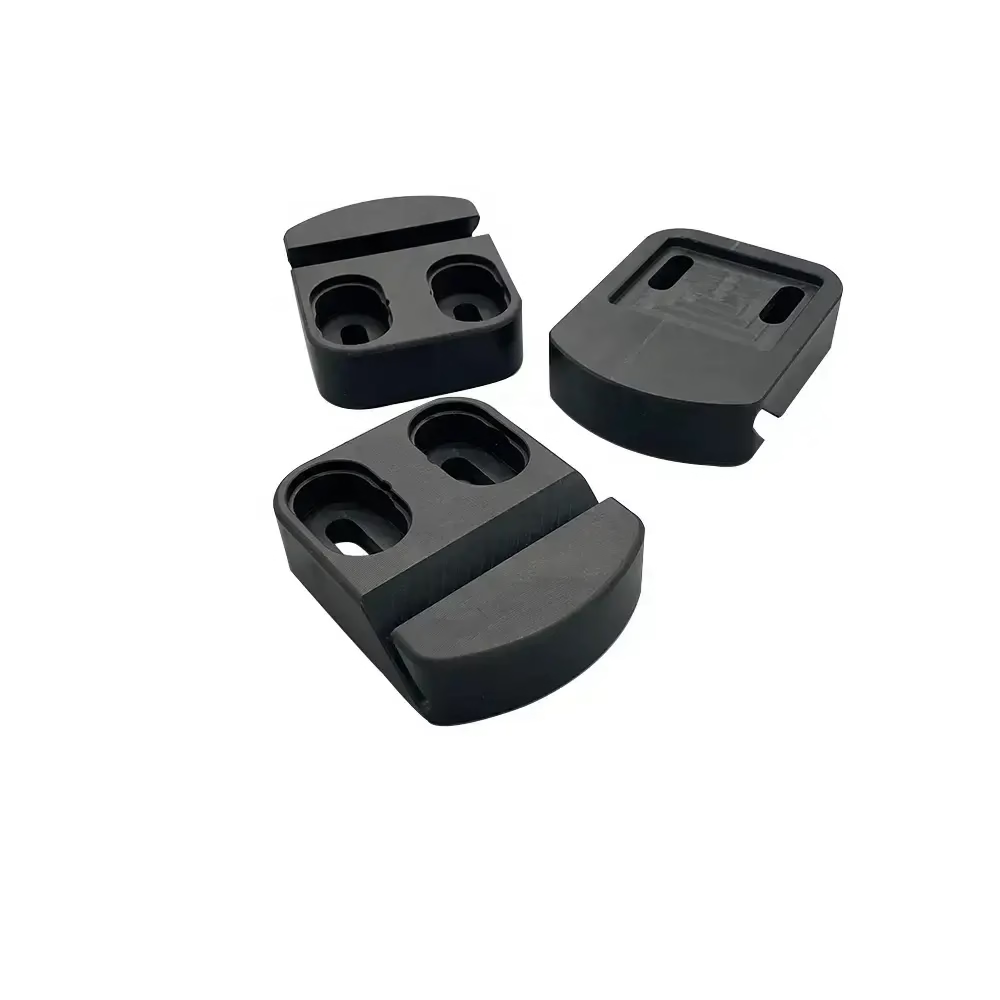
Alloy choice drives both the cut and the cost. 6061-T6 machines fast and takes a clean anodize, which makes it the default for brackets, housings, and fixtures. 7075 carries roughly twice the yield strength of 6061, so it suits robotic joints and aerospace fittings, but it cuts slower and anodizes darker. 6082 behaves close to 6061 with slightly better corrosion resistance.
Plastics follow a different rule. ABS and PC are dimensionally stable enough for enclosures and covers. POM and PEEK hold tolerance in sliding contact and high-temperature service. HDPE is tough but moves with temperature, so we hold the tight dimensions on the features that matter and leave the rest loose.
Pick by geometry and quantity, not by habit.
| Part condition | Recommended process | Why |
|---|---|---|
| Flat plate, holes on one face | 3-axis milling | Lowest setup cost, fastest cycle |
| Features on four sides | 4-axis milling | Indexed table, one datum retained |
| Compound angles, deep pockets | 5-axis simultaneous | One setup, short rigid tooling |
| Round part, milled flats | Mill-turn | Turning and milling in one program |
| Thin wall under 1 mm | 5-axis with light finishing passes | Controlled radial load, less deflection |
| Prototype, 1 to 20 pieces | 3-axis or 5-axis, no hard tooling | Design changes cost nothing to absorb |
Machining is the core. These services cover the steps around it.
16 simultaneous five-axis centers handle compound angles, deep cavities, and multi-face parts in one setup. Maximum part envelope reaches 4,000 mm on our large-travel machines.
12 four-axis mills and 27 three-axis machines cover prismatic parts, plates, and housings where five axes would add cost without adding value.
16 mill-turn centers cut shafts, bushings, and fittings with cross features, holding concentricity without a second operation.
Machined prototypes in the production alloy, so the fit check reflects the real material and the real process.
Anodizing, plating, powder coating, black oxide, bead blasting, and laser marking, all coordinated before shipment.
Raw material check, in-process monitoring, and final inspection on 100% of parts. Dimensional reports on request.
| Category | Range | Notes |
|---|---|---|
| Machines on floor | 127 high-precision CNC | Across 3 wholly-owned plants |
| Largest travel | 4,000 × 400 × 150 mm | Long structural parts |
| Medium travel | 750 × 1,150 × 550 mm | Enclosures and plates |
| Compact travel | 500 × 500 × 450 mm | Small precision components |
| Rotary table | Ø400 mm | Indexed and simultaneous work |
| Achievable tolerance | ±0.005 mm (±0.0002 in) | On qualified features |
| Surface finish | Ra 0.2–3.2 μm | Depending on operation |
| Order size | 1 to 10,000+ pieces | No minimum order quantity |
Every claim here maps to a machine, a certificate, or a measured result.
Fifteen years of production work in Dongguan, with a second plant in Singapore for regional supply.
Qualified features hold ±0.005 mm, or ±0.0002 in, with the inspection record to prove it.
16 five-axis centers, 12 four-axis mills, 27 three-axis machines, and 16 mill-turn centers.
Parts that pass final inspection on the first submission across production runs.
Quotation and free DFM analysis returned within 12 hours of receiving your files.
ISO 9001:2015, IATF 16949:2016, ISO 13485:2016, and ISO 27001:2022.
Thin ribs and tight hole patterns in 7075 and Ti-6Al-4V.
Cooling channels and sealing faces held across production runs.
Harmonic drive housings and arm segments cut in one setup.
Stainless and PEEK components with documented inspection.
Send STEP or IGES for the solid model, plus a 2D drawing if any dimension carries a tolerance, datum, or surface callout.
PDF drawings are fine. We review the geometry and the tolerances together and flag anything that cannot be held before quoting.
We quote ±0.005 mm, or ±0.0002 in, on qualified features. That figure depends on the material, the feature size, and how the part is fixtured.
Very thin walls, deep narrow slots, and long unsupported bores are harder. We tell you which features we can hold and which need a design change, and that answer comes with the quote.
No. We run one prototype or 10,000+ pieces. Setup cost is spread over the order, so the per-piece price drops as quantity rises, but there is no floor.
Pilot builds of 10 to 50 parts are normal for us and use the same process as the volume run.
Quotation and DFM analysis come back within 12 hours. Production can start within 24 hours of approval.
Standard parts ship in 3 to 5 days. Larger runs and multi-operation parts take longer, and we state the schedule in the quote rather than after.
Aluminum 6061-T6, 6082, and 7075 cover most structural work. Stainless 303 and 316L handle corrosion and food-contact parts.
For plastics, ABS, PC, POM, and PEEK are the common choices. Titanium Ti-6Al-4V and Inconel are available for high-temperature and high-strength applications.
Uploads stay secure and confidential. We sign an NDA on request before you send drawings.
Files are not shared outside the project team, and tooling or fixtures made for your part are not reused for anyone else.
Every part passes raw material check, in-process monitoring, and final inspection before shipment. Inspection covers 100% of the order.
Dimensional reports and material certificates are available on request. Tell us which dimensions matter and we will record them.
Yes, if the drawing is complete. We rebuild the geometry from the views and send a model back for your confirmation before cutting.
If the drawing is ambiguous, we ask instead of guessing. A wrong assumption on a datum costs more than a day of clarification.
Upload your files and receive a quotation with DFM analysis within 12 hours. One prototype or ten thousand, same process and same inspection.
12-hour quote100% inspectionNo minimum order quantityNDA on request
Trusted by engineers and manufacturers worldwide










Upload your 3D model or 2D drawing and get a quotation with a free DFM analysis. Maximum processing size 4,000 mm.
CNC Metals 13 grades
CNC Plastics 10 grades
Machines & processes 12 options
Surface & post-processing 10 options
Material: not selected Machine: not selected Post-process: not selected
Fill in this short form and we'll open WhatsApp with your message ready to send. We only use these details to reply to you.
Nothing is sent until you press send inside WhatsApp.