GreatLight CNC Machining Factory logo
CNC Machining
Rapid Prototyping
Materials
Industries
News
About GL

Get Instant Quote

Automotive Prototyping

Automotive Prototyping for Parts That Have to Pass Validation

We machine and cast automotive prototypes in metal and plastic: brackets, housings, engine-side parts and EV components. Tolerances to ±0.005 mm, 100% inspection before shipment, and DFM feedback inside 12 hours.

IATF 16949:2016No minimum order quantity3–5 day shippingNDA on request
automotive-prototyping-manufacturing
16Simultaneous 5-axis centers
±0.005 mmAchievable tolerance
3–5 daysTypical shipping window
99.99%Qualification rate
Where prototyping stalls

Four Ways an Automotive Prototype Slips

Most delays start before the first chip is cut. These are the ones we see on incoming RFQs.

01

Do you get a prototype that cannot be measured?

Datum faces get modeled as cosmetic surfaces, so the CMM report has nothing to hold. A bracket checks out on the bench but not against the fixture. We flag missing datums during DFM review and confirm the datum scheme before machining starts.
02

Are wall sections too thin for the process you picked?

A 0.8 mm cast wall or a 1.2 mm machined rib warps after the first thermal cycle. The part looks right in CAD and fails on the road. Material and wall thickness decide the process, not the other way round.

03

Does the prototype use a different process than production?

You validate a machined block, then tool up for die casting. Shrinkage, draft and gate marks change the part. Where possible we keep the prototype on the same material family as the intended production route.

04

Is the surface finish wrong for the test?

An as-machined Ra 3.2 μm face on a sealing surface leaks during pressure test. A polished face changes the friction reading. Finish is a functional spec, so we ask what the part has to do before choosing it.

How we build it

From one bracket to a full prototype build

Two capability areas decide most automotive prototyping jobs: the geometry you can cut in one setup, and how closely the prototype matches the production part.

Aluminum-machining-for-automotive-engine-parts
5-axis and mill-turn

Complex geometry held in fewer setups

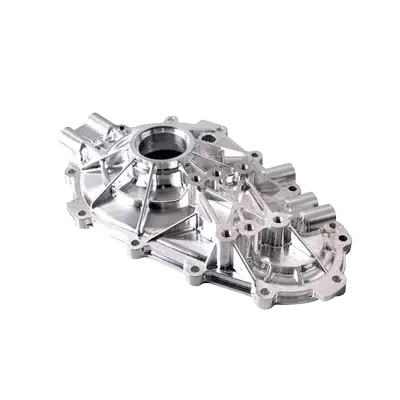
Automotive parts are rarely simple prisms. Control arms, intake housings and motor mounts carry compound angles, drafted faces and bores that do not sit on one axis. Cutting them on 16 simultaneous 5-axis centers removes most refixturing, and every refixture adds stack-up error.

16 mill-turn centers cover shaft-type parts such as sensor bosses and motor shafts in one cycle. Turning and milling on the same machine keeps concentricity between a bore and a milled flat, which matters when a bearing or a seal sits on that face.

  • 1
    One-setup accessUndercuts, drafted walls and angled ports reachable without turning the part.
  • 2
    Ø400 mm rotary tableIndexed work on circular and symmetric housings.
  • 3
    ±0.005 mmHeld on critical bores, bearing seats and mating faces.

Get Instant Quote

Automotive-front-bumper-plastic-rapid-prototyping-jpg
Materials and process match

Pick the process the production part will use

A prototype only earns its cost when the data transfers. If the production part is a machined aluminum housing, we cut 6061-T6 or 7075 and keep the alloy honest. If it is die cast, we can machine ADC12 or run a vacuum-cast tool so wall sections and draft angles stay close to the casting.

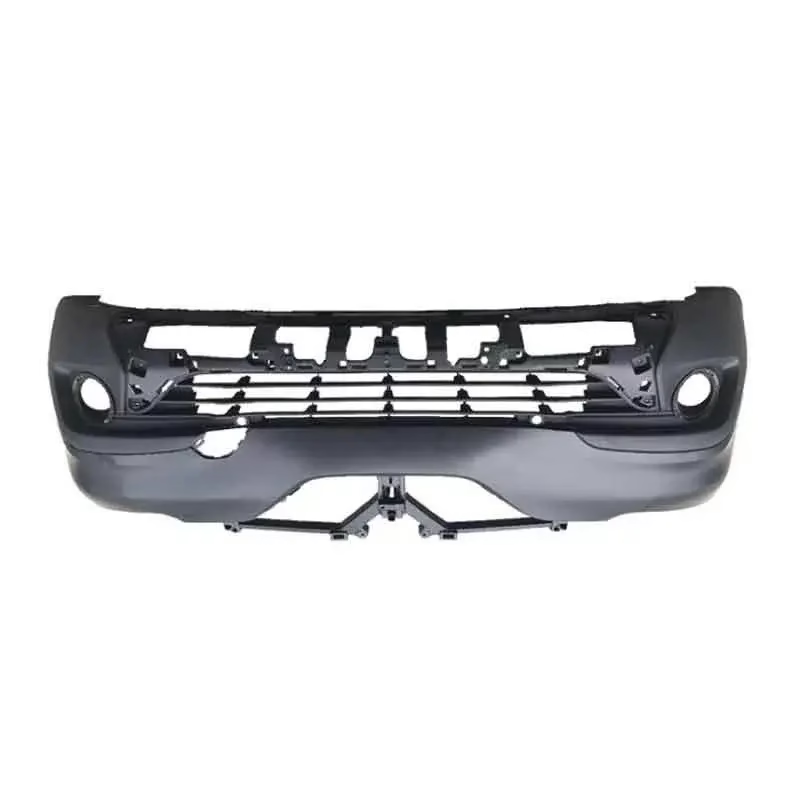
For large exterior parts such as bumper sections and trim, vacuum casting in a silicone tool gives a part with realistic wall thickness and texture at low tooling cost. Sheet metal covers brackets, heat shields and mounting plates where bend radii and hole positions drive the design.

  • 1
    Aluminum and steel6061-T6, 7075, 4140 and 17-4PH for structural prototypes.
  • 2
    Engineered plasticsABS, PC, POM, PA and PEEK for housings and connectors.
  • 3
    Finishes that behaveAnodizing, powder coating and bead blasting for appearance and wear.

Talk to an Engineer

Process selection

Which automotive prototyping route fits the part

Use the part function first, then the material. The process follows from those two answers.

Part typeRecommended routeWhy it fits
Structural bracket, mount5-axis CNC, aluminumLoad paths need real alloy properties
Motor or sensor housingCNC or vacuum castingCasting matches thin walls and draft
Bumper, trim, grilleVacuum castingLarge exterior surface, low tooling cost
Heat shield, panelSheet metal fabricationBend radii and hole pattern drive design
Sealing test pieceCNC, controlled finishSealing face needs a defined Ra band
Fit-check mock-up3D printingGeometry only, no load requirement
Services

What we run for automotive prototyping programs

One shop for the prototype and the low-volume build that follows.

01

5-Axis CNC Machining

Compound angles and drafted faces cut in fewer setups. Suits control arms, housings and motor mounts where datums must survive the process.

02

CNC Milling & Turning

Prismatic parts on 27 three-axis machines, shafts and bosses on mill-turn centers. Good for brackets, adapters and sensor bodies.

03

Rapid Prototyping

Short-run metal and plastic prototypes with DFM feedback inside 12 hours and production able to start within 24 hours of approval.

04

Vacuum Casting

Silicone-tool parts for bumpers, trim and ducting. Realistic wall thickness and surface texture without hard tooling.

05

Sheet Metal Fabrication

Brackets, heat shields and mounting plates where bend radius, hole position and flatness carry the function.

06

Part Surface Finishing

Anodizing, plating, powder coating and bead blasting. Laser marking from 1.5 mm character height for traceability.

Build envelope

Machining capacity for automotive prototype work

Sizes are the practical travel we quote against, not catalog maximums.

Machine groupCountWorking envelope
Simultaneous 5-axis16Up to 4,000 × 400 × 150 mm
Mill-turn centers16Shaft and boss parts in one cycle
Four-axis mills12Indexed work on prismatic parts
Three-axis machines27750 × 1,150 × 550 mm and smaller
Rotary tableØ400 mmCircular and symmetric housings
Maximum part size4,000 mmLong structural and rail-type parts
Why GreatLight

Numbers we quote against

Founded in 2011, three wholly-owned plants, 7,600 m² of manufacturing space in Dongguan and Singapore.

IATF 16949

Automotive quality system

Also certified to ISO 9001:2015, ISO 13485:2016 and ISO 27001:2022. Certification is the baseline, not the selling point.

12 h

Quote and DFM analysis

You get a quotation plus free DFM notes on datum strategy, wall thickness and tolerances within 12 hours.

24 h

Production start

Once the design is frozen and material is confirmed, machining can start within 24 hours.

1 pc

No minimum order quantity

From a single prototype to 10,000+ part runs on the same process and inspection plan.

100%

Inspection before shipment

Raw material check, in-process monitoring and final inspection. Dimensional reports on request.

15Y

In precision machining

150 technicians, 127 high-precision CNC machines and a compliance center handling documentation and traceability.

127High-precision CNC machines
7,600 m²Manufacturing space
150Technicians on staff
<2%Historical late-delivery rate
What we deliver

Automotive prototype part families

low volume manufacturing

Powertrain and engine-side parts

Housings and covers where bore alignment and sealing faces carry the function.

  • ±0.005 mm
  • Ra 0.8–1.6 μm
  • 100% inspection
cnc-machining-hdpe

Aluminum structural brackets

Mounts and brackets cut from 6061-T6 or 7075 with load-path geometry intact.

  • 6061-T6 / 7075
  • 5-axis
  • No MOQ
greatlight-cnc-machining-center-11 (1)

Exterior trim and bumper sections

Large panels cast in a silicone tool to production-like wall thickness and texture.

  • Vacuum casting
  • Large format
  • Texture match
greatlight-metal-technology-co-ltd-1

Under-hood plastic components

POM, PA and PEEK parts where temperature and chemical resistance decide the resin.

  • POM / PA / PEEK
  • Ra 1.6–3.2 μm
  • 3–5 day ship
FAQs

Questions engineers ask before ordering

Which process should I use for an automotive prototype?

Start with the part function. If it carries load, machine it from the production alloy. If it is an exterior panel or a duct, vacuum casting gets you closer to the final wall thickness at lower tooling cost.

If the part is a fit check only, 3D printing is enough. Send the CAD and we will tell you which route we would run and why.

Can you hold ±0.005 mm on a machined prototype?

Yes, on critical features such as bearing seats, bores and mating faces, provided the datum scheme is defined on the drawing.

The tolerance is not free on every surface. A cosmetic face or a clearance hole does not need it, and specifying it everywhere raises cost without adding function.

Do you support low-volume production after the prototype?

Yes. There is no minimum order quantity, so a program can move from one prototype to a 10,000+ part run on the same process and inspection plan.

Keeping the same shop for both stages avoids a second process qualification and a second set of fixture costs.

What do you need to quote an automotive prototyping job?

A 3D model in STEP or IGES, a 2D drawing with datums and tolerances, the material or a performance requirement, and the quantity.

Tell us what the part has to do in the vehicle. That single sentence often changes our process recommendation more than the drawing does.

How do you handle confidentiality on automotive parts?

Uploads are secure and confidential. We work under NDA on request and hold ISO 27001:2022 for information security management.

Unreleased vehicle programs are common in this shop. Files stay inside the project team.

What surface finishes can you apply to prototype parts?

Anodizing in clear, color, hardcoat and conductive types; electroless nickel, zinc, silver and gold plating; powder coating and black oxide; bead blasting, tumbling, brushing and polishing.

Laser marking is available with a minimum character height of 1.5 mm for part numbers and traceability codes.

How fast can prototypes ship?

Quotation and free DFM analysis come back within 12 hours. Production can start within 24 hours of approval, and parts typically ship in 3–5 days.

Timing depends on material availability and finishing. If a part needs hardcoat anodizing or plating, add that to the schedule before you commit to a test date.

Which materials do you machine for automotive work?

Aluminum 6061, 6061-T6, 2024, 5052, 5083, 6063, 6082, 7075 and ADC12; stainless 303, 304, 316L, 17-4PH and 440C; steels including 1018, 1045, 4130, 4140 and 4340; plus titanium TC4, Inconel and magnesium.

On the plastic side: ABS, PC, PMMA, POM, PA, PEEK, PP, HDPE and carbon fiber.

Send the drawing. Get a process answer and a price.

Upload your CAD and we will return a quotation with DFM notes inside 12 hours. One prototype or ten thousand parts, same inspection plan.

12-hour quote100% inspectionNo minimum order quantityNDA on request

Trusted by engineers and manufacturers worldwide

Tesla Ford Motor Company BYD Auto Denso Magna International Boeing Airbus Medtronic KUKA FANUC