
4 Axis CNC: What You Need To Know
This page explains what the fourth axis does, which features it cuts in one setup, and when a 3-axis or 5-axis machine is the better call. Written for design engineers and buyers who need to choose a process before sending a part out for quote.
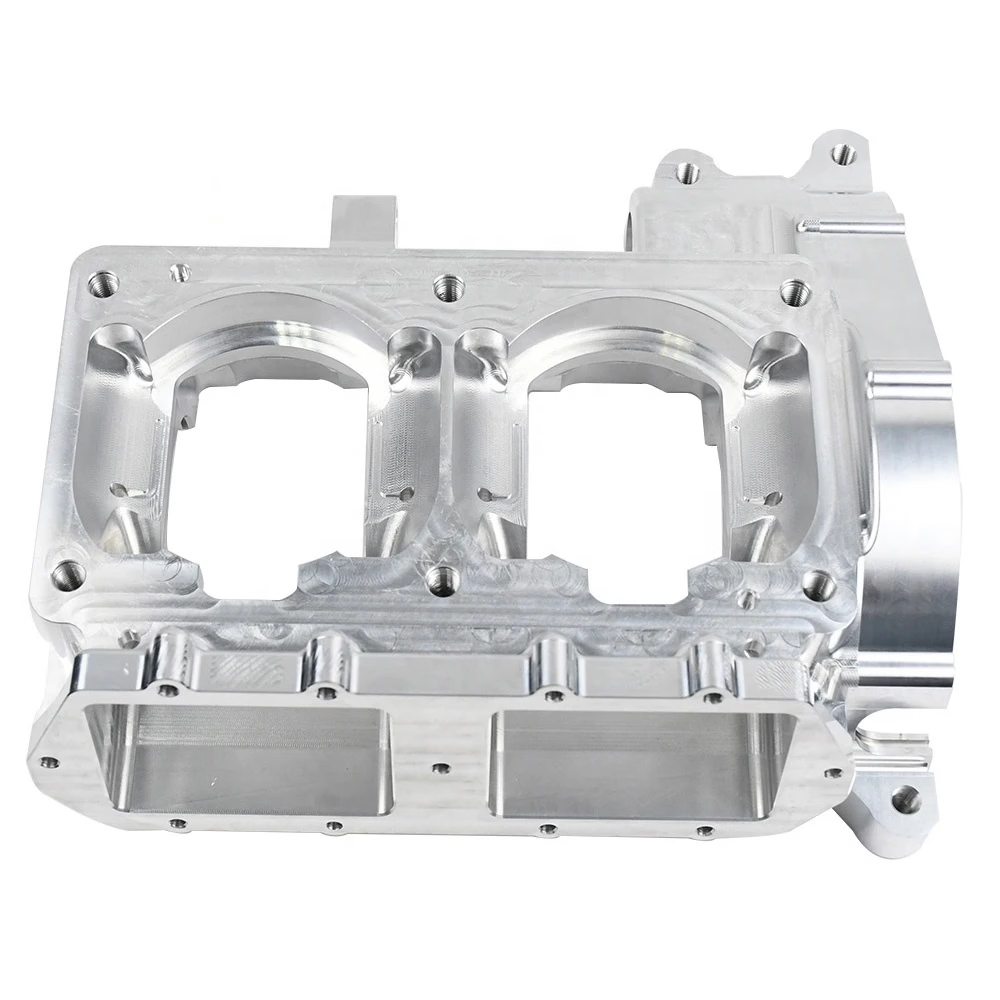
The short version
Add a rotary table or indexer to a 3-axis mill and you have a fourth axis, usually on the A-axis.
What the fourth axis actually adds
A 3-axis mill moves the cutter in X, Y and Z. Left and right, front and back, up and down. That covers a lot of parts, and most shops run more 3-axis machines than anything else. Adding a fourth axis puts the workpiece on a rotary table or indexer that turns around the X-axis. This is normally called the A-axis.
The rotary table does two different jobs depending on the control. In indexing mode it rotates to a set angle, locks, and the cut happens. In simultaneous mode the table keeps turning while the cutter moves, so the tool path follows a curve. Indexing is far more common and much cheaper to program.
That single rotation changes how many setups a part needs. Instead of unclamping and rechucking three or four times, the operator programs angles and lets the table do the repositioning. Fewer setups means fewer places for a stack-up error to enter the part.
4 axis vs 3 axis vs 5 axis
Three-axis work is still the fastest and cheapest route for flat plates, pockets, slots and parts with features on one face or two opposite faces. If your part is a bracket, a housing with a machined face, or a manifold with ports on one side, do not pay for a fourth axis.
A fourth axis earns its cost when features sit on several faces around a common centerline. Shafts with cross-drilled holes, cylinders with milled flats, rotary valve bodies, and parts that need slots every 30° or 45°. One setup instead of four.
Five-axis machines add a second rotary axis and let the tool tip away from the work. That suits deep cavities, undercuts, and contoured surfaces on impellers or turbine parts. The trade-off is programming time and hourly rate. For a part with simple radial features, 4-axis work is usually cheaper and just as accurate.
- 1Pick 3 axisFlat faces, simple pockets, features on one or two sides, tight budget.
- 2Pick 4 axisFeatures around a centerline, multiple radial angles, long shafts.
- 3Pick 5 axisContoured surfaces, undercuts, deep thin-wall cavities, one-setup complex parts.
Quick selection guide
Match the part geometry to the machine before you ask for a quote.
| Part feature | Best machine | Why |
|---|---|---|
| Flat plate with pockets | 3 axis | No rotation needed, fastest cycle |
| Shaft with cross holes | 4 axis | Rotates to each angle without re-fixturing |
| Cylinder with milled flats | 4 axis | Indexed flats in one setup |
| Part with radial slots every 45° | 4 axis | Indexer repeats angles accurately |
| Impeller with twisted blades | 5 axis | Tool must tilt to clear the blade |
| Deep cavity with undercut | 5 axis | Short tool reaches without rubbing |
| Two-sided housing | 3 axis, two setups | Cheaper than adding a rotary table |
Design rules that keep 4-axis parts affordable
Keep the part axisymmetric where you can. A rotary table holds round or near-round work best, because the centerline stays fixed as the table turns. If the part is a long rectangle with features on all six faces, you are asking the setup to fight gravity and reach, and the quote will show it.
Watch the ratio of part length to diameter. A shaft that is 400 mm long and Ø20 mm will deflect when the cutter pushes on it, even with a tailstock. Short and stubby is easy. Long and thin needs light passes, which adds time.
Put a clear datum on the part. A face, a bore, or a turned diameter that the operator can indicate in. When the datum is a rough casting surface, every angle after the first becomes a guess.
Threads and bores on the part centerline are a good fit for 4-axis work. Off-axis holes at odd compound angles are not. If a hole points somewhere between two indexed positions, a 3-axis machine with an angle plate or a 5-axis machine will handle it better.
Allow room for the chuck or collet. The rotary table jaws need to grip something, and that grip zone is not machined. Plan a stock allowance or a sacrificial stub that gets cut off later.
Materials and finishes on a 4-axis job
Aluminum is the easy case. 6061-T6 and 7075 cut fast on a rotary table, and the light cutting forces keep deflection low on long parts. 2024 and 6082 behave the same way. If the part is a rotating shaft, aluminum often needs hardcoat anodizing to survive wear at the bearing surfaces.
Stainless 303 and 304 are common for shafts and valve bodies. 17-4PH (SUS630) shows up when the part needs strength plus corrosion resistance, such as a pump shaft. Stainless work-hardens, so the rotary moves should stay under the surface rather than rubbing.
Steel grades like 4140 and 4340 go on 4-axis mills for drive shafts and splined components. Titanium TC4 (Ti-6Al-4V) is machinable but slow, and the rotary table helps because the part stays clamped through several operations.
Finishes are usually applied after machining. Anodizing, electroless nickel, black oxide and bead blasting are all standard. Laser marking needs a minimum character height of 1.5 mm to stay legible on a curved surface.
Tolerances, setups and inspection
Angle accuracy matters as much as linear accuracy on a 4-axis part. A rotary table that indexes to ±0.01° still leaves the feature position dependent on how well the part was indicated in. The first article check should include the angular positions, not just the diameters.
We hold ±0.005 mm on critical dimensions and inspect 100% of parts before shipment. That covers raw material check, in-process monitoring and final inspection. Reports are available on request for parts that go into aerospace, medical or automotive programs.
Surface finish depends on the operation. Fine finishing reaches Ra 0.2–0.8 μm, standard high finish is Ra 0.8–1.6 μm, and as-machined surfaces sit at Ra 1.6–3.2 μm. A rotary table does not improve finish by itself; the tool path and feed rate still decide it.
For a part that needs one tight bore and several loose clearance holes, do not tolerance everything the same. Tight tolerances on non-functional features add inspection time and cost without helping the part work.
Common questions
When do I need 4 axis CNC instead of 3 axis?
You need it when features sit at several angles around a common centerline. Cross-drilled shafts, milled flats on a cylinder, radial slots, and rotary valve bodies are the classic cases.
If all the features face one direction, or two opposite directions, a 3-axis machine with a second setup is usually cheaper.
Is 4-axis machining more expensive than 3-axis?
The hourly rate is higher and programming takes longer, so a simple part costs more on a 4-axis machine. The savings come from setup count.
When a part would otherwise need three or four setups, the 4-axis route often wins on total cost and holds position better.
What is the difference between indexing and simultaneous 4-axis?
Indexing rotates the table to an angle, locks it, then cuts. It is the common mode and the cheaper one to program.
Simultaneous mode turns the table while the cutter moves, which produces curved surfaces. It needs more CAM work and is used for cams and spiral features.
How long can a part be on a 4-axis mill?
Our rotary table is Ø400 mm, and the largest processing envelope in the shop is 4,000 mm with travels up to 4,000 × 400 × 150 mm.
Long thin parts still need support. A tailstock helps, but deflection limits how aggressively you can cut.
What materials can be run on a 4-axis machine?
Aluminum 6061, 7075, 2024 and 6082; stainless 303, 304, 316L and 17-4PH; steels like 1018, 4140 and 4340; titanium TC4; and plastics such as POM, PEEK and PA.
Harder alloys mean slower feeds and more attention to tool wear, not a different machine.
Can I get a quote without a full drawing package?
Send the STEP file and a note on which features are critical. We return a quotation and a free DFM analysis within 12 hours.
Production can start within 24 hours of approval, and parts typically ship in 3–5 days. No minimum order quantity, from one prototype to 10,000+ parts.
Send your part and we will tell you which machine it needs
Upload a STEP file and get a quotation with DFM feedback within 12 hours. If 3-axis is the right answer, we will say so.
12-hour quote100% inspectionNDA on request









