
5 Axis CNC Mill Mastery for Complex Metal Parts
This page explains how a 5 axis CNC mill removes material from parts that cannot be reached in three axes, and when a 4-axis or 3-axis machine is the better choice. It is written for design engineers and sourcing engineers who must decide on a process before releasing a drawing. After reading, you can judge whether your part geometry, tolerance callouts and volume justify simultaneous 5-axis work.
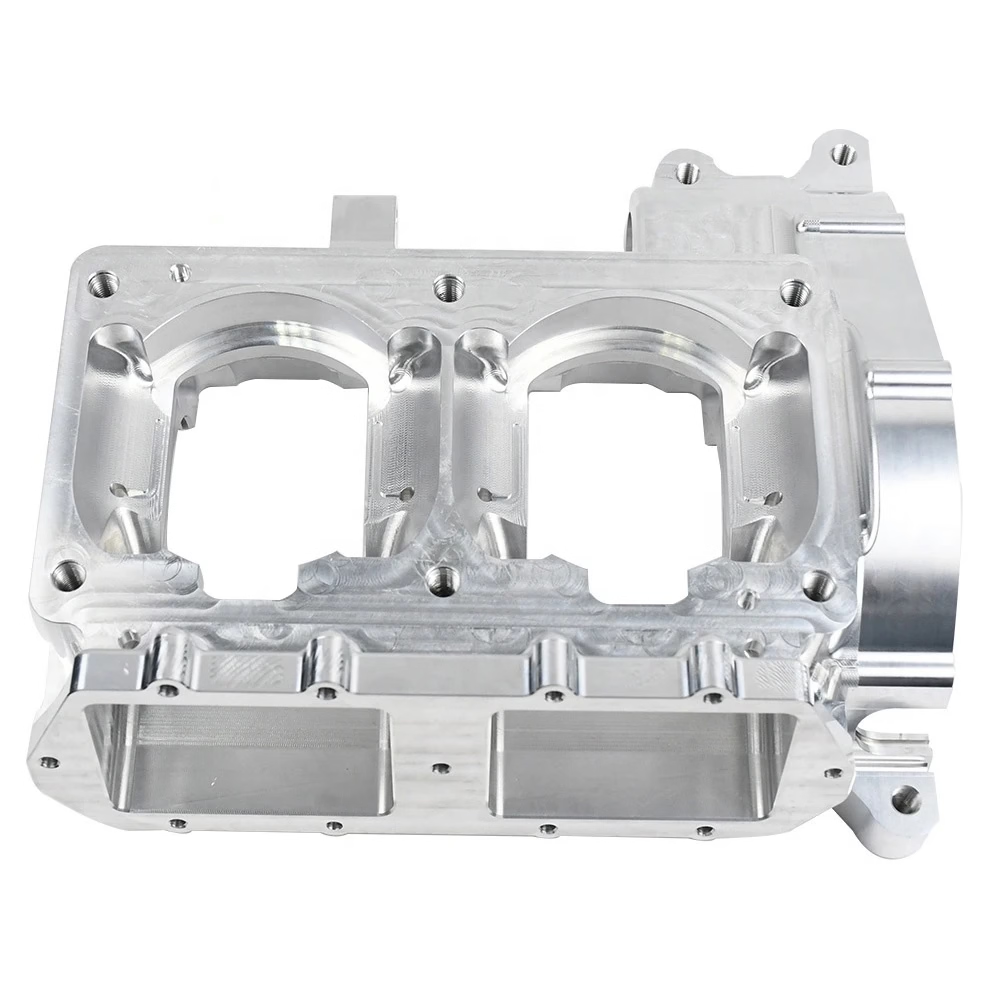
What Changes When Two Rotary Axes Are Added
A 5 axis CNC mill cuts with the same tool as a 3-axis machine. The difference is that the tool or the workpiece can also tilt and rotate, so undercuts, steep walls and angled holes are reached in one setup.
How the Five Axes Actually Move
A 3-axis mill moves the tool along linear X, Y and Z only. A 5 axis CNC mill adds two rotary axes. On a trunnion machine the table tilts (A) and rotates (C), carrying the part. With a swivel-head machine the spindle tilts instead. Both arrangements let the cutter approach a feature from a direction that a straight Z plunge cannot reach, such as a side pocket under an overhang.
Simultaneous motion is the part that matters. All five axes move at the same time along a single toolpath, so the cutter stays in contact with a curved surface while the part rotates. Indexed 5-axis work is different: the rotary axes position the part, lock, and then a normal 3-axis cut runs. Indexed work is easier to program and safer for deep pockets. Simultaneous work is what produces continuous spiral finishes on impellers, turbine blades and curved housings.
Tool tip position matters more than on a 3-axis machine. Longer tools deflect, and a tilted tool reaches into corners that a vertical tool cannot. A Ø6 mm carbide end mill held 40 mm out will chatter long before it breaks, so we shorten the gauge length whenever the geometry allows. On deep cavities we often rough with a larger tool at an index position, then finish with a smaller tool on a simultaneous path.
GreatLight runs 16 simultaneous 5-axis machining centers, plus 12 four-axis mills and 27 three-axis machines. The mix matters because not every part belongs on the most expensive machine. A flat bracket with holes on one face is cheaper and faster on a 3-axis mill. A part with five angled faces is not.
Which Parts Belong on a 5 Axis CNC Mill
Complex geometry is the first signal. If a drawing shows compound angles, contoured pockets, or features on four or five faces, a 5 axis CNC mill removes them in one setup. That removes the stacked error that comes from flipping a part between operations. Each flip adds a new datum and a new chance for position error.
Undercuts and deep cavities are the second signal. A T-slot cutter or a lollipop cutter can reach some undercuts on a 3-axis machine, but the tool has to be long and thin. On a 5 axis machine the whole cutter body can tilt into the pocket, so a stiffer tool is used. The result shows up as better surface finish and less chatter, not as a lower price.
Thin walls and large parts are the third signal. Tilting the tool spreads cutting force across the wall instead of pushing it sideways. For a 0.8 mm aluminum wall on a 300 mm housing, that difference decides whether the wall stays straight. Our 5-axis travel covers 4,000 × 400 × 150 mm on the largest machine, and 750 × 1,150 × 550 mm or 600 × 600 × 600 mm on the mid-size machines.
Some parts do not belong here. A simple prismatic block with tolerances looser than ±0.05 mm gains nothing from five axes. Neither does a part that is mostly turned. For those, 3-axis milling or mill-turn work is faster and easier to inspect. We tell you when that is the case.
Matching Part Geometry to the Machine
Use this as a first filter before requesting a quote.
| Part feature | Best process | Why |
|---|---|---|
| Holes and pockets on one face | 3-axis mill | One setup, simple fixture, lowest cost |
| Features on two opposite faces | 4-axis mill | Rotary table indexes 180°, no re-fixture |
| Compound angles, five faces | 5-axis simultaneous | One setup, no datum stack-up |
| Deep undercut pocket | 5-axis with tilted tool | Shorter, stiffer cutter reaches the corner |
| Curved blade or impeller | 5-axis simultaneous | Continuous toolpath, no facet lines |
| Thin-wall housing | 5-axis, tool tilted | Cutting force spread along the wall |
| Shaft with flats and threads | Mill-turn center | Turning and milling in one program |
| Flat plate, loose tolerance | 3-axis mill | 5-axis adds time with no gain |
Tolerances, Datums and Inspection
We hold ±0.005 mm (±0.0002 in) on 5-axis work when the drawing requires it. That number only holds if the datum scheme is realistic. A position callout measured from three separate faces on a rotating part is harder to verify than one measured from a single bore and a face. Where the geometry allows, we ask for one primary datum and one secondary datum.
Thermal drift is the quiet enemy on long cycles. A 5-axis cycle on a large housing can run several hours, and the spindle grows as it heats. We schedule roughing and finishing in separate passes and let the part stabilize before the finishing cut. Thick aluminum sections move after roughing, so a rough cut that leaves 0.3 mm is often worth the extra time.
Surface finish follows the toolpath. A tilted tool with a small stepover gives Ra 0.8–1.6 μm on aluminum and steel. Where a finer finish is called for, we can reach Ra 0.2–0.8 μm with a dedicated finishing pass. As-machined surfaces sit at Ra 1.6–3.2 μm.
Inspection is 100% before shipment at GreatLight. That covers incoming raw material checks, in-process monitoring and a final inspection, with reports available on request. For 5-axis parts we usually check the critical features on a CMM and verify the rest against the drawing. If a feature cannot be measured, we say so before cutting metal.
Materials, Fixturing and Cutting Data
Aluminum is the easy case. Grades 6061, 7075, 2024 and 6082 cut fast at high spindle speed and hold tight tolerances. Titanium TC4 (Ti-6Al-4V) and Inconel are the opposite: low cutting speed, high tool wear, and heat that stays in the cut. A 5 axis CNC mill helps here because a tilted tool can use a shorter flute length, which raises rigidity.
Stainless 303, 304, 316 and 17-4PH are common in our 5-axis work for medical and food equipment. Copper and brass grades such as C110 and C36000 machine cleanly but are soft enough to mark, so we plan the clamp positions around the finished faces. Plastics like POM, PEEK and PC need sharp tools and air blast rather than flood coolant.
Fixturing decides whether the cycle works. A trunnion table with a Ø400 mm rotary table can hold a dedicated tombstone, so several small parts run in one cycle. Large housings usually sit on a cast or machined fixture that is dialed in once. Soft jaws and dovetail blocks work for parts with no flat face to grip.
Cutting data is not universal. The same tool and material change behavior when the part rotates, because the effective cutting speed at the outer edge of a rotating table is higher than at the center. We set feeds and speeds per feature, not per part. On long, thin tools we reduce the stepdown and raise the spindle speed to keep the cut stable.
When 5-Axis Work Saves Money
Five axes cost more per hour than three. The saving comes from setup count. A part that needs four separate 3-axis operations may need one 5-axis operation, and each removed setup removes fixture time, re-datum time and queue time. On complex parts that often outweighs the higher machine rate.
For a simple part, it does not. A flat plate with a few holes is cheaper on a 3-axis mill, and we will quote it that way. The honest answer depends on the ratio of setup time to cutting time. If cutting dominates, the axis count barely matters. If setup dominates, five axes win.
Volume changes the picture again. One prototype and a 10,000-part run use different tooling. There is no minimum order quantity at GreatLight, so a single prototype can run on the same machine that later handles a production batch. If a part will eventually be cast or forged, we can machine the prototype now and adjust the drawing before tooling is cut.
Quotation and free DFM analysis come back within 12 hours. Production can start within 24 hours, and parts ship in 3–5 days for standard work. Those times assume a released drawing and a clear material callout. Missing tolerances and undefined datums are the usual causes of delay.
Questions Engineers Ask
What is the difference between 5-axis simultaneous and 3+2 indexing?
In 3+2 indexing the rotary axes move to a position, lock, and then a normal 3-axis cut runs. In simultaneous mode all five axes move together along one toolpath.
Indexed work is easier to program and better for deep pockets where a tilted tool would chatter. Simultaneous work is required for curved surfaces such as impellers and contoured housings.
Can a 5 axis CNC mill hold ±0.005 mm on every feature?
We hold ±0.005 mm where the drawing requires it and the datum scheme supports it. Features far from the primary datum, or thin walls that move after roughing, need more care.
We review the critical features before quoting and tell you which ones need a separate finishing pass.
Which materials do you run on 5-axis machines?
Aluminum 6061, 7075, 2024, 6082 and ADC12; stainless 303, 304, 316, 17-4PH; steel 1018, 1045, 4130, 4140; titanium TC4; Inconel; copper and brass; and plastics such as POM, PEEK and PC.
Hard alloys run slower and use more tool changes, which affects the quoted price but not the geometry we can cut.
How large a part can you machine?
The largest 5-axis machine covers 4,000 × 400 × 150 mm. Mid-size machines cover 750 × 1,150 × 550 mm and 600 × 600 × 600 mm, and compact machines cover 500 × 500 × 450 mm and 500 × 310 × 200 mm.
If your part is larger, send the drawing and we will say whether it fits or needs another process.
What do you need to quote a 5-axis part?
A 3D model (STEP or IGES) plus a 2D drawing with tolerances, material, finish and quantity. A marked-up view of the critical features helps.
Quotation and free DFM analysis come back within 12 hours. Uploads are secure and confidential, and an NDA is available on request.
Do you inspect 5-axis parts before shipping?
Yes. Inspection is 100% before shipment and covers raw material checks, in-process monitoring and a final inspection.
Inspection reports are available on request.
Send Us the Part You Cannot Machine in Three Axes
Upload a STEP file and a drawing. You get a quotation and a free DFM analysis within 12 hours, plus a straight answer on whether five axes are needed.
12-hour quote100% inspectionNDA on request









