
5 Best CNC Machine Manufacturers Near Me: How to Compare and Cut Cost
This page is for design and sourcing engineers who are shortlisting cnc machine manufacturers near their factory or their market. It covers how to read a supplier list, which process details decide part quality, and ten practical ways to lower cost without loosening tolerances. By the end you should be able to tell which shop fits a given part.
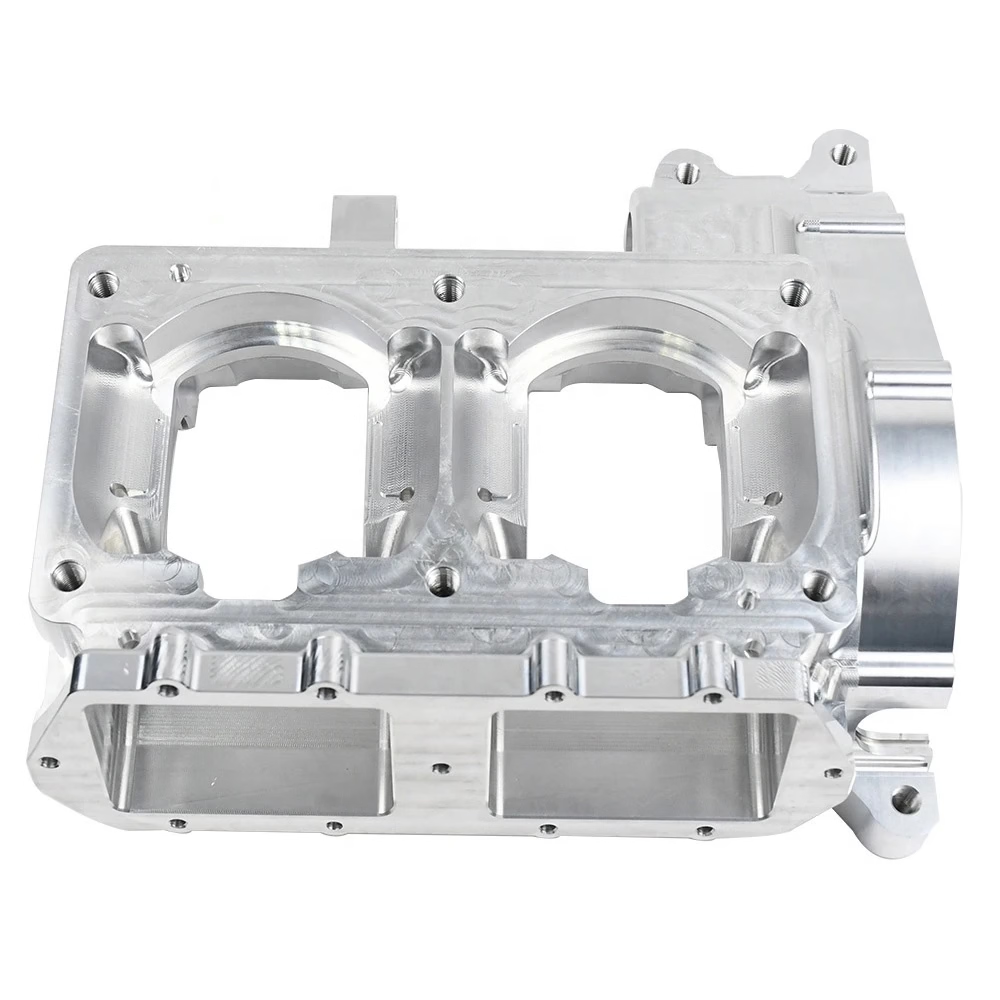
What "near me" really decides
Proximity affects freight and communication speed. It does not affect whether your part comes back in spec.
The five supplier models you will find
Search results for cnc machine manufacturers near a given city usually mix five different business models. There is the direct machining factory that owns its spindles and quotes from its own floor. Then come the broker platforms that route your file to partner shops. Some suppliers only take prototypes. Others build low-volume bridge production. A few handle long runs of one part number. Each model has a cost curve, and the curve does not look the same for a one-off bracket and a 5,000-piece housing.
The direct factory model tends to win when geometry is difficult or tolerances are tight. The shop controls setup, tooling, and inspection, so it can correct a problem mid-run instead of passing messages between sites. Platforms win on simple parts and fast pricing, because automated quoting removes human review from the first round. That speed has a limit: an algorithm cannot tell you that a 0.5 mm wall will chatter, or that a deep pocket needs a different cutter path.
Prototype-focused suppliers are strong on turnaround and weak on repeatability across volumes. Their fixtures are built for one part, not for a thousand. Volume shops are the opposite. They may push your prototype into a production cell before the design is stable. For most engineering teams the practical answer is to keep one direct factory for critical parts and use a platform for simple, low-risk brackets.
Location still matters, but for logistics rather than capability. A supplier three time zones away can hold a video DFM review the same day and ship air freight in 3–5 days. What proximity mostly buys you is the option to visit the floor, audit the inspection room, and stand next to the machine while a first article is cut.
- 1Direct factoryOwns machines, controls setup and inspection, best for tight tolerances and complex geometry.
- 2Broker platformAutomated quoting, wide material list, good for simple parts and fast price checks.
- 3Prototype shopFast first articles, fixtures built for one part, weaker on volume repeatability.
- 4Volume shopLow unit cost at high quantity, needs a frozen design before release.
How to score a shortlist without visiting
You can rank five suppliers in an afternoon with four questions. Ask what tolerance they hold as a routine, not as a best case. A shop that says ±0.005 mm across the shop floor is telling you something different from one that quotes ±0.05 mm and offers tighter on request. Ask how many spindles are actually cutting, and how many are five-axis. Machine count without axis count is a marketing number.
Then ask how parts are inspected and what report ships with them. A supplier that inspects 100% before shipment and can send dimensional reports on request is easier to qualify than one that samples. Finally, ask what happens when a first article is out of tolerance. The answer tells you whether you are talking to a process engineer or a sales desk.
Do not skip the material question. Aluminum 6061 and 7075 machine differently, and 17-4PH stainless in the H900 condition will eat tool life compared with 303. If the quote does not name the alloy and temper, the price is not comparable to the next one.
One more check: send the same STEP file to all five and compare the DFM notes, not just the price. The supplier that flags a thin wall, an unreachable corner, or a thread that needs a different callout is the one that will catch problems before the chips fly.
Supplier model vs. part profile
Use this as a first filter before you send RFQs.
| Part profile | Best fit | Watch out for |
|---|---|---|
| One-off prototype, simple geometry | Prototype shop or platform | Higher unit price, limited post-processing |
| Complex 5-axis geometry | Direct factory with 5-axis centers | Fewer shops can quote; longer DFM review |
| Tight tolerance, ±0.005 mm | Direct factory with in-house inspection | Cost rises fast below ±0.01 mm |
| Bridge volume, 500–5,000 parts | Factory with mill-turn and fixtures | Design must be frozen before release |
| Large part, over 1,000 mm | Shop with 4,000 mm travel | Freight and fixturing drive cost |
| Medical or automotive part | ISO 13485 or IATF 16949 shop | Audit paperwork adds lead time |
Ten tips that actually move cost and quality
1. Design for manufacturability first. A DFM pass before quoting is the cheapest step in the project. Corner radii that match a standard end mill, pockets no deeper than four times the cutter diameter, and wall thickness above 0.8 mm in aluminum remove setup time and scrap. If a feature cannot be reached from any of five axes, it will need an EDM or a second op, and both show up in the price.
2. Keep operations under one roof. When milling, turning, heat treat, and finishing happen across four vendors, every handoff adds queue time and a chance for damage. Full-process integration shortens the critical path and keeps one team responsible for the final dimension.
3. Match tolerance to function. Calling ±0.005 mm on a bracket that only needs ±0.1 mm multiplies inspection and scrap cost for no benefit. Reserve the tight class for bearing bores, sealing faces, and mating features. Everything else can breathe.
4. Choose material by machinability, not habit. 6061-T6 cuts cleanly and takes anodizing well. 7075 gives strength but costs more in tool wear. 303 stainless machines far better than 304. On a 500-part run, the alloy choice can outweigh the hourly rate.
5. Certifications cut hidden cost. ISO 9001:2015, IATF 16949:2016, ISO 13485:2016, and ISO 27001:2022 mean documented process control and data handling. That paperwork saves you from re-auditing the supplier for every new program.
6. Use five-axis for contoured parts. One setup on a five-axis center replaces three setups on a three-axis machine. Fewer setups mean tighter true position and less fixture cost. For prismatic parts with flat faces, a three-axis machine is still cheaper per hour.
7. Plan post-processing early. Anodizing, bead blasting, and laser marking all add days and can change a critical dimension. Hardcoat anodizing builds thickness on the surface. Laser marking needs a minimum character height of 1.5 mm to stay legible.
8. Compare total cost of ownership. Unit price is one line. Add freight, incoming inspection, rework rate, and the engineering hours spent chasing updates. A slightly higher quote from a shop that ships on time is often the cheaper program.
9. Ask for a design review before you commit. A short call about datum strategy and inspection method catches more errors than a revised drawing. It costs nothing and usually happens before the PO.
10. Build one long-term relationship per process family. Repeat work lets the shop keep your fixtures and programs, which cuts setup on every reorder. That is where the real cost reduction lives.
How GreatLight fits this list
We are a direct machining factory, not a broker. GreatLight Metal was founded in 2011 in Dongguan and now runs three wholly-owned plants with 7,600 m² of floor space and 150 technicians. The machine list covers 127 high-precision CNC machines: 16 simultaneous 5-axis centers, 12 four-axis mills, 27 three-axis machines, and 16 mill-turn centers. Maximum processing size is 4,000 mm, with travels that range from 4,000 × 400 × 150 mm down to 500 × 310 × 200 mm and a Ø400 mm rotary table for round work.
Routine tolerance is ±0.005 mm, or ±0.0002 in. Surface finish runs from Ra 0.2–0.8 μm on fine work to Ra 1.6–3.2 μm as machined. Every part is inspected before shipment, covering incoming raw material, in-process monitoring, and final inspection, with dimensional reports available on request.
Materials we cut daily include 6061, 7075, 17-4PH, 303 and 316L stainless, 4140 and 4340 steel, C36000 brass, Ti-6Al-4V, Inconel, and engineering plastics such as POM, PEEK, and carbon fibre. Finishing is in-house: anodizing, electroless nickel, zinc, powder coating, bead blasting, and laser marking.
For quoting, DFM analysis comes back within 12 hours, production can start within 24 hours, and parts ship in 3–5 days. There is no minimum order quantity, so a single prototype and a 10,000+ part run use the same process. Uploads stay confidential and an NDA is available on request.
Questions engineers ask before awarding a PO
How do I compare quotes from different cnc machine manufacturers near me?
Normalize the scope first. Confirm the alloy and temper, the tolerance class, the surface finish callout, the inspection level, and who pays freight. A quote without those five items is not comparable.
Then compare DFM notes. If one supplier flags a thin wall and another does not mention it, the second quote has an unpriced risk inside it.
Is a lower unit price always the cheaper option?
No. Add incoming inspection, rework, freight, and the engineering hours spent on status chasing. A part that arrives out of tolerance costs more than the difference in unit price.
For repeat programs, setup time dominates. A supplier that keeps your fixtures and programs will quote lower on the second order than a new shop quoting the first time.
When should I specify five-axis machining instead of three-axis?
Use five-axis when the part has contoured surfaces, angled features, or tight true-position requirements across several faces. One setup holds the datums together.
For flat, prismatic parts with simple holes and pockets, a three-axis machine is faster and cheaper. Five-axis only pays off when it removes setups or reaches features no other setup can.
How tight a tolerance do I actually need?
Tie it to function. Bearing bores, seal faces, and mating pilots often justify ±0.005 mm. Cosmetic edges, clearance holes, and non-critical lengths usually do not.
Every step tighter adds inspection time and scrap risk. Loosening one non-critical dimension can pay for tightening a critical one on the same drawing.
What should I send with an RFQ?
Send a STEP file, a 2D drawing with datums and tolerance callouts, the alloy and temper, the finish specification, and the annual quantity. Mention any inspection report or certification you need.
If the part is medical or automotive, say so at the start. That routes the job to a shop with ISO 13485 or IATF 16949 controls rather than adding the paperwork later.
How do I protect my design when I send files out?
Ask for an NDA before releasing CAD, and confirm how uploads are stored and who can open them. ISO 27001 is the relevant information-security standard here.
Keep the release staged: share the envelope and interface features first, then the full model once the NDA is signed.
Send a file and get a DFM read, not just a number
Upload your STEP and drawing. We return a quotation and free DFM analysis within 12 hours, with the tolerance and material assumptions spelled out.
12-hour quoteNo minimum order quantity100% inspection before shipmentNDA on request









