
5 Ways 3D Printing Transforms Consumer Goods Design
A practical look at how additive manufacturing changes consumer product development, written for engineers, product managers and sourcing teams. Read it to judge which iterations belong on a printer and which belong on a CNC machine.
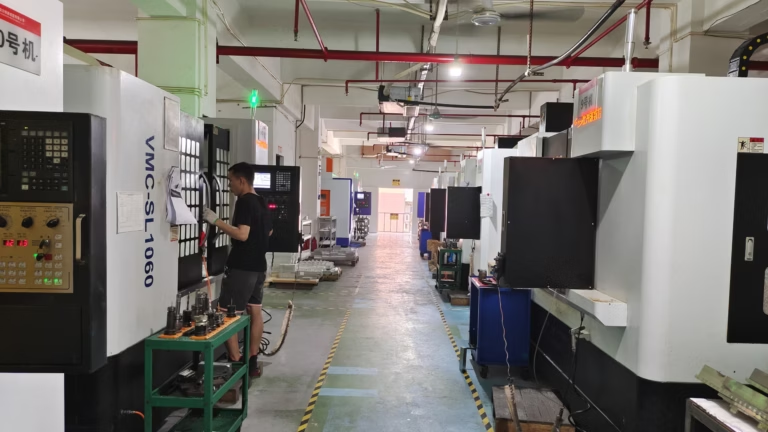
Where Additive Fits in a Consumer Product Program
Five changes, each with a decision attached.
1. Iteration Moves From Weeks to Days
Consumer products live or die on how many loops a team can run before the tooling budget locks the design. An injection mold is expensive and slow to change. Cutting a new mold insert means weeks, and re-fixturing a machining center for a revised housing is not much faster.
Additive flips that order. Send a revised CAD file to an SLA or SLS machine in the evening, and a physical part sits on the desk the next morning. Designers check grip, button travel, wall thickness and how the part sits in the hand. A screen hides those things.
Speed only helps if the loop is honest. Print in the same resin or powder family you will use later, or note where the printed part misleads you. A rigid SLA shell will not tell you how a soft-touch PP cover flexes.
Keep a printed check part next to the machined one. When the two disagree, the disagreement is the useful data.
- 1Use additive whenform, fit, ergonomics and assembly order still change weekly
- 2Skip it whenthe question is tolerance stack, thread strength or wear life
2. Complex Geometry Stops Costing Extra
Injection molding needs draft so the part releases. CNC machining needs tool access, and a deep undercut often becomes a second operation or a split part. Both constraints push designers toward simple, boxy shapes that were never the goal.
Additive builds layer by layer, so internal channels, lattice cores, organic ribs and captured geometry come almost free. A handle can be hollowed into a lattice that drops mass without losing stiffness. A speaker housing can carry a curved acoustic channel that no straight drill reaches.
The trade is anisotropy. FDM and many powder parts are weaker across the layer lines than along them, so plan print orientation around the load path, not around build-plate packing. A bracket that survives a hand test may still fail on a drop rig if the layers run the wrong way.
Complex geometry also has to be inspectable. If an internal channel cannot be measured, do not put a tolerance on it. Say what the channel is for, then set a bore and surface callout you can actually check.
- 1Good candidateslattice handles, conformal cooling, internal wiring routes, single-piece hinges
- 2Poor candidatessealing faces, bearing bores, precision threads, sliding fits
3. Mass Customization Without a New Mold
Consumer goods increasingly ship in variants: left and right hand, three grip sizes, two colorways, a bracket for each regional socket. A mold per variant is a hard cost that only pays back at high volume. Additive absorbs variant change as a file edit.
That does not make it a production method for a million units. The honest use is the top and tail of the curve. Print the pilot batch, the limited edition, the spare part for a discontinued model, the jig that holds the product during assembly.
When a variant proves out and volume climbs, move it to a repeatable process. CNC machining covers low and mid volume with real engineering materials and no tooling. Die casting and injection molding take over when the annual quantity justifies the tool.
Decide the crossover on total cost and lead time, not on which machine is already busy. A printed part at 40 units can be cheaper than a mold. At 40,000 units it usually is not.
Matching the Process to the Stage
Use this as a starting point, then confirm with a DFM review.
| Stage | Typical process | What it answers | Watch out for |
|---|---|---|---|
| Concept form | SLA / SLS printing | Shape, grip, proportions | Resin is stiffer than final plastic |
| Fit and function | CNC machining, aluminium or PEEK | Tolerance, threads, snap fits | Higher unit cost than printing |
| Pilot batch | CNC, vacuum casting, die casting | Real material behavior | Tooling lead time at higher volume |
| Mass production | Injection molding, die casting | Unit cost, repeatability | Design changes require new tooling |
| Spares and jigs | 3D printing, CNC | Availability, low quantity | Check material data for the duty cycle |
4. Materials and Functions That Survive Contact With the User
Early additive parts were visual models. That is no longer the whole picture. Engineering resins, glass-filled nylon, TPU-like elastomers and metal powders now cover wear surfaces, living hinges, gaskets and housings that take a real load.
The decision is about the duty cycle. A printed enclosure that sits on a shelf is easy. A printed latch that cycles 20,000 times is a materials question, and the answer may be a machined or molded part in a known grade.
This is where a shop with both processes helps. At GreatLight we run additive for form and fit, then cut the validation parts from 6061-T6, 7075, 17-4PH or PEEK on 5-axis machines when the numbers have to hold. Tolerances reach ±0.005 mm, and finishes run from Ra 1.6–3.2 μm as machined down to Ra 0.2–0.8 μm when the surface matters.
Functional integration follows the same logic. Combine parts into one printed piece when assembly cost or a joint is the problem. Split it back into machined pieces when the joint has to be serviceable or the tolerance is tight.
- 1Print forergonomics, ducting, brackets, jigs, low-cycle parts
- 2Machine forbearing fits, sealing faces, threads, wear surfaces, tight bores
5. On-Demand Supply and Digital Inventory
Storing slow-moving spare parts is expensive. A digital file plus a qualified process replaces a shelf of molded spares that may never ship. When an order lands, the part is made, finished and inspected.
For consumer brands the same idea covers bridge production. A product launch slips, the mold is late, and the channel still needs units. Machined or printed bridge stock keeps the shelf filled while the tool comes online.
The catch is qualification. A spare part made on demand is only useful if it fits. Keep the drawing, the material grade, the finish callout and the inspection record with the file. Otherwise the second run will not match the first.
GreatLight holds no minimum order quantity, so a single prototype and a 10,000-part run go through the same quoting path. Uploads stay confidential, and we sign an NDA when the program needs one.
Questions Engineers Ask Before Committing
Can a 3D printed part be used as the final production part?
Yes, for low volumes, spare parts, jigs and limited editions. The material data has to match the duty cycle, and you need an inspection plan for the features that matter.
For a part that cycles thousands of times, seals, or carries a structural load, a machined or molded version is usually the safer call. We will say so during the DFM review rather than after the first failure.
When should we switch from printing to CNC machining?
Switch when the question changes from shape to numbers. If you are checking tolerance stack, thread engagement, bearing fit or wear, a machined part in 6061-T6, 7075 or 17-4PH tells you more than a printed one.
A common pattern is printing for the first two or three fit iterations, then machining the validation build. Both run under the same roof at GreatLight, so the drawing does not get reinterpreted between vendors.
What tolerance and surface finish can we expect from machined parts?
We hold ±0.005 mm and reach Ra 0.2–0.8 μm on finishing passes. As-machined surfaces sit around Ra 1.6–3.2 μm.
Achievable numbers depend on geometry, material and the datum scheme. Send the drawing with critical features marked and we will confirm what is realistic.
Do you handle both prototyping and production volumes?
Yes. There is no minimum order quantity, from one prototype to 10,000+ part runs. Quotation and a free DFM analysis come back within 12 hours, and production can start within 24 hours of approval.
127 CNC machines, including 16 simultaneous 5-axis centers, cover the volume range. Parts typically ship in 3–5 days.
How do you protect our design files?
Uploads are secure and confidential. We hold ISO 27001:2022 for information security and sign an NDA on request.
Files are shared only with the engineers and machinists working on your job.
Which materials do you stock for functional prototypes?
Aluminium 6061, 6061-T6, 2024, 5052, 5083, 6063, 6082, 7075 and ADC12. Stainless 303, 304, 316L, 17-4PH, 420 and 440C. Titanium TA1, TA2 and TC4. Plastics include ABS, PC, PMMA, POM, PA, PEEK, PP, HDPE and carbon fibre.
Finishes range from anodizing and plating to powder coating, bead blasting and laser marking.
Send the File and Get a Straight Answer
Upload your CAD and we will tell you which process fits the stage you are in, with a quote and a free DFM analysis back within 12 hours.
12-hour quoteNo MOQ±0.005 mmISO 9001 / IATF 16949









