
7 Essential Tips for Choosing Right Profile Machining
For engineers and buyers sourcing long extrusions, frames and rails. This guide covers spindle and travel limits, workholding, software, quality checks and total cost, so you can judge whether a shop fits your part before you send an RFQ.
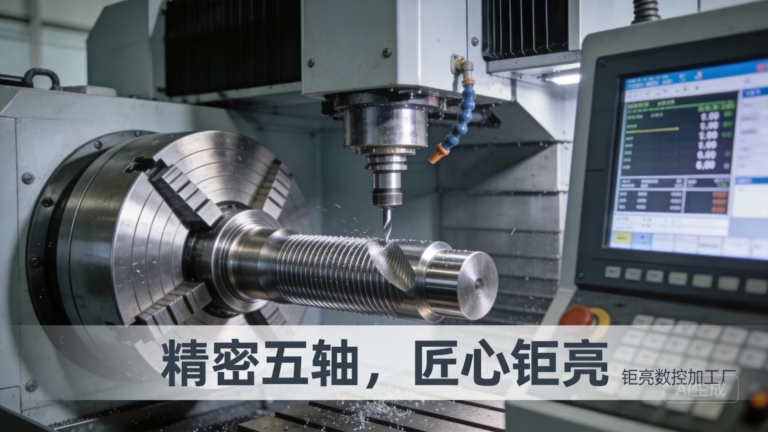
What profile machining actually demands
Profile work is not box work. The part is long, thin and often unsupported in the middle, and that changes every machine choice.
Define the part envelope before you look at machines
Start with four numbers: maximum length, maximum section width, wall thickness and the tightest feature tolerance. A 2,500 mm aluminum extrusion with a 3 mm wall behaves differently from a 400 mm bracket, even if both are 6061-T6. If a shop cannot state its travel in writing, you are already guessing.
Length drives machine class. A gantry or long-bed machining center handles full-length rails in one setup; a 750 × 1,150 × 550 mm vertical can only run shorter sections or needs repositioning. Repositioning adds a datum shift, and every shift adds error to hole spacing along the part.
Also write down quantity and mix. One prototype and a 10,000-part run should not use the same fixturing plan. If the drawing allows, split long profiles into bolted or welded segments — that decision often opens up cheaper machines without losing function.
- 1Envelope firstLength, width, wall thickness, tightest tolerance.
- 2Repositioning costEach extra setup adds datum error along the length.
- 3Segment if allowedShorter sections can run on smaller, faster machines.
Match spindle power and speed to the material
Spindle choice follows material removal rate more than spindle size. Aluminum profiles cut fast: 6061 and 6082 run well at high rpm with light depth of cut, so a 12,000 rpm spindle with modest torque is fine. Steel 4140 or 17-4PH needs lower rpm and higher torque, and the tool load goes up sharply on interrupted profile cuts.
Ask for the torque curve, not just the peak kilowatt number. A spindle that holds torque at 3,000 rpm will drill and tap a steel profile without stalling. A high-speed spindle with a steep drop below 8,000 rpm will chatter the moment you push a Ø12 mm cutter into 304 stainless.
Tools matter as much as the spindle. Long reach is unavoidable on deep profile sections, and a Ø6 mm end mill hanging 80 mm out of the holder will deflect regardless of machine brand. Shops that track tool runout and replace holders on schedule hold tolerance on long parts; shops that do not will send you a bowed profile.
Which machine class fits which profile
Use this as a first filter. Confirm the actual travel and spindle data with the shop before quoting.
| Profile type | Typical size | Machine class | Why |
|---|---|---|---|
| Aluminum window and frame rails | Up to 4,000 mm | Long-bed gantry, 3-axis | One setup, no repositioning |
| Twisted or angled profiles | 600–1,500 mm | Simultaneous 5-axis | Multi-angle cuts in one pass |
| Thin-wall heatsink sections | 300–800 mm | High-speed 3-axis | Light cuts, high rpm, low force |
| Steel structural profiles | Up to 1,200 mm | 4-axis with high-torque spindle | Rigid head, indexing for side holes |
| Short machined brackets | Under 500 mm | Compact 3-axis or mill-turn | Fast cycle, lower hourly rate |
Workholding decides your repeatability
A profile is a beam, and an unsupported beam rings. Chatter on a long rail usually comes from the fixture, not the spindle. Hydraulic vises, custom soft jaws and modular fixturing that supports the section along its length do more for surface finish than a spindle upgrade.
For thin-wall extrusions, watch clamping pressure. Aluminum 6063 with a 2 mm wall will collapse under a vise tightened for steel. Shops that run profile work keep low-pressure jaws and often add a sacrificial core or expanding mandrel for hollow sections.
Volume changes the answer again. On a few hundred parts, manual loading with a good vise is fine. On higher runs, pallet systems or robotic loading cut the non-cut time that dominates profile machining, because cycle times are often short relative to setup.
- 1Support along the lengthReduces chatter and bow on long rails.
- 2Pressure controlThin aluminum walls deform under steel-level clamping.
- 3Pallet or robot loadingWorth it when setup time exceeds cut time.
Check the CAM and post-processing chain
A machine is only as good as the code it runs. Ask how the shop handles long-part programming: does it use a post that supports full travel, or does the CAM system split the toolpath into windows and force repositioning? The second option quietly adds cost and tolerance stack-up.
For 5-axis profile work, the post must output the correct rotary limits and tool vector for the control. A generic post can produce code that looks fine in simulation and then over-travels on the machine. Shops with in-house CAM engineers catch this before the first cut.
Post-processing is the other half. Anodizing, powder coating and black oxide all add or remove material, and heat treatment moves it. If finishing happens outside the shop, someone has to own the tolerance budget across vendors. One-stop flow removes that gap.
Quality systems and the paperwork behind them
ISO 9001:2015 is the baseline for any serious profile shop. If your parts land in a car, look for IATF 16949:2016; medical device profiles need ISO 13485:2016. When your drawings are the valuable asset, ISO 27001:2022 covers how the shop protects them.
Certificates are not the whole story. Ask what is measured and how often. For profile work the useful checks are straightness over the full length, hole position along the rail, and section dimensions at both ends.
Request the inspection report before you need it, not after a problem. A shop that inspects 100% before shipment and can send raw material, in-process and final records makes your incoming inspection a formality.
- 1StraightnessMeasured over full length, not on a short sample.
- 2Hole positionCritical when profiles bolt into a frame.
- 3Both endsCatches bow that mid-section checks miss.
Total cost, and proof the shop has run your part type
Unit price hides the real cost. Setup hours, fixture cost, rework rate, freight and lead time variance all land on your project. A slightly higher piece price with a stable process often beats a cheap quote that returns 8% of parts for rework.
Ask directly: how many profile jobs like mine did you run last year, and what failed? A shop that has machined long aluminum extrusions will talk about bow, chip evacuation and fixture wear without prompting. A shop that mostly cuts short blocks will not.
Finally, test the process with a small order. Send one profile, check straightness and hole position yourself, and see how the shop handles a revision. That single part tells you more than any capability brochure.
Common questions on profile machining selection
What tolerance can I expect on a long aluminum profile?
On a rigid setup with supported fixturing, ±0.005 mm is achievable on local features such as holes and slots. Over a full 2,000 mm length, thermal growth and machine geometry add up, so state the tolerance over the whole part, not just at one feature.
Do I need 5-axis for every profile?
No. Straight rails with end drilling run fine on a 3-axis long-bed machine. Simultaneous 5-axis earns its cost when the profile twists, has angled faces, or needs multi-side access without repositioning.
How do I keep thin-wall extrusions from deforming?
Control clamping pressure, support the section along its length, and use light radial cuts at higher rpm. If the wall is under 2 mm, a sacrificial core or expanding mandrel usually helps more than a fixture redesign.
Which certifications should a profile machining supplier hold?
ISO 9001:2015 for general work, IATF 16949:2016 for automotive, ISO 13485:2016 for medical, and ISO 27001:2022 when your design data is sensitive. Match the certificate to your end market rather than collecting all of them.
Should finishing be done in the same shop?
It reduces risk. Anodizing, plating and heat treatment all shift dimensions, and a single supplier can hold one tolerance budget. If finishing is outsourced, agree in writing who measures the part after coating.
What order quantity makes automation worthwhile?
It depends on cycle time versus setup time. As a rough check, if setup takes longer than cutting, pallet or robotic loading pays back sooner. For one-off prototypes, manual loading with good fixturing is the practical choice.
Send your profile drawing and get a process check
We review travel limits, fixturing and tolerance against your actual profile, then quote. Quote and free DFM analysis within 12 hours.
12-hour quote100% inspection±0.005 mmNo MOQ









