
7 Features to Look For in a Hobby Metal CNC Machine
This guide is for hobby builders and small-batch teams who design metal parts and need a machining partner rather than a desktop router. It walks through seven features worth checking before you send a file, and when each one actually matters.
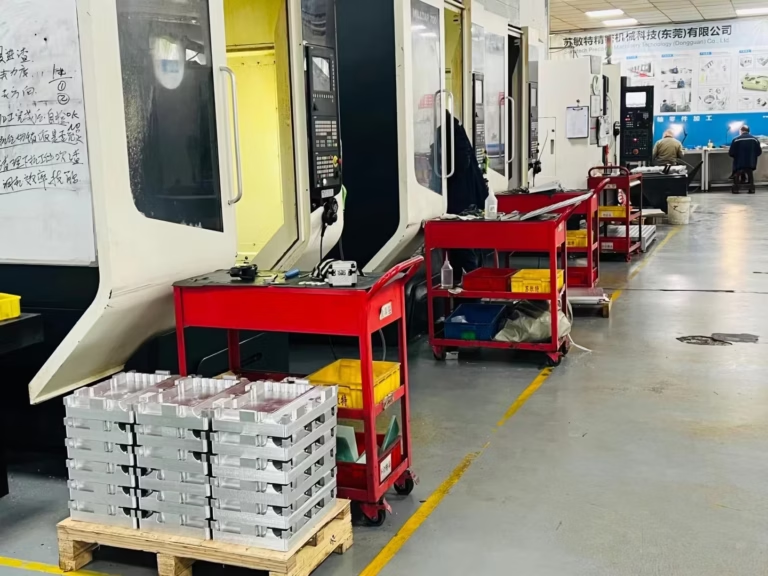
What Separates a Hobby Machine From a Hobby-Grade Service
A hobby machine is cheap until your part needs a second setup, a real alloy, or a tolerance that holds across ten pieces.
Tolerance That Holds on the Tenth Part
Tolerance is the first feature to check, and the easiest to misread. A spec sheet that says ±0.005 mm tells you what a machine can do in a controlled cut, not what a shop will hold across a run. Thermal drift, tool wear and fixture repeatability decide the real number. Ask how parts are measured, not just how they are cut.
For hobby work the failure mode is small and specific. A gear pair with a 0.02 mm center distance error whines. A bearing pocket that runs 0.015 mm tight will not accept the bearing you already bought. Those errors rarely show up on piece one; they show up on piece eight, after the spindle has warmed up.
At GreatLight, incoming metal is checked before it reaches a machine, dimensions are monitored during the run, and every part is inspected before shipment. Reports are available on request. CMM and laser interferometer data is what turns a tolerance claim into something you can verify.
When it does not matter: brackets, spacers and cosmetic plates that bolt to a slotted hole rarely need tight numbers. Spending for ±0.005 mm on a part with 1 mm clearance is wasted money.
- 1CheckHow the shop measures, not only what it claims
- 2Ask forInspection report on the first article
- 3WatchWhether the tolerance repeats across a batch
Material Range Beyond 6061 and 304
Many hobby-facing shops stock two alloys: 6061 aluminum and 304 stainless. That is enough for a bracket and not enough for a project. A robot arm wants 7075 for stiffness at low weight. A heat sink wants copper. A model engine block may want 4130 or a tool steel. A saltwater part may want 316L.
Material choice also drives machining strategy. 7075 cuts cleanly but is less forgiving of chatter than 6061. 316L work-hardens, so a light finishing pass at the wrong feed will polish the surface instead of cutting it. Titanium Grade 5 needs slower speeds and more coolant. A shop that runs these every week has the tooling and the feeds already dialed in.
GreatLight stocks over 30 engineering materials, including aluminum 6061, 2024, 5052, 5083, 6082 and 7075, stainless 303, 304, 316, 316L, 17-4PH and 440C, carbon and tool steels, brass and copper grades, titanium TA1, TA2 and TC4, Inconel, magnesium, and plastics such as POM, PEEK, PA and carbon fibre.
If your design needs one specific alloy, ask before you redesign around what the shop happens to have on the shelf.
- 1Good fit7075 arms, copper heat paths, titanium brackets
- 2Poor fitExotic alloys on a part with no load case
- 3Ask forThe exact grade, not just "aluminum"
Which Work Envelope Fits Which Hobby Part
Confirm table size, Z clearance and rotary capacity before committing to a design.
| Part type | Typical size | Envelope to ask for |
|---|---|---|
| Drone frame plate | 150 × 150 × 5 mm | 500 × 500 × 450 mm |
| Robot joint housing | 200 × 200 × 150 mm | 600 × 600 × 600 mm |
| Model engine block | 400 × 250 × 200 mm | 750 × 1,150 × 550 mm |
| Gearbox plate, long | 900 × 300 × 40 mm | 750 × 1,150 × 550 mm |
| Chassis rail, one piece | 2,500 × 300 × 80 mm | 4,000 × 400 × 150 mm |
| Round flange, turned | Ø350 mm | Ø400 mm rotary table |
Maximum Part Size and How It Affects Your Design
Hobby scale does not mean small. A humanoid robot torso plate, a scale engine block or a long chassis rail can run past 300 mm in one direction. The work envelope of the shop decides whether that part is machined in one setup or split, welded and re-machined. Split parts need dowel pins, alignment and a stress relief step, and they still show a seam.
The number to ask for is not a single figure. Table size, X, Y and Z travel, spindle clearance and rotary table diameter all constrain different features. A part can fit the table and still fail because the Z axis cannot clear the fixture.
GreatLight runs machines up to 4,000 mm of processing size, with travel groups at 4,000 × 400 × 150 mm, 750 × 1,150 × 550 mm, 600 × 600 × 600 mm, 500 × 500 × 450 mm and 500 × 310 × 200 mm, plus a Ø400 mm rotary table. Long parts stay in one setup.
When a shop caps out at 600 mm, the honest answer is usually to redesign around a bolted joint rather than to weld a seam into a stressed part.
DFM Feedback Before the Spindle Starts
A quote that only returns a price is half a service. The useful part is a manufacturability read: a 1.5 mm internal corner that needs a 3 mm cutter, a pocket deeper than four times its width, a thread that runs into a wall, a wall thin enough to deflect under clamping. These are cheap to fix in CAD and expensive to fix in metal.
Feedback speed matters as much as the feedback itself. A redesign round trip that takes a week kills a weekend project. GreatLight returns a quotation and a free DFM analysis within 12 hours, and production can start within 24 hours once the file is locked.
Read the notes carefully. A good DFM note states the problem and offers options, such as opening a corner radius to Ø6 mm or moving a hole 2 mm off the edge. A vague note that says "tight tolerance" without a number is not useful.
Design files stay confidential, and an NDA is available on request if your project is not public yet.
- 1SendSTEP plus a 2D drawing with critical dimensions
- 2ExpectNotes tied to specific features, not general advice
- 3FixCorner radii and depth ratios before tooling
Small-Batch Speed Without a Minimum Order
Hobby projects are usually one to twenty parts. A shop with a high minimum order quantity forces you to buy parts you do not need or to pay a setup fee that dwarfs the part. The first question to ask is whether the shop will run a single piece.
The second is how fast. GreatLight has no minimum order quantity and handles anything from one prototype to runs of 10,000 or more. Quotation and DFM analysis come back within 12 hours, production can start within 24 hours, and parts ship in 3 to 5 days. Historical late-delivery probability is below 2%.
Speed should not come from skipping steps. If a shop offers next-day metal parts with no first-article check, the tolerance story from feature one does not hold. Fast and verified are compatible; fast and unmeasured are not.
For a one-off part, ask the shop to hold the setup for a week. A revision after you test-fit the part is then a small change, not a new project.
Process Control and the Support Behind It
Certifications are not decoration; they describe how a shop controls its process. ISO 9001:2015 covers general quality management. IATF 16949:2016 covers automotive production, where traceability and change control are audited. ISO 13485:2016 covers medical devices. ISO 27001:2022 covers information security, which matters if your CAD files are sensitive.
Behind the certificates sit people. GreatLight was founded in 2011 and now runs three wholly-owned plants covering 7,600 m² with 150 technicians and 127 high-precision CNC machines, including 16 simultaneous 5-axis machining centers, 12 four-axis mills, 27 three-axis machines and 16 mill-turn centers. The qualification rate is 99.99%.
The last feature is less measurable. Can you reach the same engineer twice? Does the shop remember that your part is a bearing housing and not a bracket? Long projects with revisions, surface finishes and small follow-up runs go better with a named contact.
Finishing options are part of the same conversation: anodizing, electroless nickel and plating, powder coating and black oxide, bead blasting, brushing and polishing, and laser marking down to 1.5 mm character height.
Questions Engineers Ask Before Sending a File
What tolerance can a hobby-scale order actually hold?
GreatLight works to ±0.005 mm (±0.0002 in) on stable materials such as aluminum 6061 and stainless 304. That figure depends on geometry: a thin wall or a deep pocket will move, so the drawing should mark which dimensions are critical.
Parts are inspected before shipment, and inspection reports are available on request. If a feature cannot hold the stated number, we say so during DFM review rather than after cutting.
Will a shop run just one part?
Yes. There is no minimum order quantity, so a single prototype and a 10,000-part run go through the same quoting process. Setup cost is the same for one part as for ten, which is why the per-part price drops as quantity rises.
For one-offs, expect to send a STEP file plus a 2D drawing that calls out the critical dimensions and any fit with an existing part.
Which materials are available beyond aluminum and stainless?
The stock list covers aluminum, stainless steel, carbon and tool steel, brass and copper grades, titanium, Inconel, magnesium, and engineering plastics including POM, PEEK, PA, ABS, PC and carbon fibre.
Grade matters more than family. Specify 7075-T6 or 17-4PH rather than "aluminum" or "stainless", because the grade changes feeds, speeds and, in some cases, whether the part should be machined at all.
How are surface finishes specified?
Quote the finish with a Ra number and a process. As-machined is roughly Ra 1.6–3.2 μm, a high-quality machined finish is Ra 0.8–1.6 μm, and fine finishing reaches Ra 0.2–0.8 μm.
Available processes include anodizing in clear, color, hardcoat and conductive types, electroless nickel, zinc, silver and gold plating, powder coating, black oxide, bead blasting, tumbling, brushing, polishing, and laser marking.
What happens to my CAD files?
Uploads are treated as confidential and an NDA is available on request. ISO 27001:2022 covers the information security side of the process.
If your project is under an existing NDA with a third party, mention it in the first message so the file handling matches that agreement.
When is CNC the wrong process for a hobby part?
CNC is a poor fit for a part with no critical dimensions that can be printed or cut from sheet, and for a shell with no machinable faces. Hollow organic shapes often print better.
It is also the wrong first step when the design is still moving. Fix the geometry first, then machine. Cutting metal before the fit is settled just adds a revision cycle.
Send the File and Get a Real Read on It
Upload a STEP file and get a quotation plus free DFM analysis within 12 hours. One part or ten thousand, no minimum order.
DFM in 12 hoursParts ship in 3–5 days100% inspection









