
ABS CNC machining guide
ABS is the workhorse of engineering thermoplastics: tough, dimensionally stable, and cheap to buy. This guide covers grades, cutting parameters, clamping, wall thickness, and the tolerances a machined ABS part can actually hold. Written for design engineers and buyers who need to decide whether ABS is the right call for a housing, bracket, or prototype panel.
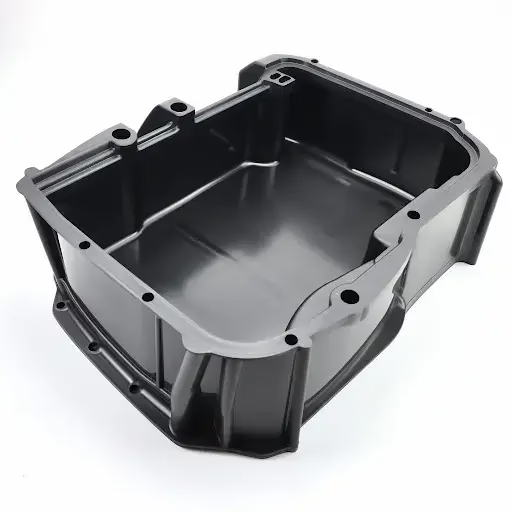
What this guide covers
Read the sections in order if ABS is new to you; jump to the table if you only need cutting parameters.
What ABS is and where it earns its place
The resin is a terpolymer of acrylonitrile, butadiene, and styrene. Acrylonitrile brings chemical resistance and surface hardness, butadiene brings impact toughness, and styrene keeps the melt flowing so the resin can be molded or extruded easily. That balance is why the material shows up in so many enclosures, bezels, and internal brackets.
For CNC work the useful properties are predictable. Unfilled grades run a tensile strength around 40 MPa and a modulus near 2.3 GPa, and they hold dimensions well because the resin absorbs very little moisture compared with nylon or acetal. A machined panel that sits in a humid warehouse for a month will not swell the way a PA6 part does.
Impact strength is the reason designers pick it over acrylic or polystyrene. A 3 mm wall survives a drop that would crack PMMA, and the failure mode is ductile rather than brittle. It is not a high-temperature material, though. Keep service temperatures under roughly 80 °C, and expect the modulus to fall off well before that.
Grades you will actually see on a quote
Generic extrusion-grade ABS plate is the default for prototypes and low-volume fixtures. It machines cleanly, costs little, and comes in black, natural, and white. If your drawing does not name a grade, this is what a shop will quote.
High-impact and flame-retardant grades exist, but they behave differently at the cutter. FR grades carry mineral or brominated additives that are abrasive, so tool life drops and you may see a slightly chalky surface. High-impact blends cut a little gummier and want sharper tools and lighter depths of cut.
For parts that will be painted, plated, or glued, tell the shop up front. Plating grades are formulated for adhesion, and a general-purpose plate may not take the same pretreatment. Bonding works well with methylene chloride or cyanoacrylate, but solvent choice affects joint strength, so it is worth a test coupon on a critical assembly.
Starting cutting parameters for unfilled ABS
Roughing values for sharp carbide tooling. Adjust to chip evacuation, not to a fixed number.
| Operation | Surface speed | Feed per tooth | Notes |
|---|---|---|---|
| Face milling | 300–600 m/min | 0.05–0.15 mm | Positive rake; air blast |
| End milling, rough | 200–400 m/min | 0.05–0.12 mm | Climb cut, 50% radial WOC |
| End milling, finish | 300–600 m/min | 0.03–0.08 mm | 0.5–1.0 mm axial DOC |
| Drilling | 60–120 m/min | 0.05–0.20 mm/rev | 118–130° point, peck if >3×Ø |
| Reaming | 30–60 m/min | 0.10–0.25 mm/rev | Two-flute, generous coolant |
| Tapping | 10–25 m/min | – | Form taps beat cut taps here |
Heat, chip evacuation, and why ABS melts instead of cutting
ABS has a low thermal conductivity, so heat generated at the edge has nowhere to go except into the chip and the part. Once the tool tip passes roughly 90 °C the material stops shearing and starts smearing. You get a gummy burr, a dull surface, and a chip that wraps the cutter instead of flying clear.
Two-flute and three-flute end mills with polished flutes work better than the four-flute cutters you would grab for aluminum, because the chip has more room to leave the pocket. High rake angles and sharp, uncoated carbide are the usual choice. Coated tools help on abrasive FR grades but add nothing on unfilled stock.
Air blast is the default coolant. Flood coolant keeps the part cool but can load the chips into a paste if flow is weak, and ABS does not need the thermal shock. If you must use mist, keep it light and aim it at the exit side of the cut.
Feeds should be moderate to high so the edge bites and the chip carries heat away. A light, fast rub is the worst case: the tool polishes the surface, generates heat, and shortens its own life.
Clamping, wall thickness, and part design
The material is softer than aluminum, so vise jaws bite into finished faces with very little pressure. Use soft jaws machined to the part profile, or aluminum jaw caps, and keep clamping force just enough to stop movement. Distortion from over-clamping looks like a dimensional error and often gets blamed on the machine.
Thin walls deflect under cutting pressure. A 1.5 mm wall is workable in a supported pocket but will chatter if it stands free at 20 mm tall. Ribs, bosses, and a thicker bottom flange are cheap ways to add stiffness without adding weight. Where a wall must stay thin, rough it, let it relax, then take a light finish pass.
Sharp internal corners are stress risers in any plastic. A corner radius of at least one third of the wall thickness spreads load and gives the cutter room to move. Threads below M3 in ABS strip easily; use metal inserts for anything that will be assembled more than a few times.
Tolerances and annealing
A well-supported ABS feature can hold ±0.05 mm on a dimension tied to a single setup, and we machine to ±0.005 mm on the machine side where the geometry allows. Across multiple setups the practical figure loosens, because each refixture adds stack-up and the material moves as stock is removed.
Stress relief is the main cause of a part that measures correctly off the machine and drifts a day later. Rough machining releases internal stress from the extruded plate, so for tight parts we rough, anneal, then finish. A typical anneal for ABS sits around 70–80 °C for a few hours with a slow ramp and slow cool.
Temperature matters in the inspection room too. A part checked at 20 °C and rechecked at 28 °C will read differently. If a tolerance is genuinely critical, state the measuring temperature on the drawing.
Post-machining, bead blasting hides tool marks and gives a matte finish. Vapor polishing produces a gloss and rounds edges, but it removes material and softens corner definition, so it is a poor fit for parts with sharp functional edges.
Common questions
Can ABS be machined to the same tolerance as aluminum?
Not quite. On a rigid, well-supported feature in one setup, ABS can hold ±0.05 mm, and the machine itself is capable of ±0.005 mm. The limit comes from the material, not the spindle.
Aluminum is stiffer and moves less after cutting, so it holds tighter numbers over more setups. For ABS, keep critical tolerances on features that can be cut without refixturing.
What surface finish can I expect on a machined ABS part?
As-machined faces typically land in the Ra 1.6–3.2 μm range with a sharp cutter and good chip evacuation. A fine finishing pass can reach Ra 0.8–1.6 μm.
Bead blasting gives a uniform matte look and hides witness marks. Vapor polishing gives gloss but softens edges, so avoid it on sealing faces.
Does ABS need annealing after machining?
Only when geometry or tolerance demands it. Thin, long, or asymmetric parts are the ones that move. A rough, anneal at about 70–80 °C, then finish sequence settles the part before the final cut.
Simple blocks and brackets rarely need it. If the part is inspected immediately and shipped, the drift may not show up until the customer measures it.
Is ABS a good choice for outdoor or high-temperature use?
No. UV exposure yellows the surface and degrades impact strength over time, and service temperature should stay under roughly 80 °C.
For outdoor parts, consider ASA or PC with a UV-stable grade. For anything near an engine or a heater, move to PEEK or a filled nylon instead.
How does ABS compare with PC or POM for CNC parts?
PC is stronger and clearer but costs more and is notch sensitive, so sharp corners crack. POM is stiffer, machines beautifully, and holds tight tolerances, but it is more expensive and harder to bond.
ABS sits in the middle: cheap, tough, easy to machine, and easy to glue. It is the right default for enclosures, covers, and prototypes that need to look and feel like production.
Can you machine ABS parts from a single prototype upward?
Yes. There is no minimum order quantity, so one prototype and a 10,000-part run go through the same process. Uploads stay confidential, and an NDA is available on request.
Quotation and a free DFM review come back within 12 hours, and production can start within 24 hours of approval.
Send us your ABS part
Upload a STEP file and get a quote with a free DFM review within 12 hours.
12-hour quote100% inspectionNDA on request









