
Advantages of Titanium Alloy CNC Processing
This page explains what titanium alloy CNC machining gives you in real parts, which grades suit which jobs, and where the process stops making sense. It is written for design engineers and sourcing teams who specify metal components and need to judge whether titanium is the right call.
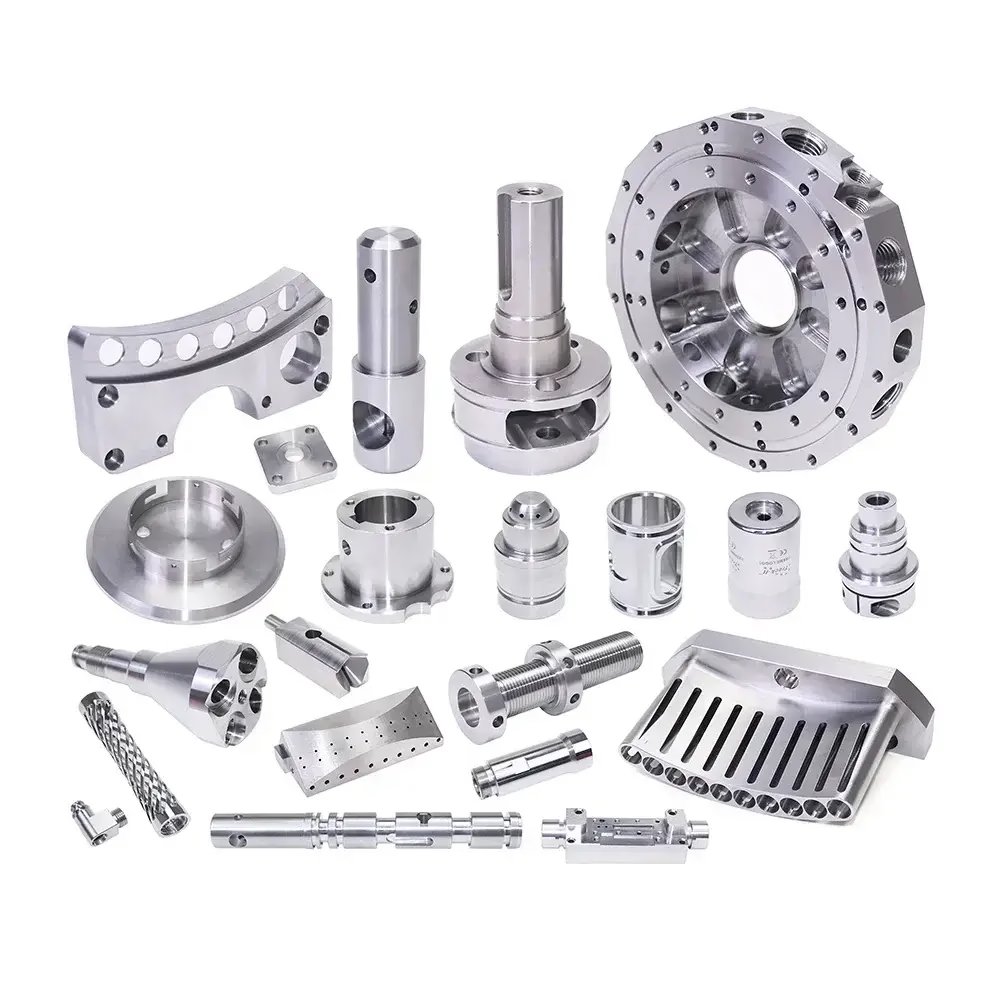
What titanium actually delivers in a machined part
Titanium sits in an unusual spot for machined components. Its density is roughly 4.5 g/cm³, about 57 percent of steel, yet annealed Ti-6Al-4V reaches a tensile strength near 950 MPa. That ratio is the reason a bracket can lose weight without losing stiffness. For aero, drone and robotic arm parts, that single number often decides the material.
The second property is corrosion. A passive oxide layer forms on the surface within milliseconds of exposure to air and re-forms if scratched. Titanium handles seawater, chlorides, most acids and human body fluids without plating. Compared with 316 stainless, it resists pitting far better in chloride environments.
The third is biocompatibility. Medical device makers use titanium for bone plates, dental implants and surgical instruments because the metal does not trigger rejection and bonds with bone tissue. The same qualities make it useful in food and pharmaceutical equipment, where a part must be cleanable and non-reactive.
Why titanium is hard to cut, and what that means for your part
Titanium conducts heat poorly. About 7 W/m·K at room temperature, versus roughly 167 for aluminum. Cutting heat does not leave through the chip, so it stays at the cutting edge. Tool life drops fast if speeds and feeds are not dialed in. This is the main cost driver in titanium work.
The material also work-hardens. A dull tool rubbing the surface instead of shearing it raises local hardness and makes the next pass worse. Machinists counter this with sharp carbide, low surface speed, high feed per tooth and a rigid setup. Titanium is also chemically reactive at high temperature and can weld to the tool edge, which is why coated carbide and abundant coolant matter.
These traits add time, not impossibility. A titanium part usually costs two to four times the same geometry in 6061 aluminum. What you get back is a part that survives where aluminum would fatigue and steel would corrode.
- 1Thin wallsTitanium's low modulus causes chatter; walls under 1 mm need support or reduced radial engagement.
- 2Deep pocketsChip evacuation is critical. Poor evacuation recuts chips and dulls tools quickly.
- 3Tight holesHoles below Ø2 mm in Ti-6Al-4V are slow; consider reaming or EDM instead.
- 4Long partsDeflection grows with length; supports and progressive passes help.
Choosing the right titanium grade
Commercially pure grades TA1 and TA2 are softer and more formable. They machine more easily than alloys and resist corrosion well, which suits chemical fittings, heat exchanger plates and some medical instruments. Strength is lower, so they are rarely the choice for load-bearing structure.
TC4, also written Ti-6Al-4V, is the workhorse. It is heat treatable, reaches the high strength numbers, and holds up in fatigue. Most aerospace brackets, medical bone screws and motorsport components use it. The trade-off is the machining cost just described.
For parts that need higher temperature strength or better creep resistance, grades outside this list exist, but they are harder to source and much harder to cut. We machine TA1, TA2 and TC4 routinely, and we will say so if a job is better served by 17-4PH stainless or a different alloy.
Titanium grades compared for machining and service
Values are typical ranges for annealed material and should be confirmed against your material cert.
| Grade | Tensile strength | Corrosion | Typical machined parts |
|---|---|---|---|
| TA1 (CP) | ~240 MPa | Excellent | Chemical fittings, heat exchanger plates |
| TA2 (CP) | ~345 MPa | Excellent | Medical instruments, marine hardware |
| TC4 (Ti-6Al-4V) | ~950 MPa | Very good | Aerospace brackets, bone screws, motorsport |
| 316L stainless | ~485 MPa | Good, pits in chloride | General industrial parts |
| 7075-T6 aluminum | ~570 MPa | Fair | Lightweight brackets, housings |
Where CNC machining wins over casting or forging
Titanium is expensive per kilogram, and near-net processes reduce waste. Forging and casting make sense at high volume with generous geometry. CNC machining wins when geometry is complex, when tolerances are tight, or when the quantity is low. A five-axis machine can produce an organic bracket with undercuts and contoured pockets from solid stock, in one setup, without a mold.
The advantages of titanium alloy CNC machining show up most clearly in three situations. First, prototypes and bridge builds before a casting tool exists. Second, parts with pockets, ribs and thin features that would be difficult to cast cleanly. Third, parts where surface finish and dimensional accuracy matter more than unit cost.
At GreatLight we run 16 simultaneous 5-axis centers, 16 mill-turn centers, and machines up to 4,000 mm in the largest travel. Tolerance is held at ±0.005 mm, and finish reaches Ra 0.2–0.8 μm when a part calls for it. That range covers most titanium work we see, from a fist-sized bone plate to a 1.5 m structural beam.
- 1Best fitComplex geometry, tight tolerance, low to medium volume, or pre-tooling prototypes.
- 2Poor fitSimple parts at very high volume, where casting or forging beats machining on cost.
- 3BorderlineLarge parts with simple shapes; material waste can outweigh machining flexibility.
Quality control on titanium parts
Titanium hides nothing. A crack or porosity will show under dye penetrant or X-ray, and a wrong heat treat lot will show in hardness testing. For safety-critical parts, we run raw material checks against the mill certificate before cutting, monitor dimensions in process, and perform a 100 percent inspection before shipment. Reports are available on request.
Our quality system holds ISO 9001:2015, IATF 16949:2016, ISO 13485:2016 and ISO 27001:2022. The medical and automotive certificates matter for titanium because those are the two industries that buy the most of it. Every upload is handled as confidential, and we sign an NDA when a customer needs one.
A note on the qualification rate: we track 99.99 percent on shipped parts. That number is not a marketing claim, it is what our inspection data shows. If a feature on your drawing is difficult to measure or inspect, tell us early. It is cheaper to adjust the design than to argue about a part at the end.
Common questions from engineers
Is titanium alloy CNC machining more expensive than aluminum?
Yes. Titanium stock costs more per kilogram, and cutting speeds are lower, so machine time is longer. A typical titanium part runs two to four times the cost of the same geometry in 6061 aluminum.
Which titanium grades can you machine?
We machine TA1, TA2 and TC4 (Ti-6Al-4V) regularly. Other grades may be possible but need review for tooling and lead time.
What tolerances and finishes are achievable on titanium?
Standard tolerance is ±0.005 mm, and surface finish reaches Ra 0.2–0.8 μm when specified. As-machined finish is typically Ra 1.6–3.2 μm.
What is the minimum order quantity for titanium parts?
There is no minimum. We run single prototypes up to 10,000+ part runs. For titanium, one-off prototypes are common because tooling for casting is not justified at low volume.
Can titanium parts be anodized or coated?
Yes. Anodizing, including hardcoat and color, works well on titanium. Laser marking is also common, with a minimum character height of 1.5 mm.
How do you handle confidentiality for titanium aerospace or medical parts?
All uploads are secure and confidential. We sign an NDA on request, and our ISO 27001:2022 system covers information handling.
Send your titanium part for review
Upload a model and we will return a quotation with free DFM analysis within 12 hours.
12-hour quote100% inspectionNo MOQNDA available









