
Affordable CNC Machining Solutions: Where the Cost Actually Comes From
This page explains how affordable CNC machining solutions are built in practice, not by cutting corners. It is written for design engineers and sourcing teams who need to judge a quote on more than unit price. After reading, you can tell which features of a part drive cost, and which ones do not.
A quote is a sum of decisions, not a single number
Machining cost is set long before the spindle turns. Fixturing, tool access, tolerance callouts and inspection method each add or remove time from the cycle.
Why 5-axis machines lower cost on complex parts, and raise it on simple ones
A three-axis machine needs the part repositioned for every new face. Each reposition is a new setup: fixture, zero, probe, first-article check. On a bracket with four machined faces, that can be four setups. A simultaneous 5-axis center reaches those faces in one setup because the tool and the table move together. Fewer setups means fewer chances for a datum shift, and less non-cutting time on the spindle.
The trade is not automatic. For a flat plate with holes on one face, a 5-axis center is slower to program and its hourly rate is higher. It wins only when the geometry has angled features, deep pockets on multiple sides, or surfaces that must stay concentric to one datum. That is the first question to ask when comparing affordable CNC machining solutions: how many setups would this part need on a 3-axis machine?
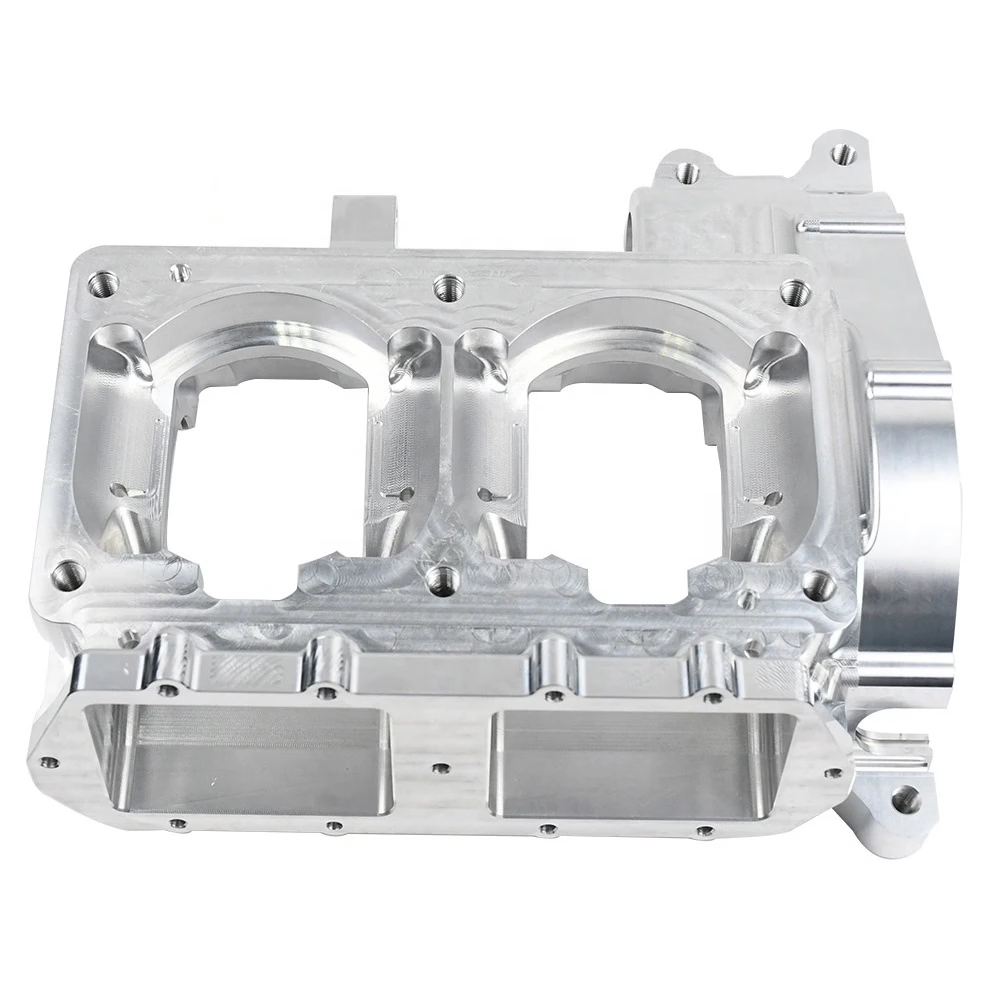
At GreatLight we run 16 simultaneous 5-axis machining centers, 12 four-axis mills and 27 three-axis machines. Small, simple parts stay on 3-axis. Complex housings, impellers and medical instruments go to 5-axis. Matching the part to the machine is usually worth more than any discount on the hourly rate.
- 1One setup, one datumAngled holes and side features stay aligned to each other.
- 2Fewer fixturesSoft jaws or a dovetail block often replace a dedicated fixture plate.
- 3Not for flat partsSimple 2.5D geometry is cheaper on a 3-axis mill.
The features that add cost, and the callouts that do not
Cost concentrates in five places: tight tolerances applied to non-functional surfaces, deep pockets that need long reach tools, sharp internal corners, surface finishes specified finer than the function needs, and features that force a second operation. A ±0.005 mm tolerance on a bearing bore is money well spent. The same callout on a clearance hole is wasted, and it slows the whole program because the machinist must now verify it.
Corner radii matter more than most drawings suggest. A pocket with sharp internal corners requires either EDM or a small tool run at low feed, and small tools break. Setting the internal radius to at least one third of the pocket depth lets a larger cutter reach the floor, which cuts cycle time. The same logic applies to thread depth, chamfer size and text height for laser marking: 1.5 mm minimum character height keeps marking legible without a rework loop.
Finish is another cost lever. As-machined at Ra 1.6–3.2 μm is standard. Ra 0.8–1.6 μm covers most sealing and sliding surfaces. Ra 0.2–0.8 μm is a lapping or fine-boring operation and should be reserved for bearing fits and optical seats. We inspect 100% of parts before shipment, with reports on request, so specifying a finish also means specifying how it gets measured.
- 1Tolerance by functionReserve ±0.005 mm for fits, not for every dimension.
- 2Corner radius ≥ 1/3 depthLarger cutter, higher feed, shorter cycle.
- 3One finish calloutMixed finishes on one face can add a second setup.
Material choice and batch size change the price more than the machine rate
Aluminium 6061-T6 machines fast and is the default for prototypes and enclosures. It is not always the cheapest answer for a production part: if a 7075 or 17-4PH part can be made 30% thinner and still pass load, the material cost per part may drop even though the stock price rises. Titanium TC4 (Ti-6Al-4V) and Inconel cut slowly and wear tools, so their cost sits in cycle time, not in the bar stock.
Quantity is the second lever. Setup and programming are one-time costs, so the first part carries them. That is why we have no minimum order quantity and run from one prototype to 10,000+ part runs. On a 10-part order, the setup is spread thin and unit price looks high. On a 500-part order the same part may cost a fraction of that. Comparing quotes at different quantities without knowing the setup split is not a real comparison.
For near-net shapes, die casting or vacuum casting may beat machining from solid. For sheet parts, laser cutting plus forming is usually cheaper than milling a plate down. We offer those processes alongside CNC, so the recommendation can follow the geometry rather than the machine list.
- 16061-T6 firstBest speed-to-strength ratio for most housings and fixtures.
- 2Hard alloys cost in timeInconel and Ti-6Al-4V need slow feeds and fresh tooling.
- 3Check the processDie casting or sheet metal may undercut milling on the right shape.
Typical process capability at GreatLight
Use these numbers when writing callouts. If a drawing sits outside them, we will flag it during DFM review rather than quote a price we cannot hold.
| Parameter | Capability | When to use it |
|---|---|---|
| General tolerance | ±0.005 mm (±0.0002 in) | Bearing bores, mating faces, dowel holes |
| As-machined finish | Ra 1.6–3.2 μm | Brackets, covers, non-contact surfaces |
| High-grade finish | Ra 0.8–1.6 μm | Sealing faces, sliding surfaces |
| Fine finish | Ra 0.2–0.8 μm | Bearing fits, optical seats |
| Maximum part size | 4,000 mm | Long rails, frames, large housings |
| 5-axis travels | 4,000 × 400 × 150 mm | Long parts with multi-face features |
| Rotary table | Ø400 mm | Parts needing 4th-axis indexing |
| Qualification rate | 99.99% | Production runs with tight inspection |
What a useful quote should tell you
A unit price alone cannot be checked. Ask for the setup count, the machine class, the material grade and the inspection method. If a supplier cannot state how many setups a part needs, the price was probably guessed. We return a quotation and a free DFM analysis within 12 hours, and production can start within 24 hours of approval. Parts ship in 3–5 days for most jobs.
DFM feedback is where affordable CNC machining solutions are actually created. Moving a tolerance, opening a corner radius or switching a tapped hole to a through hole can remove an operation. On one housing, changing a blind tapped hole to a through hole removed a tool change and a chip-clearing pause. That is a real cost cut with no loss of function.
Confidentiality belongs in the same conversation. Uploads are secure and confidential, and an NDA is available on request. If your drawing cannot leave the building without one, say so at the start so the review can begin immediately.
Certifications are a purchasing filter, not a cost driver. We hold ISO 9001:2015, IATF 16949:2016, ISO 13485:2016 and ISO 27001:2022 across 3 wholly-owned plants covering 7,600 m², with 150 technicians and 127 high-precision CNC machines. Those systems add paperwork, not unit cost, and they matter most on automotive, medical and defense-adjacent work.
- 1Ask for setup countIt reveals how the price was built.
- 2Request DFM notesA tolerance change can remove a whole operation.
- 3State the quantityOne prototype and 10,000 parts price differently.
Common questions on affordable CNC machining
Does a lower price mean looser tolerances?
No. Cost comes out of setups, tool paths and process choice, not out of the tolerance band. A part that needs ±0.005 mm gets ±0.005 mm.
If a callout is tighter than the function requires, we say so in the DFM notes and quote both versions so you can decide.
How do you price a single prototype versus a production run?
Programming and fixturing are one-time costs, so the first part carries them. We have no minimum order quantity and run from one piece to 10,000+.
Ask for pricing at two or three quantities. The difference shows you exactly where the setup cost sits.
Which materials keep the cost lowest?
Aluminium 6061-T6 and 6061, plus 303 and 304 stainless, machine quickly and are stocked in common sizes. Brass C36000 is also fast to cut.
Titanium TC4 (Ti-6Al-4V) and Inconel are affordable only when the design truly needs their properties, because cycle time rises sharply.
Can you suggest a cheaper process for the same part?
Yes, when the geometry allows it. Die casting, vacuum casting, sheet metal fabrication and 3D printing are all in house, so the recommendation is not tied to keeping work on a CNC.
A machined prototype often still makes sense first, to validate the design before tooling is cut.
How fast can I get a quote and parts?
Quotation and free DFM analysis come back within 12 hours. Production can start within 24 hours after approval, and most parts ship in 3–5 days.
Our historical late-delivery probability is below 2%. We do not quote delivery dates we cannot hold.
Are my drawings kept confidential?
Yes. Uploads are secure and confidential, and an NDA is available on request before any file is reviewed.
We hold ISO 27001:2022 for information security, which governs how files are stored and accessed.
Send a drawing and see where the cost is
We return a quotation and a free DFM analysis within 12 hours, with the setup count and process route shown. No minimum order quantity.
12-hour quoteFree DFM analysisNo MOQNDA on request









