
Affordable CNC mill sales for parts that hold tolerance
This page is for engineers and buyers who need milled parts without buying a machine. It covers what drives cost, when five-axis pays off, and which part details to settle before you request a quote.
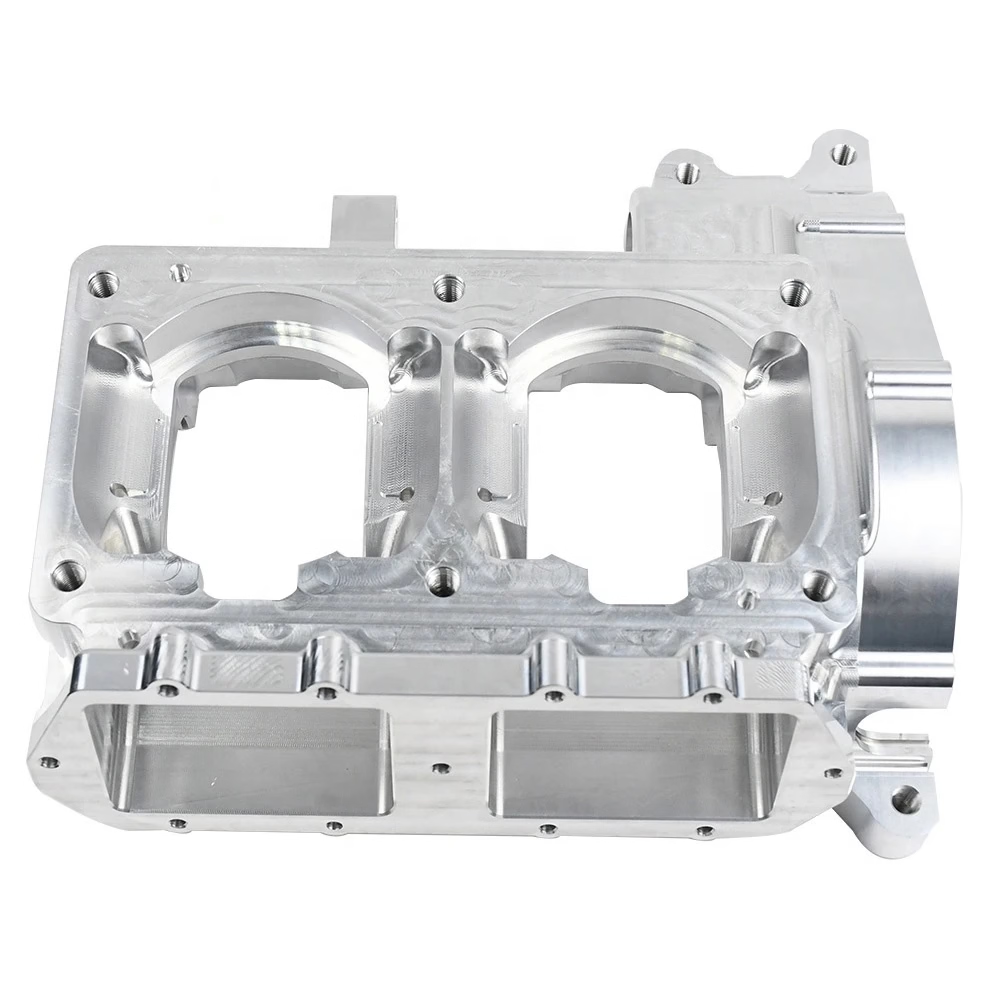
What affordable CNC mill sales actually means
Price per part is a result of geometry, tolerance, material, and quantity. Change any one and the number moves.
Why a milled part costs what it costs
A milling quote is built from machine time, setup, tooling, material, and inspection. Machine time is the largest share for most parts. A small aluminum bracket that runs in one setup on a three-axis machine is cheap. The same bracket with a deep pocket, a tight bore, and a callout on every face is not.
Setup is the second cost. Every new workholding position adds an hour or more of non-cutting time, and that time is billed. A part that needs four sides machined in three setups costs more than a part that can be finished in two. When a shop has to build a soft jaw or a fixture, the cost lands on the first order and drops on repeats.
Tolerance follows setup. Holding ±0.005 mm on one bore is routine. Holding ±0.005 mm across a 300 mm span between two features is a different problem, because thermal drift, tool wear, and clamping stress all enter the picture. Engineers who mark only the features that function get lower prices than engineers who apply a blanket tolerance to the whole drawing.
Volume changes the math again. One prototype absorbs the full setup and programming cost. A 500-piece run spreads it, and the shop can optimize tool paths and use a fixture built for repeat loading. Runs of 10,000+ parts shifted to a mill-turn center or a dedicated fixture often come in below the prototype unit price.
- 1Fewer setupsEach additional workholding position adds non-cutting time you pay for.
- 2Selective toleranceTighten only functional features, not every dimension on the print.
- 3Right machine classThree-axis for prismatic parts, five-axis when angles or deep features demand it.
- 4Quantity breaksSetup cost per part falls as the batch grows beyond the prototype stage.
When five-axis is worth it, and when it is not
Five-axis machining adds two rotary axes to the three linear ones, so the tool can reach the workpiece from almost any direction. That removes setups on parts with angled faces, undercuts, or features on five sides. A part that would need four separate fixtures on a three-axis machine can often be finished in two on a five-axis center.
The gain is real but it is not free. Five-axis machine time costs more per hour than three-axis time, and programming takes longer. For a simple plate with holes and a pocket, three-axis is faster and cheaper. Reach for five-axis when re-fixturing would introduce position error you cannot tolerate, or when the part has contoured surfaces that a ball nose tool needs to sweep at a fixed angle.
At GreatLight we run 16 simultaneous five-axis machining centers alongside 27 three-axis machines and 12 four-axis mills. That mix lets us put a job on the machine class that fits the geometry instead of defaulting to the most expensive option. Maximum processing size is 4,000 mm, with rotary table capacity up to Ø400 mm.
Materials matter here too. Aluminum 6061 and 7075 cut fast and hold finish well. Stainless 316L and 17-4PH work-harden if the tool path dwells, so they need a rigid setup and constant feed. Titanium TC4 and Inconel are slower by nature; the quote reflects that in machine time, not in a hidden surcharge.
- 1Choose five-axisAngled faces, undercuts, deep cavities, or features on four or more sides.
- 2Stay three-axisFlat prismatic parts with features reachable from one or two directions.
- 3Rigidity firstHard alloys punish light setups more than they punish slow feeds.
Machine class and process capability
Typical ranges from our shop floor. Confirm your specific part before quoting.
| Machine class | Typical part shape | Working range | Notes |
|---|---|---|---|
| Three-axis (27 machines) | Flat plates, housings, brackets | 500 × 500 × 450 mm; 500 × 310 × 200 mm | Lowest hourly rate, one or two setups |
| Four-axis (12 mills) | Cylindrical or indexed parts | Ø400 mm rotary table | Adds rotation without full contouring |
| Five-axis (16 centers) | Impellers, angled ports, complex housings | 750 × 1,150 × 550 mm; 600 × 600 × 600 mm | Fewer setups, best for contoured faces |
| Large travel | Long beams, rails, fixtures | 4,000 × 400 × 150 mm | For parts beyond standard envelope |
| Mill-turn (16 centers) | Shafts with milled flats | Up to Ø400 mm turning | Combines turning and milling in one setup |
Material selection and how it moves the price
Material cost is usually a smaller line item than machine time, but it decides how the part cuts. Aluminum 6061-T6 is the default for prototypes and fixtures: good strength, easy to machine, and it takes anodizing cleanly. 7075 is stronger and used where weight matters, though it costs more and cuts slightly slower.
Stainless 303 machines freely because of its sulfur content and is a common choice for fittings and shafts. 304 and 316L resist corrosion better but gum up tools, so they need sharp cutters and consistent coolant. 17-4PH (SUS630) holds high strength after heat treatment and appears often in aerospace and medical work.
Titanium TC4 (Ti-6Al-4V) and Inconel are chosen for high-temperature or high-strength service. Both cut slowly and wear tooling fast, which shows up as higher machine time per part. Magnesium AZ31B and AZ91D cut very fast but need chip handling controls because the fines are flammable.
Plastics behave differently again. POM and ABS are stable and cheap for brackets and covers. PEEK holds up in high-temperature or chemically aggressive service and costs far more per kilogram. Carbon fiber reinforced stock is abrasive, so tool life drops and the quote reflects it.
- 1Aluminum 6061 / 7075General purpose and high-strength parts; anodizes well.
- 2Stainless 303 / 316L / 17-4PHCorrosion resistance and high strength; slower to cut than aluminum.
- 3Titanium and InconelHigh-temperature service; expect longer machine time per part.
- 4PEEK and carbon fiberHigh-performance plastics; abrasive or costly stock raises unit price.
What to settle before you request a quote
Send a 3D model and a 2D drawing that agrees with it. When the two disagree, the shop stops and asks, and that costs you a day. Note the critical dimensions on the drawing rather than relying on the general tolerance block for everything.
State the material grade, not just the family. Aluminum 6061 and 7075 have different prices and different machining behavior. Stainless 304 and 303 are not interchangeable for free-machining parts. If the grade is open, say so, and we can suggest the one that cuts best for the function.
Call out the finish you actually need. As-machined surfaces run Ra 1.6–3.2 μm. A fine finish at Ra 0.2–0.8 μm takes additional passes and adds time. Anodizing, plating, and powder coating each add a step and a lead-time component, so list them on the drawing rather than mentioning them later.
Quantity and delivery expectations belong in the first message. We quote in 12 hours with a free DFM analysis, and production can start within 24 hours. Parts ship in 3–5 days for standard work. If your schedule is tighter than that, tell us up front so we can check machine capacity before promising anything.
- 1Model plus drawingKeep them consistent; flag any intentional difference.
- 2Named material gradeGrade affects price, tool life, and finish quality.
- 3Finish calloutsSpecify surface roughness and any coating on the print.
- 4Quantity and dateBoth shape machine choice and scheduling.
How we hold tolerance and prove it
We work to ±0.005 mm (±0.0002 in) on critical features and inspect 100% of parts before shipment. That covers raw material verification, in-process monitoring, and a final inspection pass. Inspection reports are available on request, and we can supply them with the shipment rather than after the fact.
The shop holds ISO 9001:2015, IATF 16949:2016, ISO 13485:2016, and ISO 27001:2022 certifications. For medical and automotive programs, that means the process documentation and traceability expectations are already in place. It does not change how the part is cut, but it changes what we can hand over with it.
Confidentiality is part of the workflow. Uploads are secure and confidential, and we sign an NDA on request. For programs where the drawing itself is sensitive, that step happens before any file moves to the shop floor.
We run three wholly-owned plants across 7,600 m² with 150 technicians and 127 high-precision CNC machines. No minimum order quantity applies, so a single prototype and a 10,000+ part run go through the same quoting path. The difference is only in how the work is scheduled.
- 1Tolerance±0.005 mm on critical features; ±0.0002 in equivalent.
- 2Inspection100% before shipment; reports on request.
- 3CertificationsISO 9001, IATF 16949, ISO 13485, ISO 27001.
- 4ConfidentialitySecure uploads; NDA available on request.
Questions engineers ask before ordering
Is buying a used CNC mill cheaper than outsourcing?
The purchase price is only the first cost. A used mill also needs tooling, a power drop, floor space, coolant handling, and someone trained to program and run it. Those costs continue whether or not you have work for the machine.
Outsourcing turns that into a per-part cost. For low and irregular volumes, the total usually lands lower, and you can move to a five-axis machine without owning one.
How tight a tolerance can you hold on a milled part?
We work to ±0.005 mm (±0.0002 in) on critical features. That is achievable on bores, slots, and mating surfaces with the right setup and inspection plan.
The limit is not the same as a target. Holding that tolerance across a long span, in a hard alloy, or on a thin wall needs a conversation before quoting.
What does five-axis machining add to the price?
Five-axis machine time costs more per hour and programming takes longer, so a simple part will quote higher on a five-axis center than on a three-axis mill.
The saving arrives on parts that would otherwise need three or four fixtures. Fewer setups means less accumulated position error and less non-cutting time, which often offsets the higher hourly rate.
Can you machine a single prototype?
Yes. There is no minimum order quantity, so one part and a 10,000+ part run both go through the same quoting process.
Prototype orders carry the full setup cost, which is why the first unit price is higher. Repeats drop once the fixture and program exist.
Which file formats and details should I send with the RFQ?
A STEP or IGES model plus a 2D drawing covers most work. Note the material grade, the critical tolerances, the surface finish, the quantity, and the date you need the parts.
If the model and drawing disagree, tell us which one governs. That single sentence avoids a back-and-forth that can cost a day.
What lead time should I plan for?
Quotation and a free DFM analysis come back within 12 hours. Production can start within 24 hours, and standard parts ship in 3–5 days.
Parts with finishing steps or unusual material may run longer. Give us the target date in the RFQ and we will confirm capacity before committing.
Send a drawing, get a milling quote in 12 hours
Upload your model and drawing. We return a price, a free DFM analysis, and a machine-class recommendation before you commit to anything.
12-hour quote±0.005 mm toleranceNo MOQNDA on request









