
Aluminum Alloy Battery CNC Machining for EV and Energy Storage
This page covers how we machine battery housings, covers, busbars and cold plates: which alloys cut cleanly, where wall thickness and flatness decide the process, and which features belong on a mill rather than a press. Written for design and manufacturing engineers comparing suppliers. After reading, you can judge whether your part geometry fits 5-axis milling.
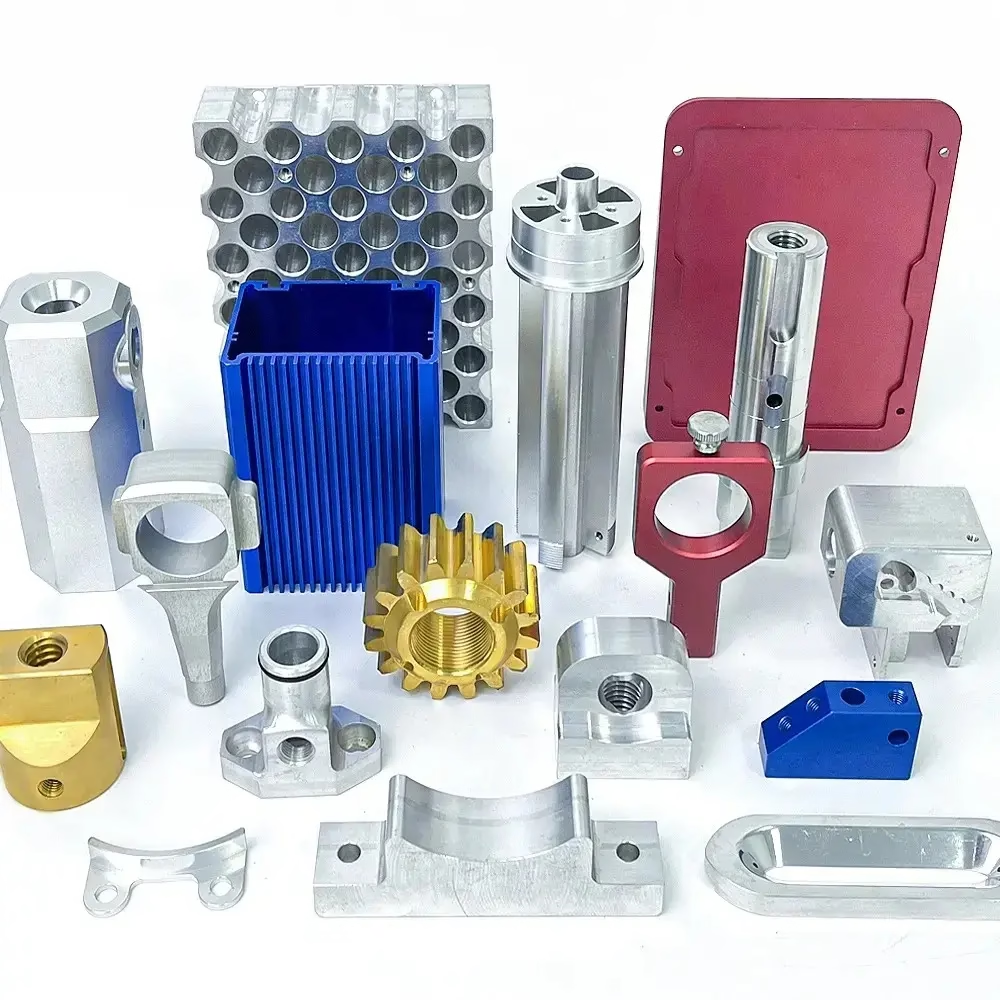
What Aluminum Alloy Battery CNC Actually Covers
A battery pack is a stack of parts with different machining needs. Sorting them by function is the fastest way to choose a process.
Which Battery Parts Belong on a CNC Mill
Battery work splits into structural, conductive and thermal parts, and each one behaves differently on a machine. Structural parts include module housings, end plates, pack frames, covers and trays. Conductive parts are busbars, terminals and interconnect plates. Thermal parts are cold plates and cooling channels. The three groups rarely share the same process logic.
Structural housings and covers are the most common starting point for aluminum alloy battery CNC work. Wall thickness often sits between 1.5 mm and 4 mm, and flatness on the sealing face usually drives the setup more than the outer profile does. If a cover carries a gasket groove, that groove is normally milled, not formed, because the seal needs a consistent depth around the full perimeter.
Busbars are a different problem. They are thin, long and easily bent by clamping force. For machining, we prefer to fixture them on a flat plate with light down-pressure and take shallow passes. If the part is only a flat strip with holes and a bend, laser cutting plus forming is usually cheaper. Machining earns its place when the busbar needs tight hole position, a stepped cross-section or a coined contact face.
Cold plates carry cooling channels, and channel geometry decides whether milling is practical. Straight drilled channels are fast. Serpentine channels with small radii, or channels with varying depth, need 3-axis or 5-axis milling and often a bonded or friction-stir-welded lid. We machine the channel in one half and the matching face in the other, then control flatness so the two halves close without gaps.
- 1Mill itPack frames, end plates, covers with gasket grooves, stepped busbars, machined cold plates.
- 2Form or cut itFlat busbars, simple brackets, thin cosmetic panels without sealing faces.
- 3Watch clampingThin busbars and long covers deflect under vise pressure; use light down-pressure fixtures.
Choosing the Alloy: 6061, 6082, 7075 or ADC12
Most battery housings and covers are cut from 6061 or 6061-T6. It welds well, machines cleanly, takes anodizing, and holds flatness after stress relief. When a European drawing calls out 6082, we treat it as a near-equivalent for structural parts, with slightly higher strength and similar machinability. Either grade is a safe default unless the design has a specific reason to move.
Where weight matters more than weldability, 7075 offers higher strength but cuts with more tool wear and is harder to weld. It suits brackets, end plates and small structural nodes rather than large welded frames. For conductive parts, 1050 or 1350-grade pure aluminum would be ideal electrically, but they are gummy and difficult to machine to tight tolerance. In practice, 6061 busbars are common, with plating to control contact resistance.
ADC12 is a die-casting alloy, not a wrought grade. If your volume is high enough for casting, a machined ADC12 housing with finish passes on sealing faces and bores can be cheaper per part than a fully machined billet. For prototypes and low volume, billet machining avoids tooling cost and gives you a chance to revise the design before committing to a die.
Corrosion and galvanic behavior matter at the pack level. Aluminum in contact with copper or steel needs separation or plating, and that choice affects the machining drawing. We have seen joint designs where the plating was specified but the masking areas were not, which forces a second operation. Mark masked zones on the drawing before quoting.
- 16061-T6Default for housings, covers, frames. Welds, anodizes, machines predictably.
- 26082-T6Slightly stronger structural alternative when drawings specify it.
- 37075-T6High-strength brackets and nodes. More tool wear, poor weldability.
- 4ADC12Cast housings at volume, with finish machining on critical faces.
Process and Tolerance Reference for Battery Parts
Typical values we work to. Tighten only where the function needs it.
| Feature | Typical tolerance | Process note |
|---|---|---|
| Sealing face flatness | 0.05 mm over 200 mm | Face mill, then light finishing pass |
| Gasket groove depth | ±0.05 mm | Milled with a form or small end mill |
| Bolt hole position | ±0.05 mm | Drilled and reamed in one setup |
| Bearing or bushing bore | ±0.005 mm | Bored on a 5-axis center, single setup |
| Busbar hole position | ±0.1 mm | Fixture flat, shallow passes, no vise squeeze |
| Cooling channel width | ±0.1 mm | 3-axis or 5-axis, depends on path radius |
| As-machined surface | Ra 1.6–3.2 μm | Standard end mill finish |
| Sealing surface finish | Ra 0.8–1.6 μm | Finish pass with sharp tool, no dwell |
Holding Thin Walls and Long Parts Without Distortion
Distortion, not cutter choice, is the main risk in battery housing work. A 2 mm wall deflects under normal vise pressure, and the springback shows up as a tapered wall or a bowed sealing face. The fix is usually a fixture rather than a slower cut. We use dedicated soft jaws, vacuum plates or low-melt fixturing for thin covers and long trays.
Setup count drives both cost and accuracy. A cover that is machined on five faces in three setups will accumulate stack-up error at each refixture. Our 16 simultaneous 5-axis centers and 16 mill-turn centers let us reach most faces in one or two setups, which is often the difference between a part that seals and one that leaks. Maximum processing size is 4,000 mm, so long pack frames fit on the large-travel machines.
In-process measurement matters more than final inspection on these parts. We check wall thickness and flatness during the run, not only at the end, because a tool wear trend on a long run can push the sealing face out of tolerance before the last part is finished. Raw material is verified on receipt, and 100% inspection happens before shipment, with reports on request.
For prototype quantities, we quote and return a free DFM analysis within 12 hours. That review often catches a gasket groove that is too narrow for a standard cutter, or a corner radius that forces a tiny tool with poor reach. Catching those before cutting saves a revision cycle.
- 1Fixture firstSoft jaws, vacuum plates or low-melt fixturing for thin walls.
- 2Fewer setups5-axis and mill-turn centers reduce refixture error.
- 3Measure in processFlatness and wall thickness checked during the run, not only at the end.
Surface Finishing, Plating and Documentation
Battery parts usually need finishing for corrosion resistance, conductivity or appearance. Anodizing is the common choice for housings: clear, color, hardcoat for wear surfaces, or conductive anodizing where the surface must still pass current. Busbars and terminals more often get electroless nickel, zinc, silver or gold plating to keep contact resistance low and stable over time.
Masking is where finishing drawings fail. If a housing is anodized but a grounding pad must stay conductive, that area needs to be masked, and the mask must be shown on the drawing. The same applies to plated busbars with a weld zone. Without masking notes, the shop either plates everything or masks by guess, and both create rework.
Laser marking is often specified for traceability. Minimum character height on our marking setup is 1.5 mm. Smaller text tends to fill in or lose contrast after anodizing, so if the marking must survive the finish, size it up and specify it before anodizing, not after.
On documentation, we hold ISO 9001:2015, IATF 16949:2016, ISO 13485:2016 and ISO 27001:2022. IATF 16949 covers the automotive and EV work where PPAP-style records are expected. Uploads are secure and confidential, and an NDA is available on request. We do not share customer drawings or part photos without written permission.
- 1AnodizingClear, color, hardcoat, conductive. Standard for housings and covers.
- 2PlatingElectroless nickel, zinc, silver, gold for busbars and terminals.
- 3Mark the maskShow masked zones on the drawing; do not leave it to the shop.
- 4Marking sizeMinimum character height 1.5 mm, specified before finishing.
Common Questions from Engineers and Buyers
What is the difference between milling a battery housing and die casting it?
Milling cuts the part from a billet or plate, so there is no tooling cost and design changes are cheap between runs. Wall thickness and bosses can be adjusted on the next order. Die casting needs a mold, which only pays back at higher volume.
If your annual volume is low or the design is still moving, billet machining is usually the better first step. A cast housing with finish-machined sealing faces and bores can take over once the geometry is frozen.
Can you hold a sealing face flat enough to avoid a gasket leak?
Yes, but flatness is a fixturing problem more than a cutting problem. We face the sealing surface in the same setup as the bolt holes where possible, and use light clamping to avoid bowing the part.
Typical flatness on a sealing face is around 0.05 mm over 200 mm. If the joint is critical, tell us the gasket type and bolt pattern at quoting so we can plan the setup around it.
Which aluminum grades do you machine for battery parts?
6061, 6061-T6, 2024, 5052, 5083, 6063, 6082, 7075 and ADC12. For housings and covers, 6061-T6 and 6082 are the usual picks. 7075 suits high-strength brackets and end plates.
ADC12 is a die-casting alloy, so we machine it as a casting rather than from billet. If you need a specific temper or a material certificate, note it on the drawing.
How thin can the walls be on a machined battery cover?
We regularly machine aluminum walls down to about 1.5 mm, and thinner in short sections with the right fixture. The limit is not the cutter, it is how much the wall moves when you release the clamp.
For walls under 2 mm, expect us to ask about the fixture and possibly quote a soft jaw or vacuum plate. That is usually cheaper than scrapping the first batch.
Do you machine cold plates with internal cooling channels?
Yes. Straight drilled channels are the fastest and cheapest. Serpentine or variable-depth channels are milled on 3-axis or 5-axis centers, and the plate is then closed by bonding or friction stir welding.
Send the channel path with radii and depth on the drawing. Small internal radii force a small cutter with limited reach, which raises both cost and risk of tool breakage.
What lead time and quantity can you take on?
There is no minimum order quantity. We run from a single prototype to 10,000+ part runs on the same process. Quotation and a free DFM analysis come back within 12 hours.
Production can start within 24 hours of approval, and parts typically ship in 3–5 days. For long programs, we schedule around your build plan rather than quoting a fixed date up front.
Send Your Battery Part Drawing for a Process Review
Upload a STEP file and we will return a quote with a free DFM analysis within 12 hours, including alloy and setup recommendations.
12-hour quoteFree DFM analysisNo MOQ100% inspection









