
Application trend and development of magnesium alloy shells in new energy vehicles
This page covers where magnesium alloy shells are used on EVs today, which alloys and casting routes fit which part, and where machining is unavoidable. Written for design engineers and sourcing engineers who have to pick a material and a process, not a slogan.
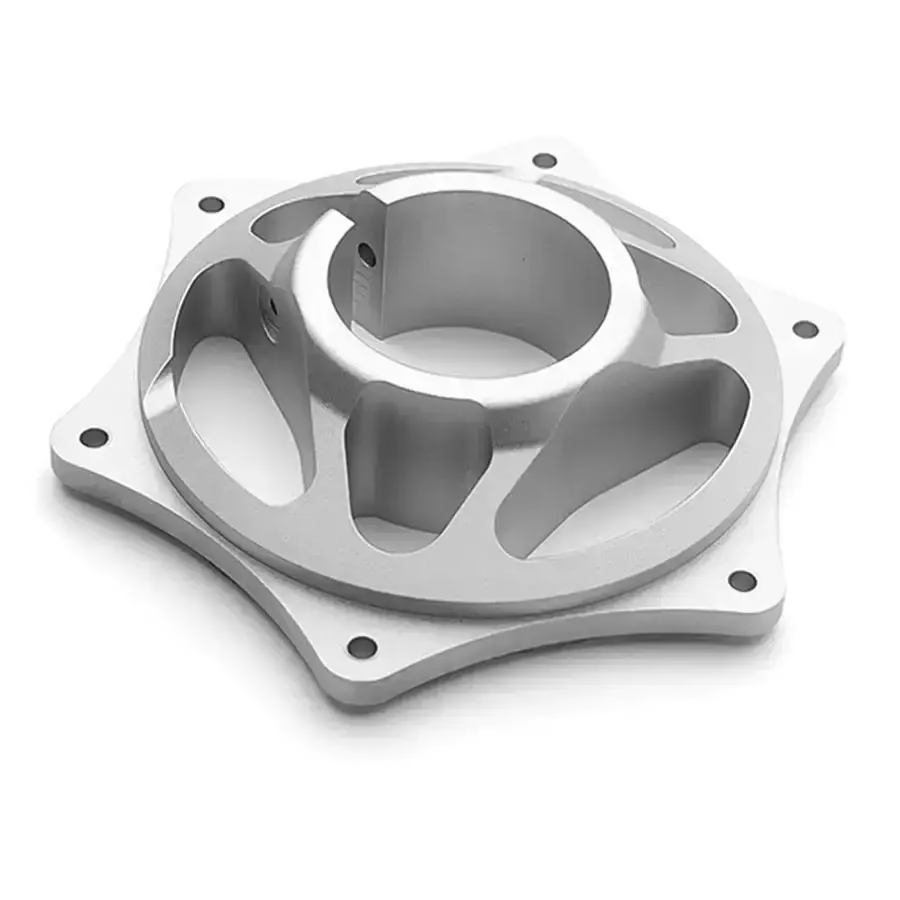
What this page answers
Which magnesium shells are already shipping on EVs, which ones are still risky, and how the machining side holds tolerance.
Why magnesium gets picked for EV shells
Magnesium sits at roughly 1.74 g/cm³, about a third lighter than aluminum and a quarter of steel. A housing that weighs 8 kg in aluminum drops to around 5 kg in magnesium, and that saving sits high on the vehicle, where it also lowers the center of gravity and helps range.
Density alone is not the argument. Damping is. Magnesium AZ91D absorbs vibration noticeably better than aluminum, so an inverter or charger housing made from it runs quieter without extra acoustic padding. Thermal conductivity is also higher than steel, which matters on parts that sit near power electronics.
The trade is stiffness and corrosion. Magnesium has a lower elastic modulus than aluminum, so a thin flat cover can flex under load. It also corrodes fast in salt spray unless the surface gets a proper conversion coating or paint system. Those two limits decide where the material fits.
- 1Best fitCover-like and mid-stiffness housings where mass and damping matter more than bending strength.
- 2Poor fitLarge flat panels or parts that see road salt without a full coating stack.
- 3WatchGalvanic contact with steel or carbon, which accelerates corrosion at the joint.
Where magnesium alloy shells are used on an EV
The clearest application trend is around the battery and drive electronics, not the body-in-white. Battery pack end plates and module housings use magnesium where the pack needs mass cut without losing stiffness at the mounting points. Inverter, OBC and DC-DC housings are a second volume application, because the parts are enclosed, coated, and not directly exposed to road spray.
Transmission and e-axle cases are the harder case. A case has to absorb torque, hold bearing bores in precise relative position, transfer heat, and damp gear noise. Magnesium handles the noise and heat side well, and the mass saving on a large casting is real. The stiffness limit is why many e-axle designs still use aluminum for the main case and magnesium for covers and smaller shells.
Development direction points to larger thin-wall castings and more integrated parts. Instead of a welded assembly of castings and stamped plates, one magnesium die casting carries the ribs, bosses and cooling channels. That cuts part count and joints, but it raises the bar on tooling and on the machining that follows.
Seat frames, steering column brackets and some interior structural shells also use magnesium, though these are often extruded or forged rather than die cast. For high-volume EV programs the die-cast shell remains the main route.
Magnesium alloy and process fit by part type
Use this as a first filter before detailed CAE work.
| Part type | Typical alloy | Process route | Key limit |
|---|---|---|---|
| Battery module housing | AZ91D | Hot-chamber die casting + CNC | Corrosion coating required |
| Inverter / OBC housing | AZ91D | Die casting + CNC, sealed faces | Flatness and seal groove finish |
| E-axle end cover | AZ91D | Die casting + CNC, bearing bores | Bore position and roundness |
| Structural bracket | AZ31B | Extrusion or forging + CNC | Lower stiffness than aluminum |
| Large thin-wall shell | AZ91D | Vacuum-assisted die casting + CNC | Wall thickness and porosity |
Casting first, machining second
Almost no magnesium shell ships as-cast. Die casting gives the near-net shape, the ribs and the thin walls, but it cannot hold a bearing bore to ±0.005 mm or a sealing face flat enough to seat a gasket. Those features are cut after casting.
Micro-arc oxidation is the common surface step before or between machining operations. It builds a ceramic-like oxide layer that resists salt spray and gives paint something to bite. The layer is thin, usually tens of microns, so it does not rescue a badly cast surface, and machined faces often need a mask or a re-cut after coating.
Machining magnesium is not the same as machining aluminum. Chips are light and can ignite if they build up, so we run sharp tooling, high feed, no fine dust accumulation, and dedicated chip handling. Coolant choice matters too: water-based coolant can stain the surface if it sits on the part, so we keep parts dry and move them quickly between operations.
On our 5-axis centers we hold ±0.005 mm on bearing bores and sealing faces, with surface finish down to Ra 0.2–0.8 μm where a seal or a sliding fit needs it. General machined faces sit at Ra 1.6–3.2 μm. We check 100% of parts before shipment, and raw material, in-process and final inspection records can be supplied.
- 1FixturesSoft jaws or cast-in datums, because thin magnesium walls distort under clamp pressure.
- 2ToolingSharp carbide, no dwell, generous chip clearance to avoid heat build-up.
- 3InspectionCMM on bore position and flatness; reports on request.
What to decide before you commit to magnesium
Start with the corrosion path. If the shell sits in a wet, salt-exposed area and you cannot guarantee a full coating stack, magnesium is the wrong choice and aluminum will cost less over the vehicle life. If the part is enclosed and coated, the mass case is strong.
Then check stiffness. Run the load case on the magnesium design, not on the aluminum drawing with a density swap. Ribs and wall thickness usually have to change, and that changes the casting and the tool.
Then talk to the machinist early. Datum strategy, coating sequence and which faces get cut after coating all affect the drawing. Getting that settled before tooling is cut avoids a rework loop later. We quote and return a DFM analysis within 12 hours, and production can start within 24 hours once the design is frozen.
Common questions
Can magnesium shells be machined to the same tolerance as aluminum?
Yes, on rigid features. We hold ±0.005 mm on bearing bores, sealing faces and mounting holes.
The limit is the part, not the material. Thin unsupported walls flex under clamping, so those areas need better fixturing or a cast-in datum.
Which magnesium alloy should we specify?
AZ91D covers most die-cast EV shells. It balances strength, castability and corrosion behavior after coating.
AZ31B is more common for extrusion and forging, where you need higher ductility and are not relying on a casting.
Does magnesium need a coating before or after machining?
Usually both steps exist. Micro-arc oxidation goes on before or between machining, and machined sealing faces may need a re-cut or masking after coating.
Decide the sequence before the drawing is released, because it changes which surfaces are cut last.
What lot sizes can you run?
There is no minimum order quantity. We run from a single prototype to 10,000+ part runs.
Prototype shells are often machined from billet to validate geometry before the die is cut.
How do you handle confidentiality on a new EV housing?
Uploads are secure and confidential, and we sign an NDA on request before drawings are shared.
We hold ISO 27001:2022 for information security.
What lead time should we plan for?
Quotation and free DFM analysis come back within 12 hours. Production can start within 24 hours after that.
Machined parts ship in 3–5 days. Casting tooling lead time depends on the part and is quoted separately.
Send us your magnesium shell drawing
We review the casting-to-machining sequence, return a DFM analysis and quote within 12 hours, and hold ±0.005 mm on the faces that seal.
12-hour quote100% inspectionNDA on request









