
Application of the Equipment Combination Machine
An equipment combination machine does turning, milling, drilling and sometimes grinding in one work envelope, so a part keeps one datum instead of three. This article explains where that pays off, how to plan the setup, and when a single-purpose machine is still the better call. Written for engineers and buyers sizing a job before quoting.
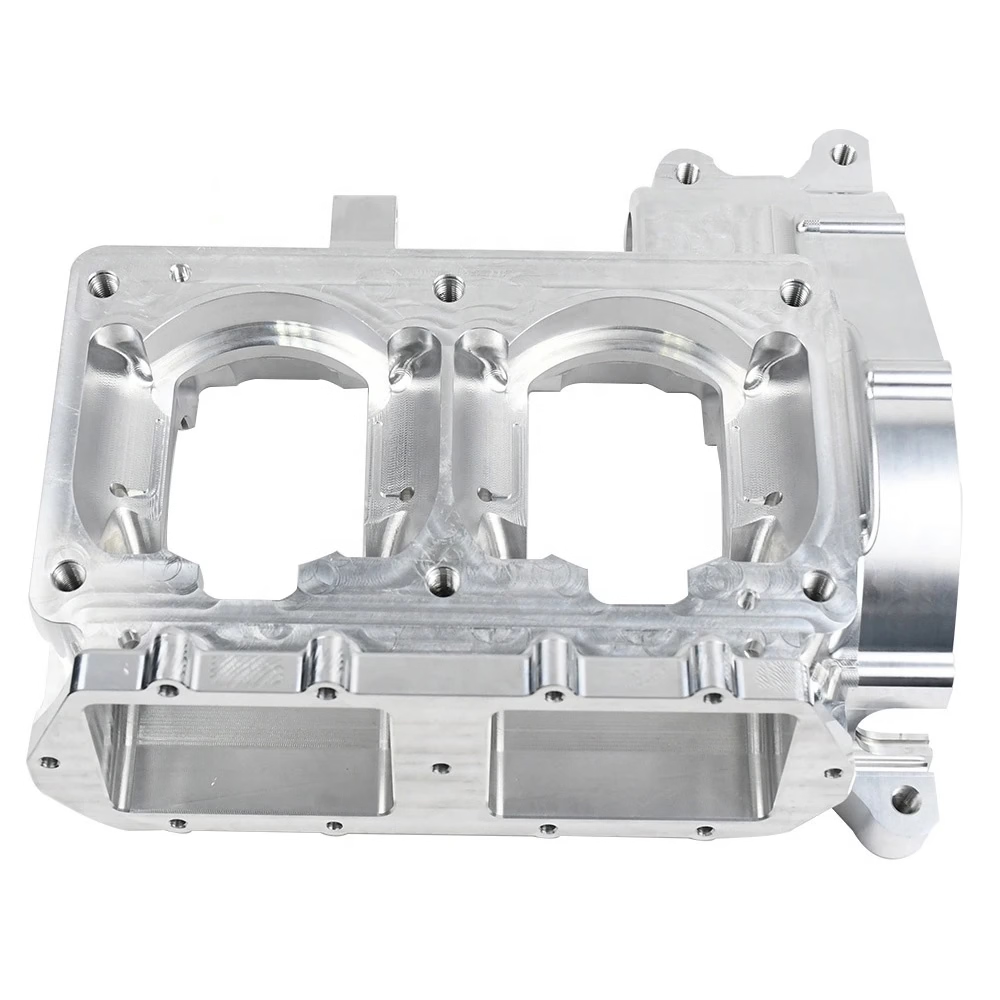
What the combination machine actually changes
Fewer fixtures, fewer datum shifts, and a shorter route from bar stock to finished part.
One machine, several processes, one setup
An equipment combination machine carries more than one process on the same frame and control. A mill-turn center is the common form: a spindle that turns the part, a turret or tool changer that mills, drills and taps, and often a sub-spindle that picks up the back side. Some machines add a grinding head or a laser for marking.
The reason to reach for this class of machine is datum count. On separate machines, each new fixture re-clocks the part, and every re-clocking adds error. Keep a part on one spindle and the runout between a turned bore and a milled pad stays inside ±0.005 mm. Move it three times and you are stacking three fixtures on top of each other.
That matters most when features have to line up. A hydraulic manifold with cross-drilled ports, a gearbox housing with bores on two faces, an electrode with a turned shank and a milled tip. These parts punish you for every extra setup.
Cycle time is the second reason, but it is smaller than people expect. Tool change and index time drop, yet the cutting itself still takes what it takes. The real saving is in queue time between operations and in the labor spent loading the same part again.
- 1Best fitParts with features on more than two faces and a tight positional callout.
- 2Weak fitSimple shafts and plates that one lathe or one mill can finish alone.
How to plan the operation sequence
Start from the tolerances that matter, not from the feature list. Mark which dimensions carry a true position or a runout callout, then decide which of them must be cut in the same setup. Everything else can be spread across operations without much risk.
The usual sequence on a mill-turn center runs: face and center in the bar, turn the main outside diameter and bore, mill the flats and slots, drill and tap the cross holes, then part off and finish the back side on the sub-spindle. A rotary table rated Ø400 mm covers most of the radial work.
Chip control decides more than people admit. Turning makes stringy chips, milling makes broken ones, and a machine that does both needs a coolant strategy that handles each. High-pressure through-tool coolant helps on deep cross holes; air blast is often enough on aluminium.
Leave a small stock allowance on any surface that gets re-chucked. Even with a sub-spindle, a 0.2 mm allowance on a critical diameter gives the finishing pass something to clean up if the transfer is off by a few microns.
Matching the machine to the part
Use this as a first filter before you commit a route to a combination machine.
| Part feature | Combination machine | Separate machines |
|---|---|---|
| Features on 3+ faces | One setup, one datum | Two or three fixtures |
| Bore-to-pad position, tight | Held in one chuck | Stacks fixture error |
| Simple turned shaft | Overkill, slow to program | Faster on a lathe |
| Long part, over 1,000 mm | Limited by travels | Split across machines |
| Small batch, under 5 parts | Setup cost dominates | Often cheaper |
| Thin-wall housing | Chuck pressure risk | Tailstock support easier |
Where the combination machine loses
Travel limits bite first. A machine built for one-setup work usually has a shorter Z than a dedicated bed mill, and the turret eats into the envelope. Parts near 4,000 mm belong on a large gantry or a boring mill, not here.
Chuck pressure is the second trap. Holding a thin-wall housing hard enough for a heavy milling cut will distort the bore. You can back off the pressure and take lighter passes, but then you have given back the cycle time you were chasing.
Programming effort is real. Posting a mill-turn job takes a postprocessor that understands both spindles and the B-axis, and a first article will take longer to prove out. If the part runs once and never again, that cost may not come back.
Tooling also adds up. Live toolholders, angle heads and a second set of drills are not free, and a machine that sits idle because one holder is missing has stopped earning.
Materials and finishing on one platform
Aluminium 6061 and 7075 run well on a combination machine. Light cuts, high spindle speed, and no need for heavy fixturing. Stainless 303 and 17-4PH are common on mill-turn work, though 316L work-hardens and wants a rigid setup and sharp edges.
Titanium TC4 and Inconel need lower surface speed and more coolant. A combination machine can cut them, but the payoff shrinks because the heavy roughing moves to a dedicated machine anyway.
Finishing usually happens off the machine. Anodizing, electroless nickel, bead blasting and laser marking all come after. One thing to watch: masking for hardcoat anodizing has to follow the same datums the part was machined to, or the coating lands in the wrong place on a sealing face.
Laser marking needs a minimum character height of 1.5 mm to stay legible after anodizing, so plan the marking field before the last operation, not after.
Common questions
How much tolerance can a combination machine hold?
On a well-maintained mill-turn or 5-axis center, ±0.005 mm is realistic for a feature cut in the same setup, with surface finish down to Ra 0.2–0.8 μm on a finishing pass.
Once a part moves to a second fixture or a second machine, the total tolerance depends on the fixture stack, not the machine. Budget the extra error there.
When is a combination machine the wrong choice?
Very simple parts, very long parts, and very small batches. A single turned shaft on a lathe beats a mill-turn center on both cost and lead time.
Parts longer than the machine travels also rule it out, since the turret and sub-spindle reduce usable Z compared with a plain bed mill.
Does one setup really remove the need for inspection?
No. It removes a source of error, not the need to verify. We still run raw material checks, in-process monitoring and a final inspection before shipment, with reports on request.
First-article inspection on a combination machine is worth doing carefully because a programming error shows up on several features at once.
What materials can you run on a mill-turn center?
Aluminium 6061, 7075 and 6082, stainless 303, 304, 316L and 17-4PH, steel 1045, 4140 and 4340, plus brass C36000 and copper C110.
Titanium TC4 and Inconel are possible, but the roughing often moves to a more rigid machine and only the finishing stays on the combination platform.
How do you handle drawings and confidentiality?
Send the 3D model and the 2D drawing with the tolerance callouts. We return a quotation and a free DFM analysis within 12 hours, and production can start within 24 hours after that.
Uploads stay secure and confidential, and we sign an NDA on request. No minimum order quantity applies, from one prototype to 10,000+ parts.
What is the typical lead time?
Parts ship in 3–5 days for most jobs once the program is proven. Historical late-delivery probability sits below 2%.
A first article on a new mill-turn program can add a day or two for prove-out, depending on how many features share the critical datums.
Send the part, get a route and a price
Upload your model and drawing. We will tell you whether the job belongs on a combination machine or somewhere simpler, and quote it either way.
12-hour quote100% inspectionNDA on request









