
Are Guitars Cut on a CNC Machine?
Short answer: yes, most solid-body guitar parts are cut on a CNC machine today. But not every part, and not every cut. This page explains which operations suit CNC, where hand work still wins, and what tolerances and materials actually matter for guitar bodies, necks, fretboards and hardware.
What CNC Actually Does on a Guitar
A guitar is a mix of parts with very different tolerance needs. CNC is not the answer to all of them.
Which Guitar Parts Belong on a CNC Machine
A solid-body electric guitar is a good CNC candidate. The body outline, the neck pocket, the pickup cavities, the control cavity and the bridge mounting holes all sit in one coordinate system. Cut them in one setup and the neck aligns with the bridge without hand fitting. That repeatability is the real reason builders moved to a guitars cut cnc machine workflow, not speed alone.
The neck is where it gets harder. A neck has a curved back profile, a tapered fretboard radius, a truss rod channel and a heel that must match the pocket. A 3-axis machine can rough the outline and cut the truss rod slot. For the back profile and the heel transition, a 4-axis or 5-axis setup saves a second fixturing step and keeps the centerline consistent.
Fretboards and inlays are a strong fit. Slot spacing, radius and taper are pure geometry. CNC holds fret slot positions to ±0.05 mm over a 650 mm scale length, which keeps intonation predictable across a production run. Inlays sit in pockets cut to the same model, so the pearl or abalone drops in without shimming.
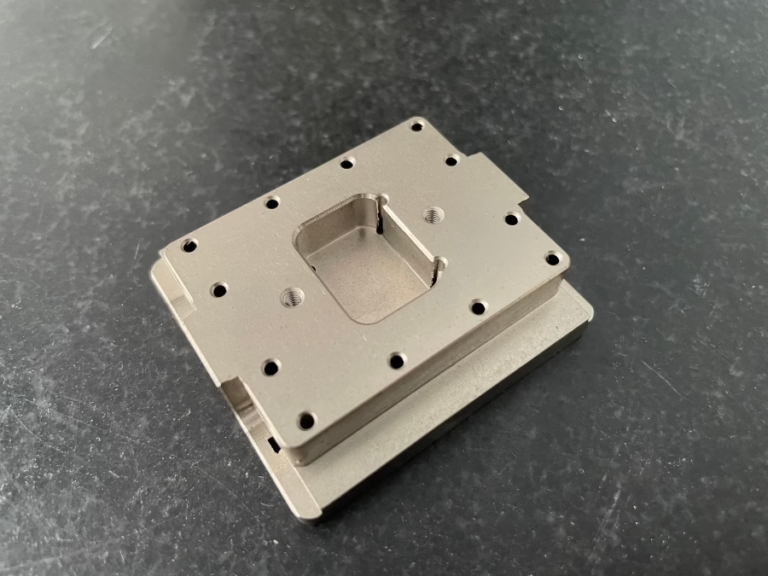
Hardware is the other half. Bridges, tailpieces, control plates, pickup rings, tuning key plates and neck plates are metal parts with real tolerances. Here a guitars cut cnc machine job is closer to normal precision machining: aluminium 6061, brass C36000, stainless 303 or 316L, cut to ±0.005 mm and finished to Ra 0.8–1.6 μm.
- 1Good CNC partsBodies, neck pockets, fretboards, inlay pockets, bridges, plates
- 2Mixed partsNeck back profile, heel fit, top carve — CNC plus hand blending
- 3Poor CNC partsFinal fret dressing, nut slot depth, finish sanding, setup
3-Axis, 4-Axis or 5-Axis: Picking the Right Setup
A 3-axis machine cuts on three linear axes. The tool always approaches from the top. That is enough for a flat-top body, a control cavity, a pickup route, a fretboard slot and any plate or bracket. It is the cheapest way to cut a guitar part, and for a flat slab it is also the fastest.
Add a rotary table and you get a 4-axis machine. The workpiece turns while the tool cuts, so you can machine around a neck blank or a cylindrical part in one setup. This is a common choice for neck profiles and for hardware with features on several sides. Our rotary tables are Ø400 mm, which covers a full neck blank with room for the fixture.
A 5-axis machine adds tilt as well as rotation. Two extra axes let a stub tool reach under a carved top, cut a heel that flows into the body without a hard line, and drill angled tuner holes in one pass. The gain is not just shape. Fewer setups means fewer datum shifts, so the neck pocket, the bridge holes and the pickup cavities stay aligned to each other.
Not every shop needs 5-axis for guitars. If your part is flat and your volume is low, 3-axis with a good fixture gives the same result for less money. The 5-axis argument starts when the geometry is genuinely three-dimensional, or when you need to repeat a complex part hundreds of times and cannot afford re-fixturing errors.
- 13-axisFlat bodies, cavities, fret slots, plates, brackets
- 24-axisNeck profiles, cylindrical hardware, multi-side parts
- 35-axisCarved tops, blended heels, angled holes, complex hardware
Guitar Part to Machine and Tolerance
Typical values from parts we quote. Wood moves with humidity, so wood tolerances are looser than metal ones.
| Part | Suggested setup | Typical tolerance | Common material |
|---|---|---|---|
| Solid body, flat top | 3-axis, 2 setups | ±0.1 mm on cavities | Alder, ash, basswood |
| Carved top body | 5-axis, 1–2 setups | ±0.1 mm on the carve | Maple cap on mahogany |
| Neck blank | 4-axis or 5-axis | ±0.05 mm on centerline | Maple, mahogany |
| Fretboard | 3-axis | ±0.05 mm slot pitch | Rosewood, ebony, maple |
| Inlay pocket | 3-axis | ±0.02 mm on pocket | Same as fretboard |
| Bridge and tailpiece | 3-axis or 4-axis | ±0.005 mm | Aluminium 6061, brass |
| Control and neck plates | 3-axis | ±0.01 mm | Stainless 303, aluminium |
| Tuner and pickup rings | 3-axis, small tools | ±0.02 mm | Aluminium, ABS, POM |
Wood, Metal and Plastic: What Cuts Well and What Fights Back
Wood is not a metal and should not be quoted like one. Grain direction, moisture content and internal stress all change the cut. A sharp cutter and a climb cut on the finishing pass reduce tear-out on mahogany and ash. If the blank is not dried to a stable moisture level, a body that measures perfect on the machine can move 0.3 mm a week later.
Hardwoods cut cleanly with carbide tooling at high spindle speed and moderate feed. Maple, mahogany and ash behave well. Rosewood and ebony are denser and abrasive, so tool wear is faster and we change cutters sooner. Basswood and alder are soft and can fuzz if the feed is too low.
Metals used in guitar hardware are ordinary machining work: aluminium 6061 and 7075, brass C36000, stainless 303 and 316L, titanium TC4 for high-end bridges. These hold ±0.005 mm without trouble and take anodizing, plating, bead blasting or polishing. Brass bridge saddles are often left raw or nickel plated.
Plastics cover pickup rings, cavity covers, nuts and binding. ABS, POM and PC machine well with sharp tooling and air blast. PEEK is tougher on tools but holds tight tolerances. Carbon fiber can be cut, but the dust needs extraction and tool life is short.
Where CNC Stops and Hand Work Starts
CNC removes material accurately. It does not decide how a guitar feels or sounds. The last few percent of a build is still manual, and pretending otherwise leads to bad parts.
Fret leveling and crowning is hand work. The slots can be cut to ±0.05 mm, but the frets still need to be seated, leveled and dressed against the actual neck under string tension. No machine in our shop does that.
Nut slot depth, final neck relief, saddle height and intonation are setup steps. They depend on string gauge, action preference and playing style. A CNC-cut neck pocket gets you a repeatable starting point, not a finished instrument.
Finish work is also manual. Sanding between coats, buffing and blending a carved top are done by hand. If you are building a small batch of custom instruments, plan for that time in your schedule. If you are making parts for others to assemble, stop at the machined and finished part.
Common Questions
Can a CNC machine cut a whole guitar in one setup?
No. A flat-top body usually needs two setups, one for the top and one for the back. A carved-top body with a neck needs more. Each additional setup adds a datum shift, so we keep the count low and use locating pins where possible.
What tolerance can you hold on wood parts?
On metal hardware we work to ±0.005 mm. On wood we usually quote ±0.1 mm on cavities and outlines, and ±0.05 mm on fret slot pitch, because wood moves with humidity. Tightening beyond that is not stable over time.
Do you cut one-off prototypes or only production runs?
Both. There is no minimum order quantity. We cut one prototype or a run of 10,000+ parts on the same machines, and we send a free DFM analysis with the quote within 12 hours.
Which guitar hardware materials do you machine?
Aluminium 6061, 6061-T6, 7075 and 2024, brass C36000 and C27400, stainless 303, 316L and 17-4PH, titanium TC4, plus ABS, POM, PC and PEEK for plastic parts.
Can you keep my guitar design confidential?
Yes. Uploads are handled as confidential, and we sign an NDA on request. We hold ISO 27001:2022 for information security, and design files are not shared outside the project team.
How fast can you ship machined guitar parts?
Quotation and DFM feedback come back within 12 hours. Production can start within 24 hours, and parts typically ship in 3–5 days. We inspect 100% of parts before shipment and send reports on request.
Send Us Your Guitar Part Files
Upload a STEP or STL file and we will return a quote, a DFM note and a tolerance review within 12 hours. One prototype or a full run, no minimum order quantity.
12-hour quote±0.005 mm on metal100% inspectionNDA on request









