
Automated enhanced CNC output: where the extra capacity comes from
This page explains what automation actually changes inside a CNC workflow: setup, tool changes, part transfer, probing and lights-out running. It is written for engineers and buyers who need to judge whether an automated setup fits their part. You will see which geometries and batch sizes benefit, which ones do not, and what to ask a supplier before committing.
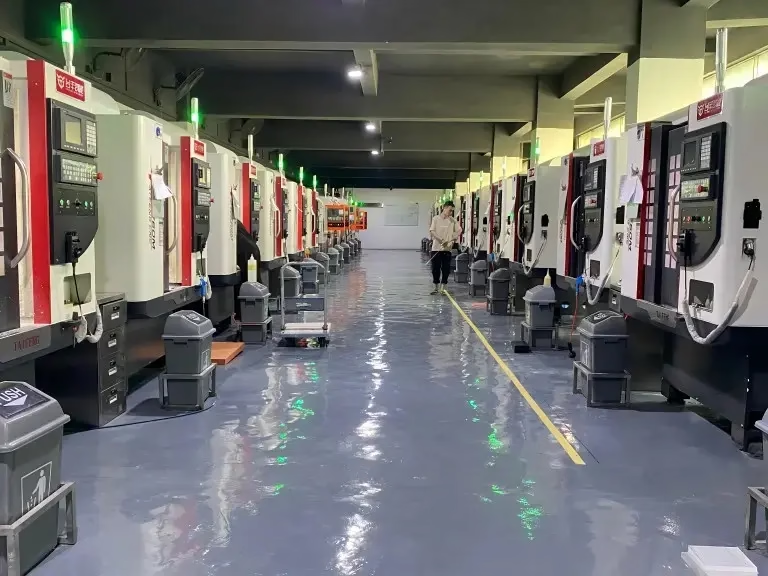
What automation does to a CNC process
Automation is not a single machine feature. It is a set of changes to how a part moves through setup, cutting and inspection.
Where machining time is actually lost
On a manual five-axis job, the spindle is not the bottleneck. Load and unload, vise or fixture changes, tool changes, offset entry, first-article checks and operator breaks all sit between cuts. On a part with a 20-minute cycle and a 15-minute manual setup, more than 40% of the day goes to non-cutting work. That is the number automation targets.
Cutting parameters rarely move much. A 12 mm carbide end mill in 6061-T6 still runs at the speeds and feeds the tool and the machine allow. What changes is how many of those cutting hours are available in a 24-hour window.
So when we talk about automated enhanced CNC output, we mean the same spindle doing more cutting hours per week, not a faster spindle. The gain comes from fewer gaps between cycles, not from deeper cuts.
- 1SetupFixture change, zero setting, drawing check
- 2Tool changeA 24-tool ATC removes 10–40 seconds per swap
- 3In-process checksTouch probing replaces caliper stops
- 4Operator fatigueNight shift output drops on manual cells
Automation hardware that changes throughput
The first layer is inside the machine. A 24-station automatic tool changer plus through-spindle coolant keeps the cut going while chips clear. On deep pockets in 7075 or 17-4PH, chip evacuation is often what forces a slower feed; through-spindle coolant removes that reason to slow down.
The second layer moves parts. A pallet pool or robot loader lets one operator tend several machines. GreatLight runs 16 simultaneous 5-axis machining centers, 12 four-axis mills and 16 mill-turn centers across three wholly-owned plants, so pallet systems are shared across similar work rather than tied to one product.
The third layer measures. A spindle touch probe checks datum and stock condition before the first cut, and a tool-setter checks length and diameter after each change. If a bore drifts past tolerance, the control re-cuts or flags the part instead of finishing the batch wrong.
None of these layers is exotic. They are common options. The reason they matter is that together they turn a machine from something an operator babysits into something that runs a queue.
- 1Tool changer24-station ATC with tool breakage detection
- 2Pallet poolTwo to eight pallets, loaded while cutting
- 3Touch probeDatum, stock and in-process checks
- 4Chip managementThrough-spindle coolant and conveyor
When automation pays off and when it does not
Use this as a first filter before quoting an automated cell.
| Part situation | Automated cell | Manual or light automation |
|---|---|---|
| Batch size | 10 to 10,000+ parts, repeating | One-off or two-off geometry |
| Geometry | Stable, one or two setups | Freeform, hand-fitted surfaces |
| Fixtures | Repeatable soft jaws or custom | Loose stock, odd clamping |
| Tolerance | ±0.005 mm on critical bores | Open tolerance, ±0.05 mm or looser |
| Material | Aluminium, steel, stainless, titanium | Soft plastics, thin walls, fragile parts |
| Changeover | Same family, weeks of work | New design every few days |
Automation on five-axis: what to watch
Five-axis machines already cut four sides in one setup, which removes several fixtures by itself. Automation adds a second shift of value: the machine can keep cutting while the operator loads the next pallet, and the rotary axes hold position without re-clamping. GreatLight runs a Ø400 mm rotary table on the smaller five-axis platforms and travels up to 4,000 × 400 × 150 mm on the large ones.
The caution is thermal and geometric drift. A five-axis machine that runs unattended for eight hours sees spindle growth and ballscrew warming. Probing between parts catches the drift. Without it, the last 20 parts of a night run may sit at one edge of the tolerance band.
Another caution is chip and coolant build-up in trunnion pockets. A part that machines cleanly in a 30-minute attended cycle can trap chips in a long unattended run, and a trapped chip becomes a scrapped part. Programming a mid-cycle wash or an air blast is part of the job, not an extra.
Finally, unattended running only works when the tool life is known. We log tool usage and replace on count rather than on sound. A broken 3 mm end mill at hour six will ruin every part after it unless detection stops the cycle.
Lights-out running and what it can realistically produce
Lights-out does not mean nobody is in the building. It means the machining cell can complete a scheduled queue without an operator standing at the door. A typical cell runs 4 to 12 hours unattended, then an operator reloads pallets and restarts.
The realistic gain is not a fixed percentage. It depends on cycle time against load time. A 40-minute cycle with a 2-minute pallet swap can run near-continuously. A 4-minute cycle with a 3-minute load gains far less, and a robot loader may not be worth the programming cost.
For small parts, mill-turn centers change the math. Turning and milling in one program removes a second op and a second setup, so the part leaves the machine finished. That is often a bigger output gain than any loader.
Where the part count is high and the geometry is stable, the combination of pallet pool, probing and tool monitoring gets a five-axis cell close to continuous cutting. Where the geometry changes every week, the fixture and programming time eats the gain, and a well-organized manual cell is the honest answer.
- 1Good fitStable geometry, repeat orders, tight bores
- 2Poor fitNew design each week, hand blending
- 3WatchTool life, thermal drift, chip build-up
- 4MeasureCutting hours per week, not spindle speed
How to verify output without visiting the floor
Ask for the cutting-hour number, not the machine count. A shop with 127 high-precision CNC machines can still run most of them at 40% spindle time. The useful figure is scheduled cutting hours against calendar hours for the specific cell your part will run on.
Ask how first-article and in-process checks are handled. At GreatLight, parts get raw material check, in-process monitoring and a 100% inspection before shipment, with reports on request. In an automated cell, the probe data is the first line and the CMM is the confirmation.
Ask what happens when a tool breaks at 2 a.m. A cell that stops and waits is fine. A cell that keeps cutting is not. Tool breakage detection and a stop-on-fault policy are the difference between a saved batch and a scrapped one.
Ask about material and finish coverage. Automation is easier on 6061 and 304 than on Inconel or magnesium AZ31B, where chip handling and fire risk change the rules. A supplier who has run your alloy before will give a more honest answer.
- 1Cutting hoursSpindle time per week on your cell
- 2InspectionProbe data plus CMM confirmation
- 3Fault policyStop on tool break, do not continue
- 4Alloy historyTitanium and magnesium need different rules
Questions engineers ask about automated CNC output
Does automation change the tolerance a shop can hold?
No. The machine and the process set the tolerance. Automation holds that tolerance more consistently across a long run because probing catches drift and the operator is not resetting offsets by hand every hour.
At GreatLight the working figure stays ±0.005 mm (±0.0002 in) on critical features. What changes is how many parts in a 10,000-piece run land near the center of the band instead of the edge.
What batch size makes an automated cell worth setting up?
There is no fixed number. The test is whether fixture and programming time is small against total cutting time. If a part runs 40 minutes and you need 200 of them, the setup pays back quickly.
If you need three parts and the design is still moving, a manual setup is usually faster to first article. We will say so rather than sell a cell you do not need.
Can lights-out running handle titanium or magnesium?
Titanium is workable with the right coolant strategy and tool-life logging, because the main risk is heat and tool wear. Magnesium is different: fine chips are a fire risk, so unattended running needs chip clearing and monitoring that many cells do not have by default.
We machine TA1, TA2, TC4 (Ti-6Al-4V), Inconel and magnesium AZ31B / AZ91D, and we will tell you when a part should stay attended.
How does a pallet pool affect lead time?
It removes the wait for a machine to be free and the wait for an operator to load it. Our standard flow is quotation and free DFM analysis within 12 hours, production can start within 24 hours, and parts ship in 3–5 days.
The pallet pool mainly protects the middle of a repeat order, where a stalled setup would otherwise push the whole schedule.
What do you need to quote an automated run?
A 3D model and a 2D drawing with tolerances, the material and finish, and the annual or batch quantity. Tell us which features are critical. If you can share the fixture concept or the previous process, even better.
Uploads are secure and confidential, and an NDA is available on request. We will come back with a DFM note that flags the features that drive cost.
Does automation reduce the number of people involved?
It changes what they do. One operator can tend several machines when loading is on pallets and offsets are set by probe. The skilled work shifts to programming, fixture design and first-article checks.
We run three plants with 150 technicians. The automation is there to keep those people on setup and problem solving, not to stand at a door waiting for a cycle to end.
Send the drawing and we will tell you if an automated cell fits
Upload a model and drawing for a free DFM analysis within 12 hours, with a straight answer on whether your part suits a pallet-fed five-axis cell or a manual setup.
12-hour quote100% inspectionNo minimum orderNDA on request









