
Axis CNC Machining Supplier: What Separates a Good One
This page is for engineers and sourcing staff who need a machining partner for parts that will not sit still in a vise. We cover how many axes a job actually needs, how to read a supplier's machine list, and which questions expose a shop that cannot hold your tolerance.
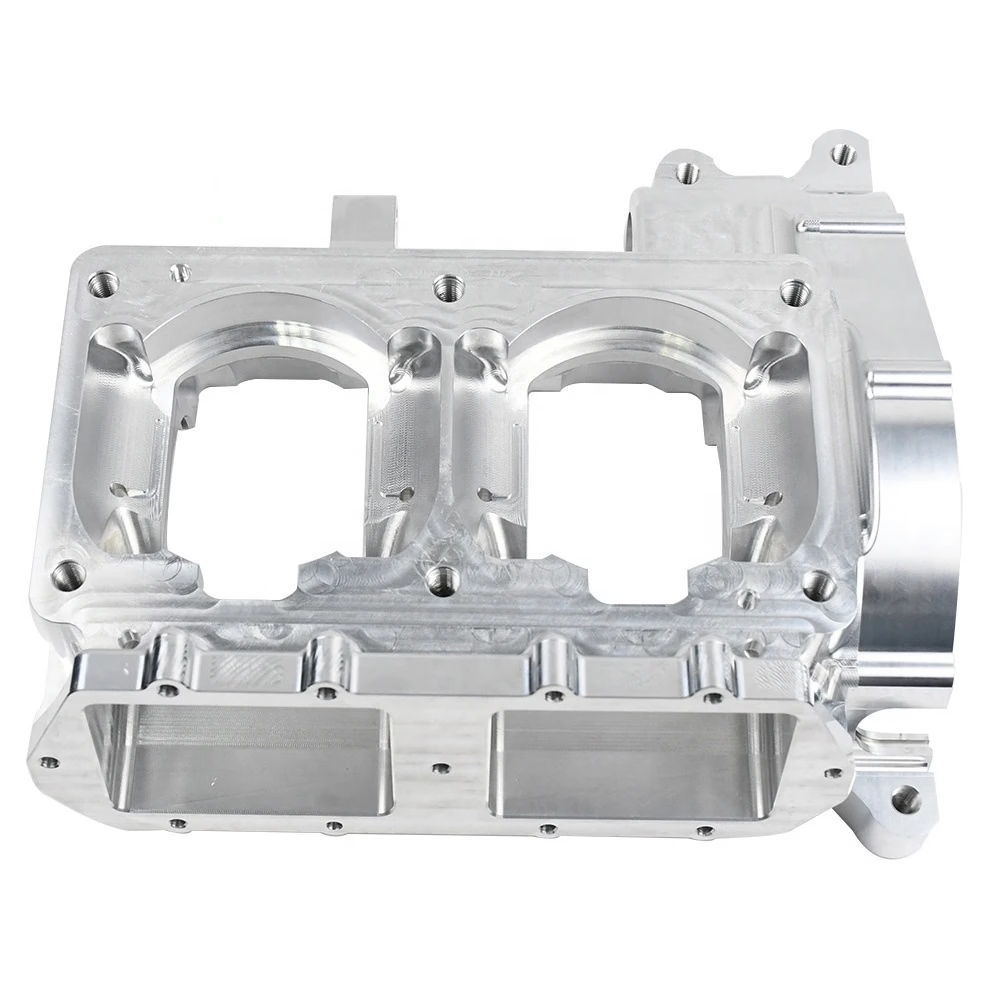
What this page covers
Pick the right axis count first, then judge the shop that runs it.
Three, four, or five axes: pick by geometry, not by habit
A 3-axis mill moves the tool in X, Y and Z. The part stays put, so every new face needs a new setup or a fixture that indexes it. That is fine for prismatic parts: plates, housings, brackets, manifolds with features on two or three sides. Cycle time is short and programming is simple.
A 4-axis machine adds rotation around one axis, usually A. Now you can cut a part's four sides in one setup, which kills the stacked error that comes from re-clamping. Shafts with cross-holes, cylinders with milled flats, and parts where hole-to-hole position across faces matters all benefit here.
Five-axis work adds two rotary axes, typically A and B or A and C, so the tool can tilt relative to the surface. Deep pockets, undercuts, compound angles and contoured blades become reachable without a custom fixture. Short tools can be used on tall walls, which reduces chatter and holds a better finish.
The axis count should follow the part, not the shop's marketing. A simple plate on a 5-axis machine wastes money and often runs slower than on a 3-axis. A twisted impeller on a 3-axis machine needs five fixtures and still loses position. Match the machine to the geometry and the quantity.
Reading a supplier's machine list without getting fooled
Simultaneous five-axis and 3+2 positioning are not the same thing. A 3+2 machine indexes the table to an angle, locks it, then cuts. That is useful, but it cannot sweep a contoured surface in one continuous path. Ask the supplier to name the control and the machine model, and ask whether the rotary axes move while cutting.
Travel size matters more than the number of machines. A shop with 16 five-axis centers is useless for your job if none of them can take a 900 mm part. Ask for the working envelope of the specific machine that will run your order, not the largest number in the catalog.
Spindle taper and torque decide what you can cut. Aluminum at high rpm is easy. Titanium and Inconel need low rpm and high torque, plus enough coolant pressure to clear chips from a deep pocket. A machine that is fast in aluminum may stall in 17-4PH.
Tooling and workholding are the quiet bottleneck. Five-axis vises, zero-point systems, and custom soft jaws cost real money and take time to build. A supplier that already stocks modular fixturing will quote faster and hold position better on the second and third setup.
Machine configuration vs. typical part
Use this as a starting point, then confirm with the shop that will run the job.
| Configuration | Typical part | When it is the wrong choice |
|---|---|---|
| 3-axis | Plates, brackets, housings | Features on four or more sides |
| 4-axis | Shafts, cross-drilled cylinders | Free-form contoured surfaces |
| 3+2 indexed | Angled holes, multi-face pockets | Continuous swept surfaces |
| Simultaneous 5-axis | Impellers, blades, medical implants | Simple prismatic parts in volume |
| Mill-turn | Turned parts with milled features | Parts under 50 mm with tight roundness |
Where the tolerance actually comes from
Fewer setups is the main reason five-axis holds tight position. Every re-clamp adds a datum shift. On a part with holes on five faces, three setups can stack 0.02 mm of error before the tool even touches the material. One setup removes that stack.
Thermal drift is the next limit. A machine that runs all day grows a few microns as the spindle and ballscrews warm up. Shops that hold ±0.005 mm control the room temperature and let the machine warm up before the first cut. Ask how they handle it.
Probing matters for the same reason. In-process probing finds the actual stock position and shifts the work offset, which helps on castings and forgings where the surface moves from part to part. Without probing, the first cut depends on how well the blank was located.
Finish is a cutting strategy, not just a machine spec. Ra 0.8–1.6 μm is a normal machined finish with a good strategy. Getting to Ra 0.2–0.8 μm usually means a separate finishing pass, a smaller stepover, or a different tool. Say which surfaces need it instead of calling out the whole part.
What the material does to your axis choice
Aluminum 6061 and 7075 cut fast and forgive a lot. Five-axis work on aluminum is mostly about reach and setup reduction, not about fighting the metal. Thin walls still deflect, so light finishing passes matter more than raw spindle speed.
Stainless 304 and 316 work-harden if the tool rubs. A five-axis machine helps because you can keep the cutter engaged at the right angle instead of dwelling in a corner. 17-4PH in the H900 condition is harder again and needs carbide and a rigid setup.
Titanium Ti-6Al-4V and Inconel 718 move the problem to heat and tool life. Both need low surface speed, high pressure coolant, and a toolpath that does not re-cut chips. Five-axis access lets you use a shorter, stiffer tool, which is often the difference between a stable cut and chatter.
Plastics like POM, PEEK and ABS cut easily but hold tolerance poorly because they move with temperature. Machine them in a temperature-controlled room and let them relax before the final pass. Carbon fibre needs diamond or coated tooling and dust extraction, not just an axis count.
Questions that separate a real supplier from a broker
Ask who owns the machines. A supplier with its own floor can tell you the spindle hours, the maintenance schedule, and the exact machine your part will run on. A broker cannot. If the quote has no machine name, treat it as a warning sign.
Ask for the inspection plan, not just the certificate. ISO 9001:2015 tells you the process is documented. It does not tell you how your part will be measured. CMM reports, first-article inspection, and a stated sampling plan answer the question that matters.
Ask about the first article and how changes are handled. A small revision mid-run should trigger a new first article on the changed features, not a verbal OK. Shops with automotive and medical work already do this because IATF 16949:2016 and ISO 13485:2016 require it.
Confidentiality is part of qualification for many programs. Uploads should be treated as confidential by default, and an NDA should be available on request rather than something you have to negotiate from scratch. If the supplier hesitates on that, the rest of the relationship will be harder.
Common questions from engineers
How do I know whether my part needs five axes or just four?
Count the faces that need machining and look for free-form surfaces. If the features sit on four sides and all surfaces are flat or cylindrical, a 4-axis machine handles it in one setup.
Five axes earn their cost when you have contoured surfaces, deep pockets with undercuts, or compound angles that would need a custom fixture. If none of those apply, a 5-axis quote will usually be slower and more expensive.
Does a higher axis count always mean better accuracy?
No. Accuracy comes from setup count, thermal control, and probing, not from the number of rotary axes. A well-run 4-axis shop can beat a poorly maintained 5-axis shop on the same part.
That said, five-axis does remove setups, and fewer setups means less stacked error. The gain shows up on parts with features on many faces, not on simple plates.
What tolerance should I expect on a five-axis part?
±0.005 mm is achievable on the right machine with the right fixturing and a temperature-controlled room. It is not automatic, and it is not realistic on every feature of a large part.
Call out tight tolerance only where the function needs it. Over-tolerancing the whole drawing raises cost and slows inspection without improving the assembly.
Which materials are hard to machine on five axes?
Titanium Ti-6Al-4V, Inconel, and hardened tool steel are the difficult ones. The limit is heat and tool life, not reach. These need low surface speed, high-pressure coolant, and a toolpath that clears chips.
Magnesium AZ31B and AZ91D cut well but add a fire risk, so chip handling and coolant choice matter. Aluminum and brass are the easy end of the range.
Can I get a prototype and a production run from the same supplier?
Yes, and it is usually the better path. The setup, fixture, and inspection plan built for the prototype carry into the production run. Starting over with a new shop means paying for that work twice.
There is no minimum order quantity here, so a single prototype and a 10,000-part run go through the same process. Volume changes the fixture and the cycle time, not the basic method.
What happens to my CAD files when I request a quote?
Uploads are treated as confidential, and an NDA is available on request if your program requires one. Files are used to quote and to build the DFM feedback.
The DFM note comes back with the quote. It flags features that will be hard to hold, thin walls, and tight tolerances that add cost without adding function.
Send your part and get a manufacturability read
Upload a STEP file and we will come back with a quote, a DFM analysis, and a note on which machine we would run it on.
Quote + DFM in 12 hours±0.005 mmNo minimum orderNDA on request









