
Basic Knowledge of CNC Steel Processing
A working guide for design and process engineers who need to specify steel parts. It covers the grades we machine most, what each one does to the cutting process, how to set tolerance and finish, and when steel is the wrong choice. Read it and you can write a drawing that a shop can quote without three rounds of questions.
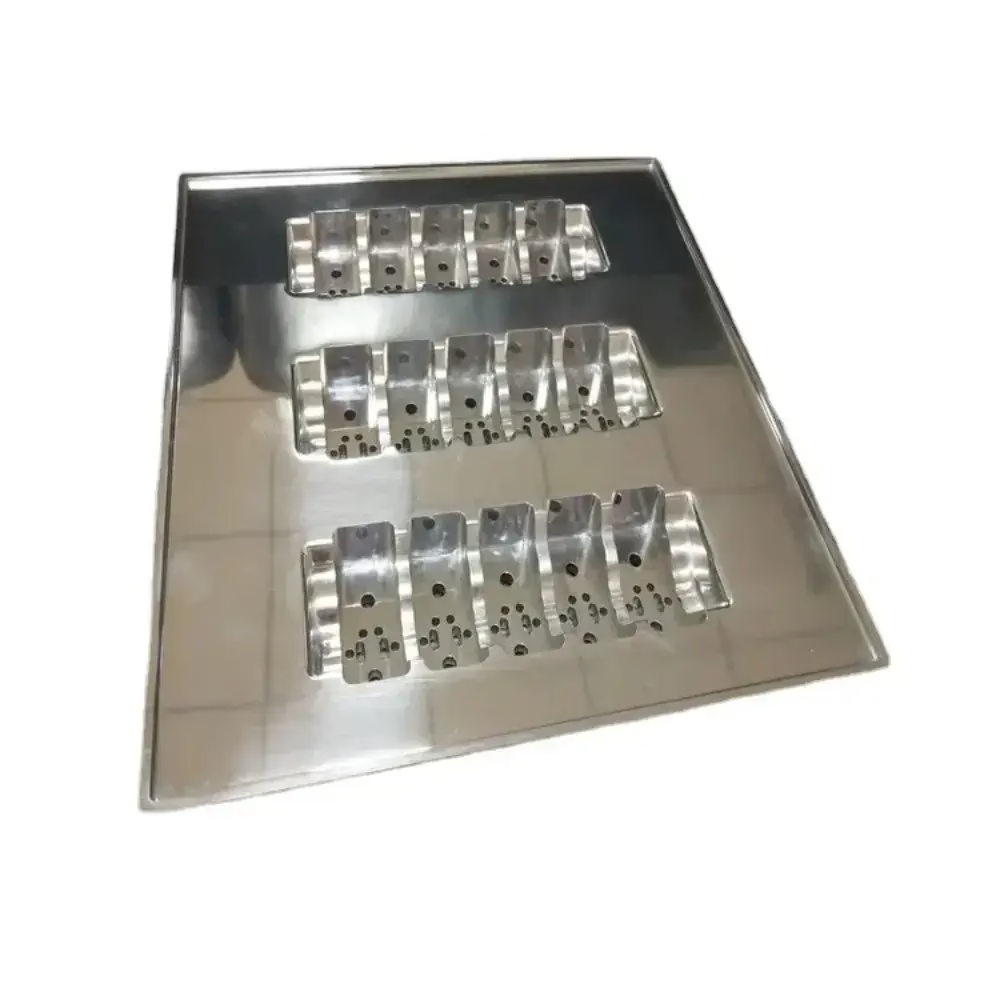
What changes when the material is steel
Steel is not aluminium with a different label. It cuts differently, moves differently, and needs different tooling.
Why steel behaves differently at the spindle
Hardness is the first variable to pin down. Low-carbon grades around 150–180 HB cut cleanly with sharp carbide and plenty of coolant. Pre-hardened 4140 at 28–32 HRC is a different job. The same cutter, the same feed, and the same speed will burn an edge in minutes.
Heat leaves the cut more slowly than it does in aluminium. Most of it goes into the tool and the chip, not the workpiece. That is why steel parts are usually run at lower surface speed, with rigid setups and flood coolant rather than air blast. Light passes chatter. Heavy passes load the spindle. The window in between is narrower than most people expect.
Chip control matters as much as speed. Mild steel produces long stringy chips that wrap around the tool and scratch a finished face. A 1045 or 4140 cut with a proper insert geometry breaks the chip into short curls that clear the flutes. Get this wrong and you spend more time stopping the machine than running it.
- 1Low-carbon steelFree-cutting, low tool wear, good for brackets, plates, fixtures.
- 2Medium-carbon steelNeeds correct feeds and inserts; responds well to heat treatment.
- 3Alloy steelHigher strength, tighter process control, slower cutting speeds.
- 4Tool steelUsually machined annealed, then hardened and ground afterward.
Choosing a steel grade for a machined part
Start from the function, not from a familiar grade. A part that only holds position can run in 1018 or A36. A shaft that carries torque and sees fatigue cycles usually wants 4140 or 4340. Anything that must resist wear at a contact face belongs in tool steel or a hardened stainless such as 440C.
Machinability is the trade-off. 1018 cuts fast and cheap. 4140 at the same hardness cuts about 30–40 percent slower and eats inserts faster. 316 stainless is worse again: it work-hardens under a dull tool, so a light pass with a worn edge hardens the surface and the next pass fights it. 303 stainless is the free-machining option when corrosion resistance matters more than weldability.
We machine 1018, 1045, 4130, 4140, 4340, A36 and tool steel, plus 303, 304, 316, 316L, 420, 430, 431, 440C and 17-4PH stainless. If the drawing does not state a hardness range, we will ask. A 4140 part specified at 28–32 HRC and the same part specified as annealed are two different quotes.
Common steel grades at a glance
Typical shop-floor behaviour, not a specification sheet.
| Grade | Typical use | Machining note |
|---|---|---|
| 1018 | Brackets, plates, shafts | Fast to cut, low tool wear |
| 1045 | Gears, axles, studs | Cuts well; hardens if heat treated |
| 4130 | Tubes, frames, structural | Good strength-to-weight, moderate speeds |
| 4140 | Shafts, housings, tooling | Pre-hardened stock cuts slower |
| 4340 | High-load shafts, gears | Tough; light passes chatter, plan for rigidity |
| A36 | Weldments, base plates | Soft and gummy; chip control is the issue |
| 303 stainless | Fittings, bushings | Free-machining, best stainless for turning |
| 316L stainless | Medical, marine, food | Work-hardens; sharp tools and constant feed |
| 17-4PH | Aerospace, high-strength parts | Machined in condition A, then aged |
| Tool steel | Dies, punches, wear plates | Machine annealed, grind after hardening |
From saw cut to inspected part
Steel parts rarely start as a near-net blank. We saw bar or plate to size, face it, and rough the main geometry with a stock allowance. Roughing removes most of the volume and lets the part move before anyone cares about dimensions. On a thin plate or a long shaft, stress relief between roughing and finishing is often the difference between a flat part and a banana.
Finishing follows the datum strategy set at the start. Holes are drilled, then bored or reamed if the tolerance is tight. Threads are milled or tapped depending on depth and position. Slots, pockets and radii are cut in an order that keeps the part rigid for as long as possible. On parts with features on several faces, we either run multiple setups on a three-axis machine or cut them in one cycle on a four- or five-axis center.
Inspection is not a final step bolted onto the end. We check incoming material, monitor dimensions during the run, and inspect before shipment. Reports are available on request. Final tolerance on steel parts is normally ±0.005 mm where the geometry allows it, and surface finish runs from Ra 0.2–0.8 μm on a fine-ground or polished face to Ra 1.6–3.2 μm as machined.
Where five-axis actually helps on steel
Steel magnifies every setup error. Each time you unclamp a part and turn it, you introduce a new datum and a new chance to miss alignment. Multi-face parts in steel are where that cost adds up. Cutting five faces in one setup removes most of it, because the relationship between features is set by the machine, not by a fixture.
The gain is largest on parts with angled faces, contoured pockets, or holes that do not sit perpendicular to any natural face. It is smaller on a simple prismatic block that two setups handle fine. Five-axis is not automatically better. It is better when the alternative is four fixtures and a stack of tolerances.
We run 16 simultaneous five-axis machining centers, 12 four-axis mills, 27 three-axis machines and 16 mill-turn centers, with a maximum processing size of 4,000 mm. For long shafts and structural steel parts, the large travel is 4,000 × 400 × 150 mm. A Ø400 mm rotary table handles round work that needs indexing. The right machine is chosen by geometry and volume, not by what happens to be free.
Heat treatment and surface finishing
If a steel part needs to be hard, that decision belongs early in the process. Harden after machining and the part will move. Harden before machining and you are cutting 50 HRC stock with ceramic or CBN, which is possible but slow and expensive. The usual route is to machine in the annealed or pre-hardened state, leave grinding stock on critical faces, then harden and finish by grinding.
Corrosion protection is the other reason to finish a steel part. Black oxide gives a thin, dimensionaly stable coating that suits tooling and fixtures. Electroless nickel adds uniform coverage including inside bores, which matters when a plated bore must still fit a shaft. Zinc plating is common on structural and automotive brackets. For stainless parts, bead blasting or brushing is often enough.
Cosmetic finishing is a separate question. Polishing to a mirror face on steel takes time and is rarely needed unless the part is a mold surface or a visible component. Laser marking works down to a minimum character height of 1.5 mm, which is fine for part numbers and traceability codes but not for dense data matrices on small faces.
Common questions
What tolerance can you hold on CNC machined steel?
We normally hold ±0.005 mm (±0.0002 in) on steel features where the geometry and setup allow it. Tight tolerances depend on part stiffness, wall thickness and how many faces need to be reached.
A thin plate or a long unsupported shaft will not hold the same tolerance as a compact block. Send the drawing and we will tell you which dimensions are realistic before quoting.
Does steel need heat treatment before or after machining?
Most parts are machined in the annealed or pre-hardened condition, then hardened afterward if the application needs it. Hardening after machining causes distortion, so critical faces usually keep grinding stock.
If the part must be machined in a hardened state, say so on the drawing. It changes the tooling, the cutting speed and the price.
Which steel grade is easiest to machine?
1018 and 303 stainless are the friendliest. Both cut quickly, produce manageable chips and put little load on the tool.
4140, 4340 and 316L are slower and harder on inserts, but they are still routine work. The grade should follow the function, not the machining cost alone.
Can you machine steel parts without a minimum order quantity?
Yes. There is no minimum order quantity. We run from a single prototype to runs of 10,000 parts or more.
Prototype work is often machined from plate or bar so the geometry can be tested before anyone commits to tooling.
What surface finishes are available on machined steel?
As-machined steel typically lands between Ra 1.6 and 3.2 μm. Finer work reaches Ra 0.8–1.6 μm, and polished or ground faces can reach Ra 0.2–0.8 μm.
Coatings include black oxide, electroless nickel, zinc plating, powder coating and bead blasting. Laser marking is available for part numbers.
How do you keep a steel part flat during machining?
Rough first, leave stock, and let the part relax. On thin or asymmetric parts we often stress relieve between roughing and finishing.
Clamping pressure also matters. Over-tightening a thin plate bows it while it is cut and springs back when released.
Send a steel drawing, get a machinability read
Upload your STEP file and we will return a quotation with free DFM analysis within 12 hours. Production can start within 24 hours. Uploads stay confidential, and an NDA is available on request.
12-hour quote100% inspectionNo minimum order quantity









