
CNC Machining Service for Brass and Stainless Steel
A working guide for engineers and buyers who need brass and stainless parts cut to tolerance. It covers which alloys behave well on a mill or lathe, where each material fights back, and how to judge a supplier before you send a drawing.
What This Page Covers
Two metals, two very different cutting problems, one set of questions worth asking before you place an order.
Brass on a CNC: Fast Cuts, Tight Control
Brass is one of the easier metals to machine, and that is exactly why it gets underestimated. Free-cutting grades such as C36000 run at high spindle speeds with small chips that clear the tool quickly. Cycle times drop, tool wear is low, and surface finish comes off the cutter clean. The risk is not difficulty. The risk is treating brass like a soft material that needs no process control.
The alloy matters more than the family name. C36000 is the standard free-machining grade and machines with short, brittle chips. C27400 and C28000 are stronger and more ductile, so they form longer chips and need different feeds and chip-breaking. C101, C103, and C110 are copper-rich grades chosen for conductivity, not for machinability, and they demand slower speeds to avoid built-up edge on the tool.
Leaded brass cuts well but faces restrictions in some markets, particularly for parts that touch drinking water or skin. If your application has a compliance limit, say so on the RFQ. We will quote a lead-free or low-lead grade instead and adjust the cutting parameters to match. That conversation is cheaper before the first chip than after.
- 1Good fitElectrical contacts, valve bodies, fittings, bushings, instrument parts, RF housings.
- 2Watch forThin walls under 0.8 mm can deflect even in brass; support or reduce depth of cut.
- 3FinishAs-machined brass often needs no extra work; laser marking holds well on it.
- 4Not idealHigh-load structural parts where strength per gram matters more than conductivity.
Stainless Steel: Where the Process Earns Its Money
Stainless steel is where a machining service either has the right setup or does not. The material work-hardens at the cut, so a tool that rubs instead of shearing will harden the surface and dull itself in the same pass. The fix is not more speed. It is a rigid setup, a sharp edge, a positive feed that gets under the hardened layer, and enough coolant delivered to the cutting zone.
Grade selection drives everything downstream. Type 303 is the free-machining austenitic grade and the most forgiving of the common stainless alloys. Type 304 machines reasonably but tends to gum up on deep bores. Type 316 and 316L resist corrosion better and cut harder, which matters for medical and marine parts. Type 17-4PH is a precipitation-hardening grade that can be machined in the annealed condition and then aged to a much higher strength, so the sequence of operations has to be planned, not improvised.
Austenitic grades also move. A long 304 shaft can distort as internal stress releases during turning, and holding ±0.005 mm over a 300 mm length needs more than a good machine. It needs stress relief, balanced material removal, and sometimes a roughing pass followed by a rest before the finishing cut. That planning is part of the quote.
- 1Good fitMedical instruments, food equipment, valve and pump parts, marine hardware, fasteners.
- 2Watch forDeep pockets and small-diameter holes are the usual trouble spots in 304 and 316.
- 3HardeningDo not let the tool dwell. Keep the feed engaged through the cut.
- 4Not idealVery high-volume simple parts where a casting or stamping would cost less per piece.
Brass and Stainless Alloys at a Glance
A starting point for grade selection before DFM review.
| Grade | Machinability | Typical parts | Notes |
|---|---|---|---|
| C36000 brass | Excellent | Fittings, bushings, connectors | Free-cutting; lead content may be restricted |
| C27400 / C28000 | Good | Valve bodies, hardware | Duplex brass; longer chips, needs chip breaking |
| C110 copper | Fair | Bus bars, contacts | Chosen for conductivity, not for easy cutting |
| 303 stainless | Very good | Shafts, nuts, instrument parts | Best default when corrosion is moderate |
| 304 / 304L | Moderate | Food equipment, tanks, brackets | Galls on deep bores; use sharp tooling and coolant |
| 316 / 316L | Moderate | Medical, marine, chemical | Higher corrosion resistance, harder to cut |
| 17-4PH (SUS630) | Fair | Aerospace, pump shafts | Machine annealed, then age to final strength |
| 440C stainless | Fair | Bearings, valve seats | High hardness after heat treatment; abrasive to tools |
From Drawing to Finished Part
Every job starts the same way. You send a 3D model and a 2D drawing with tolerances, material, finish, and quantity. Within 12 hours we return a quotation and a free DFM analysis. That analysis is not a formality. It flags features that will be expensive to hold, tolerances that are tighter than the function needs, and setups that could be removed by a small geometry change.
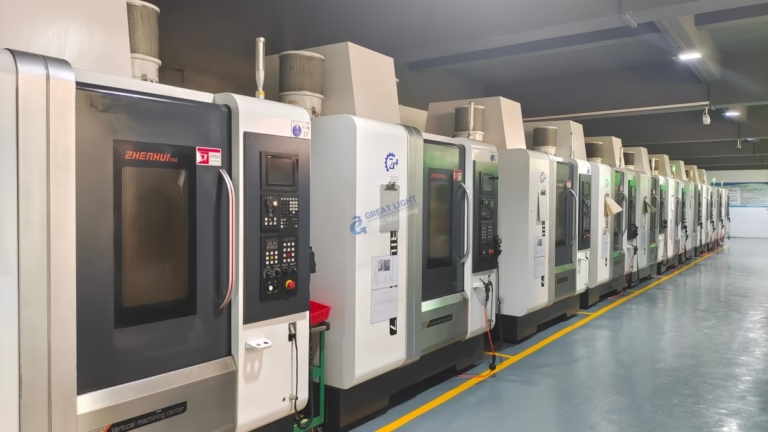
Production can start within 24 hours of approval. Brass parts typically run on our turning centers, where bar feed and live tooling handle cross-drilling and milling in one setup. Stainless parts often move across a mill-turn or five-axis platform to reduce the number of times the part is re-fixtured. Fewer setups means fewer chances to lose position. Our shop runs 127 high-precision CNC machines, including 16 simultaneous 5-axis machining centers, 12 four-axis mills, 27 three-axis machines, and 16 mill-turn centers. Maximum processing size is 4,000 mm.
Tolerances hold at ±0.005 mm (±0.0002 in) when the geometry allows it. Surface finish ranges from Ra 1.6–3.2 μm as-machined down to Ra 0.2–0.8 μm when a fine finish is called out. Inspection is 100% before shipment, with raw material check, in-process monitoring, and a final inspection report available on request. Parts ship in 3–5 days for most orders.
Finishing is where brass and stainless diverge again. Brass takes polishing and plating well and is often left bare or clear-coated. Stainless usually stays bare, bead blasted, brushed, or passivated. We offer anodizing, electroless nickel, zinc, silver and gold plating, powder coating, black oxide, bead blasting, tumbling, brushing, polishing, and laser marking with a minimum character height of 1.5 mm.
- 1Step 1Upload model and drawing; NDA available on request before files move.
- 2Step 2Quotation and DFM feedback within 12 hours.
- 3Step 3Production start within 24 hours of approval.
- 4Step 4100% inspection, then shipment in 3–5 days.
What to Check Before You Award the Job
Ask how the shop will hold your tightest tolerance, not whether it can. A supplier who names the fixture, the machine, and the inspection method is telling you the process has been thought through. A supplier who answers only with a tolerance number is guessing.
Ask about stainless work-hardening specifically. If the answer is only about cutter coating, the shop may not have hit the problem yet at your geometry. The useful answers mention feed rate, radial engagement, coolant delivery, and rigidity.
Ask where the parts are made and who inspects them. Our three wholly-owned plants cover 7,600 m² with about 150 technicians, and we hold ISO 9001:2015, IATF 16949:2016, ISO 13485:2016, and ISO 27001:2022. Those certificates matter for automotive, medical, and data-handling requirements, but they are not a substitute for asking which machine will run your part.
Ask about quantity flexibility. We work with no minimum order quantity, from a single prototype to runs over 10,000 parts. That matters early in a program when the design is still moving and a hard tooling investment is premature. Historical late-delivery probability is below 2%, which is a record, not a promise for your specific order.
Common Questions on Brass and Stainless Machining
Can you machine lead-free brass?
Yes. We machine C27400, C28000, and other low-lead or lead-free grades when the application has a compliance limit. Cutting parameters change because these alloys are more ductile than C36000, so expect slightly different cycle times. Tell us the standard you are working to and we will quote the grade that fits it.
Why does my 304 part come out with a poor surface finish?
Austenitic stainless work-hardens when the tool rubs rather than cuts. The usual causes are a feed that is too light, a dull edge, or insufficient coolant at the cutting zone. A light finishing pass on already hardened material tends to polish the hardened layer instead of removing it. Heavier radial engagement with a sharp tool usually fixes it.
What tolerance can you hold on stainless shafts?
We hold ±0.005 mm (±0.0002 in) when the geometry, length, and material condition allow it. Long slender parts are limited by deflection and residual stress rather than by the machine. For long shafts we often rough, let the part rest, then finish, and we may specify stress-relieved stock. Send the drawing and we will tell you what is realistic.
Which finish should I choose for brass and for stainless?
Brass parts are often left as-machined or polished, since the material already looks finished. Stainless is usually bead blasted, brushed, or passivated. If the part needs corrosion protection or a specific color, plating and powder coating are available. Laser marking works on both, with a minimum character height of 1.5 mm.
Do you require a minimum order quantity?
No. We run from one prototype to 10,000+ part runs. For brass and stainless, small runs are practical because both materials machine well on bar-fed turning centers with low setup burden. Larger volumes give us room to optimize fixtures and cycle time.
How do you handle confidential drawings?
Uploads are secure and confidential, and we can sign an NDA before files are transferred. We also hold ISO 27001:2022 for information security management. If your program requires controlled document handling, tell us at the RFQ stage and we will follow your process.
Send Your Brass or Stainless Drawing
Upload a model and drawing. You get a quotation and a free DFM analysis within 12 hours, with no minimum order quantity.
12-hour quote100% inspectionNo MOQNDA on request









