
Buy CNC Level Machining: How to Pick the Right Machining Center
This guide is for engineers and sourcing teams deciding what to buy when they need CNC level machining capacity, or what to specify when they outsource it. It covers the real difference between horizontal and vertical machining centers, pallet and tombstone setups, and the part geometry that decides which one wins. Read it and you can tell whether a job belongs on an HMC, a VMC, or a 5-axis mill.
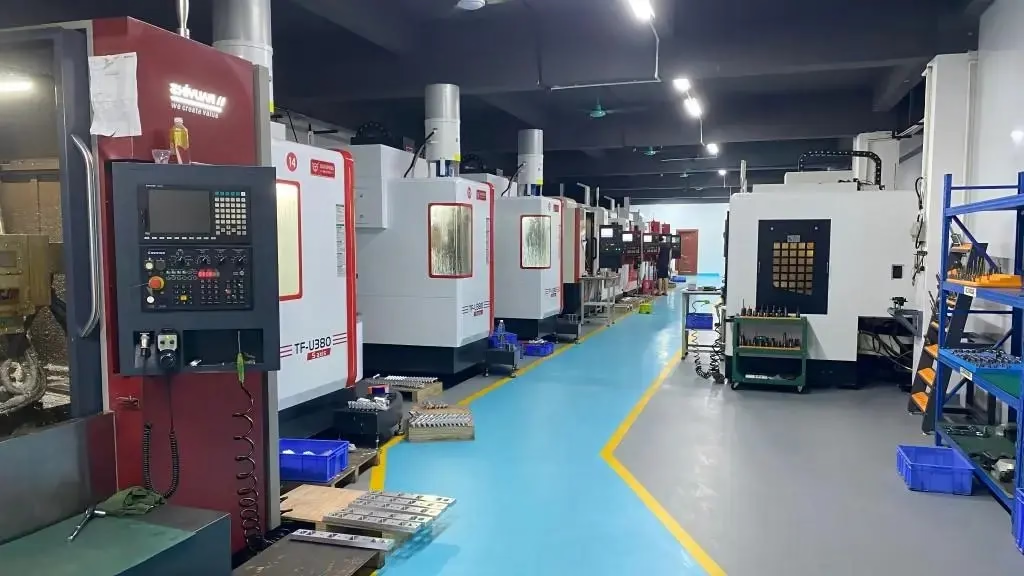
What CNC Level Machining Actually Means in a Quote
The phrase describes a class of machine, not a single model. Getting the class right is most of the decision.
Horizontal vs Vertical: The Difference That Changes Your Setup
A horizontal machining center carries the spindle on its side. The part sits on a pallet, usually tied to a rotary table that acts as the fourth axis. That single change in orientation drives nearly every downstream difference: how chips leave the cut, how rigid the setup feels, and how many faces you can finish before the part comes off the fixture.
Vertical machining centers are the default in most shops, and for good reason. Workholding is simple, the operator can see the cut, and a 3-axis VMC with a vise handles a huge range of plate work. When the part is a flat bracket with one dominant face, a VMC is usually the cheaper answer.
The split shows up in chip evacuation. On a VMC, chips fall back into the pocket you just cut. On an HMC, gravity pulls them away from the tool. Deep pockets, long pockets, and materials that make stringy chips all behave better on a horizontal spindle.
Stiffness matters too. A horizontal spindle is supported on both sides of the column, so heavy face milling and deep boring hold up with less chatter. We see this on large housings and manifolds where a VMC would need a light pass and a long cycle.
Pallet Systems and Tombstones: Where the Cycle Time Goes
An HMC is rarely bought for a single part. It is bought for a family of parts that share a fixture. The pallet changer lets one operator load the next pallet while the spindle is still cutting. That overlap is the real gain, not spindle speed.
A tombstone is a multi-sided fixture block mounted on the pallet. Four faces, sometimes more, each holding a workpiece or a different operation. The rotary table indexes the tombstone so the machine can drill face one, mill face two, and tap face three without an operator touching the part.
This is how you get multi-face machining in one setup. Every time a part moves between fixtures, you add a datum shift and a chance for error. Keeping the part on one tombstone through five faces removes those shifts. On a part with tight true position between bores, that is worth more than a faster tool.
The trade-off is fixture cost. A tombstone and its hydraulic or pneumatic clamps are a real investment, and they only pay back when the volume justifies them. Low-volume, one-off work does not fit this model.
Small parts are a different story. Loading a 40 mm bracket onto a large tombstone wastes pallet space. Group several small parts on one face, or run them on a compact 4-axis mill instead.
Matching the Machine to the Part
Use this as a first pass. The final call depends on fixture cost and annual volume.
| Part characteristic | Better fit | Why |
|---|---|---|
| Flat plate, one dominant face | 3-axis VMC | Simple vise workholding, easy to inspect |
| Deep pocket, stringy chips | HMC | Gravity clears chips out of the cut |
| Multi-face housing, one setup | HMC with tombstone | Rotary table indexes between faces |
| Complex contoured surface | 5-axis simultaneous | Tool stays normal to the surface |
| Small parts, high mix | 4-axis mill or VMC | Pallet space is wasted on a large tombstone |
| Heavy boring, long overhang | HMC | Spindle supported on both sides |
| One-off prototype | 3-axis or 5-axis VMC | No fixture investment needed |
What to Check Before You Buy or Outsource
The spec sheet tolerance is not the tolerance you will hold on a real part. Thermal growth, fixture deflection, and tool wear all eat into the budget. Ask what the shop can hold on a part the size and shape of yours, not on a test coupon.
At GreatLight we quote ±0.005 mm (±0.0002 in) on suitable features, with surface finish from Ra 0.2–0.8 μm on fine work to Ra 1.6–3.2 μm as-machined. Those numbers come with a caveat: they apply to features the machine can reach in a stable setup, not to every dimension on a complex casting.
Inspection is the other half. A tolerance you cannot verify is a tolerance you cannot promise. We run raw material checks, in-process monitoring, and a final inspection before shipment, with reports available on request. Every part is inspected before it leaves.
Spindle hours, ball screw wear, and the condition of the rotary table all move the achievable tolerance. A machine with 30,000 spindle hours will not hold what it held when new. Ask for the maintenance log, not just the model number.
Buying the Machine vs Buying the Capacity
Not every team needs to own an HMC. The machine is one line on the balance sheet; the fixture, the programmer, the tooling, and the floor space are the rest. For a part that runs twice a year, that math rarely works.
Outsourcing lets you buy the capacity without the capital. You get the tombstone setup, the 5-axis capability, and the inspection report, and you pay per part. When the program ends, so does the cost.
GreatLight runs 127 high-precision CNC machines across three plants in Dongguan and Singapore, including 16 simultaneous 5-axis machining centers, 12 four-axis mills, 27 three-axis machines, and 16 mill-turn centers. Maximum processing size reaches 4,000 mm, with travels from 500 × 500 × 450 mm up to 4,000 × 400 × 150 mm. We hold ±0.005 mm and ship parts in 3–5 days, with production able to start within 24 hours of a confirmed order.
Quotation and DFM feedback come back within 12 hours. No minimum order quantity, so one prototype and a 10,000-part run go through the same process. Uploads stay confidential, and an NDA is available on request.
Questions Engineers Ask Before Buying
Is an HMC always faster than a VMC?
No. The gain comes from setup overlap and multi-face work, not from a higher spindle speed. On a single flat part with one operation, a VMC can match it.
An HMC wins when you can keep the spindle cutting while an operator loads the next pallet, or when the tombstone lets you finish five faces without re-fixturing.
What size part fits a horizontal machining center?
It depends on the machine. Our largest travel is 4,000 × 400 × 150 mm, and we also run 750 × 1,150 × 550 mm and 600 × 600 × 600 mm envelopes.
Compact machines cover 500 × 500 × 450 mm and 500 × 310 × 200 mm. Send the part envelope and we will match it to a machine.
Do I need 5-axis or is 4-axis enough?
Use 4-axis when the part has features on four sides of a prismatic block and the tool can reach them from a fixed angle. The rotary table indexes, then the cut happens in 3 axes.
Go to 5-axis when the surface is contoured and the tool needs to stay normal to it, or when a single setup removes a tolerance stack between features.
How do you hold ±0.005 mm on a production run?
Rigid fixturing, temperature-stable coolant, and in-process checks. We inspect raw material, monitor during the run, and do a final inspection before shipment.
Some features cannot hold that tolerance because of geometry or tool reach. We flag those during DFM review rather than after the first article.
What materials can you machine on these centers?
Aluminium grades 6061, 7075, 2024 and 6082; stainless 303, 304, 316L and 17-4PH; steels 1018, 4140 and 4340; titanium TC4; Inconel; and plastics including POM, PEEK and PC.
Harder alloys like Inconel and titanium need slower speeds and more rigid setups, which changes the cycle time estimate.
Can I get a quote from a drawing only?
Yes. Send the 2D drawing or 3D model and we return a quotation with DFM analysis within 12 hours.
There is no minimum order quantity, and we can start production within 24 hours once the order is confirmed.
Send the Drawing, Get a Machining Plan
Tell us the part envelope, material, and tolerance. We will tell you which machine class fits and what it costs.
12-hour quote100% inspectionNo MOQNDA available









