
Can a CNC Point-to-Point Machine Cut a Radius?
Point-to-point (PTP) machines move from coordinate to coordinate. Whether they can also cut a smooth radius depends on one thing: does the control interpolate two axes at once? This guide is for engineers and buyers who need to decide between a PTP machine, a 3-axis mill, or a full contouring center. Read it and you can tell, from the drawing and the machine spec, whether the radius is a five-minute job or the wrong machine.
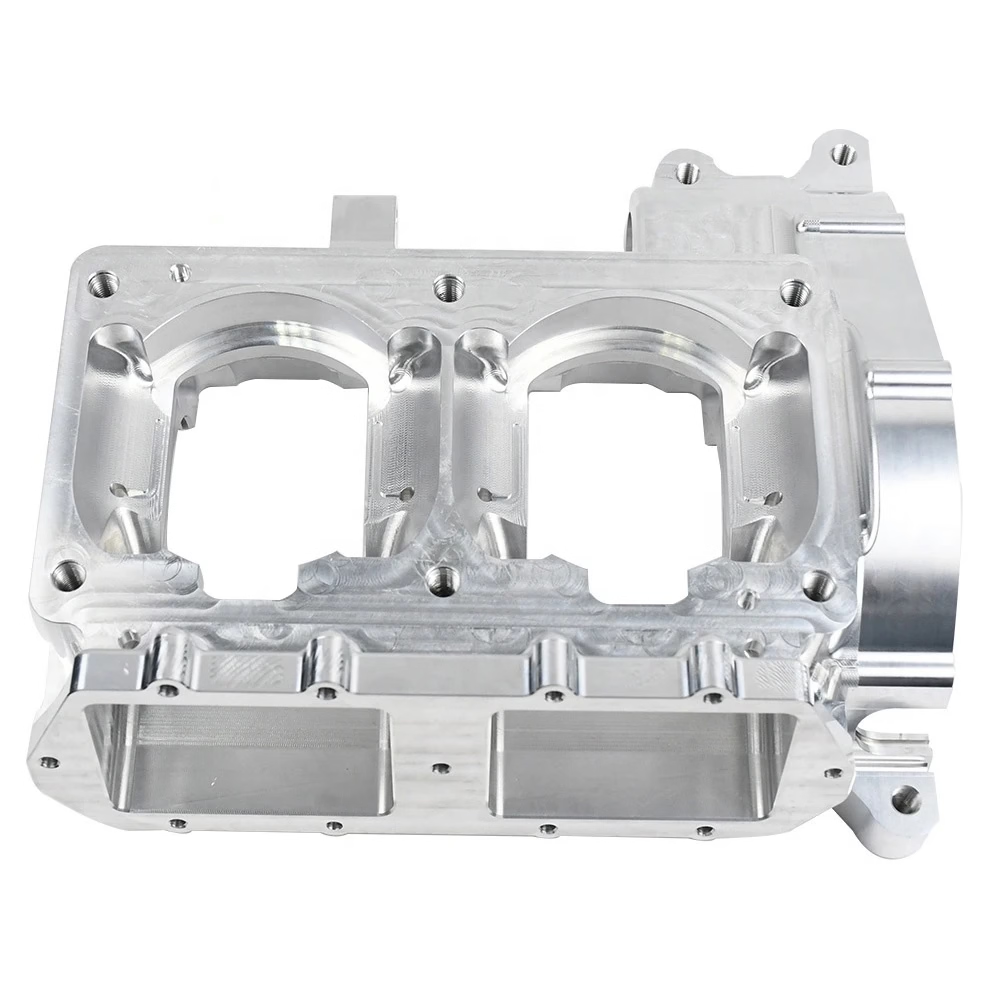
What a point-to-point machine actually does
A PTP machine positions a tool at a coordinate and executes a canned cycle. A radius is not a coordinate. It is a path.
Point-to-point vs. contouring: the control decides
The name says what the machine was built for. A point-to-point machine drives the spindle or the worktable to a set of coordinates and runs a canned cycle at each stop: drill, tap, bore, rout a straight groove. The panel and the servo tuning are set up for fast positioning between holes, not for smooth motion through a curve. That is why a PTP machine can be twice as fast as a mill on a cabinet panel full of holes, and still fail on a single 50 mm radius.
A contouring control is the opposite trade. Two or more axes move together under a constant feedrate, so the tool tip follows a continuous path. G02 and G03 are the standard codes for circular interpolation. When a PTP machine has this function enabled — and many modern ones do, at least on two axes in the X-Y plane — it can cut a radius. When it does not, the same machine can only approximate the arc with a series of short straight moves.
So the question is not really about the machine class. It is about the specific control, the axis count, and whether the servo update rate is fast enough to hold a curve without visible facets. Ask for the machine manual or the controller model before you promise a customer a radius on a PTP machine.
- 1Positioning machineFast point moves, canned cycles, no circular interpolation.
- 2Contouring machineTwo or more axes move together under feedrate control.
- 3Hybrid PTPPositioning is the main job, but G02/G03 works in one plane.
When a point-to-point machine can cut a radius
Three conditions have to be true at once. The control needs circular interpolation, at least two axes must be able to move under coordinated feed, and the tool path must lie in the plane those axes cover. On a typical PTP machine with an X-Y table, that means radii in the X-Y plane. A radius on a vertical wall, or a compound curve on a 3D surface, is outside what the machine can reach. You would need a tilting head or a fourth axis to get there.
Radii in sheet material are the common case. A 5 mm corner radius on an aluminum panel, a 20 mm arc on a plastic cover, a rounded slot — these are single-plane features and a PTP machine with interpolation handles them well. Tool diameter sets the floor on radius size. A 6 mm cutter cannot cut an inside radius smaller than 3 mm, because the corner is defined by the tool, not the path. The CAM file has to account for that, or the corner comes out oversized.
Feedrate matters more than people expect. A contouring control that is tuned for positioning may leave chatter marks when it tries to hold 600 mm/min through a 10 mm arc. The fix is usually to slow the feed and take a lighter radial depth of cut. If the part has many small radii, it may be faster overall to nest it on a 3-axis mill and leave the PTP machine for the drilling.
- 1Interpolation enabledG02/G03 active in the controller, not just rapid moves.
- 2Two axes coordinatedServos hold feedrate together, not one at a time.
- 3Radius in one planeX-Y arcs are fine. Compound curves are not.
- 4Tool radius fitsInside corner radius must be ≥ cutter radius.
Matching the machine to the feature
Use this when the drawing lands on your desk and you have to pick a process.
| Feature on the drawing | Point-to-point machine | 3-axis or 5-axis mill |
|---|---|---|
| Row of holes, one depth | First choice. Fast cycle, low cost. | Works, but slower per hole. |
| Single-plane radius, R ≥ cutter radius | Fine if interpolation is on. | Fine. Better finish control. |
| Inside corner R < cutter radius | Not possible. Corner stays square. | Needs smaller cutter or EDM. |
| Radius on a vertical wall | Not possible without a tilting head. | 4th axis or 5-axis handles it. |
| Compound 3D curve | Outside the machine's reach. | 5-axis simultaneous is the answer. |
| Mixed holes and arcs, one setup | Good if the control interpolates. | Often better overall. One setup. |
Where a point-to-point machine stops working
A PTP machine cannot cut a true 3D contour. Full stop. If the radius changes as it wraps around the part, or if the arc sits on a sloped face, the tool tip has to move in three dimensions at once. That needs simultaneous multi-axis motion, which is a different machine class. Trying to fake it with a series of 2D passes leaves steps on the surface and a radius that is not round.
Positioning accuracy and contouring accuracy are not the same number. A machine may hold ±0.005 mm when it stops at a hole, and still show 0.05 mm of error while it is moving through an arc. The error comes from servo lag, backlash, and the look-ahead in the control. On a PTP machine, the contouring error is usually not published in the spec sheet. You have to test it with a circle-square-diamond gauge or a test cut before you trust it on a production part.
Small radii are the other trap. Below about 2 mm, the cutter tip radius and the chip load start to dominate. The tool deflects, the finish goes rough, and the radius measures oversize. If a part needs a 1 mm inside radius, the right move is often to leave it sharp on the mill and finish the corner with EDM or a dedicated radius tool. A PTP machine is the wrong place to solve that problem.
- 1No true 3D contourCompound curves need simultaneous multi-axis motion.
- 2Contouring error ≠ positioning errorTest the arc, do not trust the spec sheet.
- 3Tiny radii need another processBelow ~2 mm, tool deflection takes over.
How we route radius work at GreatLight
We run 127 high-precision CNC machines, including 16 simultaneous 5-axis centers and 27 three-axis machines. When a part has single-plane radii and a lot of holes, we often rough and drill on one machine and finish the arcs on another. Splitting the work that way keeps the fast positioning where it belongs and puts the curve on a control that is tuned for it. The result is a shorter cycle and a radius that measures round.
Material changes the plan. Aluminum 6061 and 7075 cut clean arcs at high feed. Stainless 316 and 17-4PH work-harden at the tool tip, so we slow the feed and take a smaller radial step to hold the radius. Titanium TC4 (Ti-6Al-4V) is similar but worse on tool life. In all three cases, the machine choice is the same. The cutting data is what changes.
Tolerance is where the process earns its keep. We hold ±0.005 mm on critical dimensions, and finishes from Ra 0.2–0.8 μm on a fine pass to Ra 1.6–3.2 μm as machined. Every part gets a raw material check, in-process monitoring, and a final inspection before it ships. If a radius is critical, tell us the function it serves. A clearance arc and a sealing arc are not the same call.
- 1Split the cycleDrill on the fast machine, finish arcs on the contouring one.
- 2Match the cutting data to the materialAluminum fast, stainless and titanium slower.
- 3State the functionA clearance arc and a sealing arc are different jobs.
Radius cutting questions engineers ask
Can a CNC point-to-point machine cut a radius at all?
Yes, if the controller supports circular interpolation and at least two axes move together under feedrate control. Many modern PTP machines have this in the X-Y plane. Without it, the machine can only step through the arc with short straight moves, which leaves a faceted surface.
The machine class alone does not answer the question. The control model and the axis configuration do. Check the manual or run a test cut before you commit a production part.
What is the smallest inside radius a point-to-point machine can cut?
The inside radius cannot be smaller than the cutter radius. A 6 mm end mill leaves a 3 mm minimum inside corner. If the drawing calls for 1 mm, the cutter has to shrink, and at that size deflection and finish become the limiting factors.
Below roughly 2 mm, we usually recommend finishing the corner on EDM or leaving it for a dedicated radius tool rather than forcing it on a PTP machine.
Why does the radius come out faceted instead of smooth?
Facets come from three places: no true circular interpolation, a control that cannot keep up with the feedrate, or CAM output that breaks the arc into short line segments. The first is a machine limit. The second is a tuning and feed problem. The third is a post-processor setting you can fix.
A circle-square-diamond test cut separates the three quickly. If the circle shows flats, look at the CAM first. It is the cheapest fix.
Does a point-to-point machine hold the same tolerance on an arc as on a hole?
No. Positioning accuracy and contouring accuracy are separate specifications. A machine that holds ±0.005 mm at a stopped position may show several times that error while moving through an arc, because of servo lag and look-ahead limits.
For critical arcs, we test the contouring error on the actual machine and material before quoting the tolerance. That number goes on the inspection report.
When should the job move to a 3-axis or 5-axis mill instead?
Move it when the radius sits on a vertical wall, when the curve is compound, or when the part already needs three-dimensional surfacing. Those cases are outside what a PTP machine can reach. A 3-axis mill handles single-plane arcs with better finish control. A 5-axis center handles compound curves in one setup.
Cost is not always higher on the mill. Fewer setups and fewer hand-finishing steps often cancel the slower cycle.
Can GreatLight cut radii on parts sent as STEP files?
Yes. Upload the STEP or native CAD file and we return a quotation with a free DFM analysis within 12 hours. The review flags any radius that is too small for the tool, any corner that needs a different process, and any feature that would be cheaper to change.
We have no minimum order quantity. One prototype and a 10,000-part run go through the same review. Uploads are confidential, and an NDA is available on request.
Send the drawing. We will tell you which machine cuts the radius.
Upload a STEP file and get a quotation with a free DFM analysis within 12 hours. Every part is inspected 100% before it ships.
12-hour quote±0.005 mm toleranceNo minimum orderNDA on request









