
Cheap Chinese CNC Milling and Turning: What the Low Quote Actually Buys
A working guide for engineers and buyers who compare milling and turning quotes from China. Read it to judge whether a low price comes from real capacity and process control, or from fewer setups checked, looser tolerances, and rework that lands on your schedule.
Where the Low Price Comes From
Price is an output. Before you compare numbers, compare the process that produced them.
A Quote Is a Set of Process Decisions
Every milling and turning quote is built from a handful of decisions: how many setups the part needs, how the fixture is made, which machine the job runs on, how much inspection is included, and how much scrap is expected. Each one can be trimmed to lower the number. Some trims are smart. Others move cost to your side of the table.
Take setup count first. Work with features on five faces can run as five 3-axis operations, or as two operations on a 5-axis center with a Ø400 mm rotary table. The 5-axis route costs more per hour and less per piece, because each extra setup adds fixturing, an operator touch, and a new stack of tolerance.
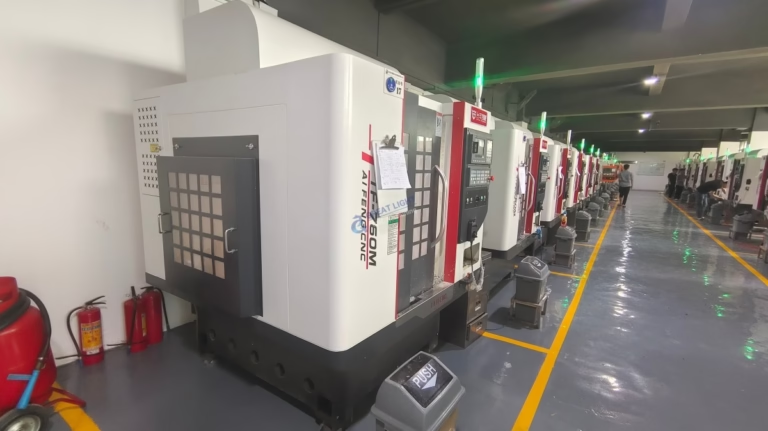
Then look at the machine mix. A shop running 16 simultaneous 5-axis centers, 12 four-axis mills, and 16 mill-turn centers can hold a complex part in one or two setups. A shop with only 3-axis machines will quote the same part lower and then chase the datums across six operations. Sometimes that works. On tight bores and true-position callouts, it does not.
Inspection is the last line item and the easiest to cut. Skipping in-process checks saves hours per batch and shows up as a mixed shipment: some parts at ±0.005 mm, some at ±0.03 mm. If your assembly is sensitive to bore-to-bore position, that spread costs more than the inspection ever would.
Deciding Between Milled and Turned Features
Most hardware is a mix. A housing might be milled from 6061-T6 plate, then have a bearing bore turned to Ra 0.8–1.6 μm on a lathe. Sending the whole job to one process usually raises cost, because the wrong machine does work it is slow at.
As a rule, round parts with a single axis of symmetry belong on a lathe, especially when the diameter-to-length ratio stays under about 4:1. Turned parts hold concentricity easily because the part never leaves the spindle between features. Adding a second operation with a mill-turn center lets you cut flats, cross-holes, and slots without losing that reference.
Milled parts win when the geometry is prismatic: pockets, ribs, angled faces, thin walls. Watch wall thickness. Below 0.8 mm on aluminum, chatter and spring pass become the limiting factor, not the machine. Thicker walls on steel behave differently again; a 1.5 mm steel rib is usually fine, a 1.5 mm aluminum rib at 100 mm tall is not.
Volume shifts the answer. One prototype justifies a 3-axis mill and a vise. A 10,000-piece run justifies a dedicated fixture, a mill-turn cycle, or a die-cast blank with machined fits. We quote both paths when the quantity sits in the middle.
Process Route by Part Shape
Use this to pick a starting route before you ask for a quote.
| Part shape | Typical route | Watch out for |
|---|---|---|
| Round, single axis, Ø under 200 mm | Turning or mill-turn, one setup | Bar stock size and chuck jaw marks |
| Prismatic plate, pockets both sides | 3-axis or 4-axis, two setups | Datum shift between ops |
| Five-face housing, tight bores | 5-axis, one or two setups | Fixture access to the underside |
| Long frame up to 4,000 mm | Large-travel gantry, multiple setups | Thermal growth over the run |
| Mixed round and flat features | Turn then mill, or mill-turn center | Concentricity after rechucking |
| Thin-wall enclosure | Milling with light passes, soft jaws | Deflection, not tool wear |
Material Choice Drives the Cheap Part More Than the Machine
Free-machining grades cut cycle time hard. 6061 aluminum and 12L14-style free-cutting steel remove fast and leave a decent finish off the tool. Switching a bracket from 7075 to 6061 can cut machining time by a third, and if the part is not strength-critical, nobody notices.
Stainless is where quotes diverge most. 303 machines cleanly. 304 and 316 work-harden, so a light finishing pass on a worn insert can smear instead of cut, and the surface reads Ra 1.6–3.2 μm when you asked for Ra 0.8–1.6 μm. 17-4PH in the H900 condition needs more passes and more tool changes. Budget for it.
Titanium and Inconel sit at the top. TC4 (Ti-6Al-4V) needs low surface speed, high coolant pressure, and sharp tooling, so cycle time can be five to eight times the aluminum equivalent. If a design can use aluminum or stainless instead, that swap usually saves more than any supplier negotiation.
Plastics have their own rules. POM and ABS cut easily but move with temperature. PEEK needs pre-drying and a sharp, polished cutter to avoid a fuzzy edge. Carbon fiber eats carbide, so expect tool changes and a dust-control plan rather than a bargain.
Checks That Separate Value From a Low Quote
Ask what the shop measures, and with what. A caliper-only shop will not hold ±0.005 mm on a bore pattern. A shop with CMM reports, micrometers, pin gauges, and a 100% inspection step before shipment can show you the numbers rather than promise them.
Ask which machine your part is scheduled on, by model. Vague answers mean the job will land wherever there is a gap in the schedule. That is not automatically bad for a simple bracket. For a part with tolerance stacks across four faces, it matters.
Ask about the fixture. Good shops describe soft jaws, a custom plate, or a tombstone before you ask. Shops that plan to clamp the part in a standard vise on a finished surface will mark it and often bend it. This is the single most common cause of a rejected first article.
Ask for the process chain. If milling, turning, anodizing, and laser marking all happen under one roof, you avoid the freight and the lost accountability between vendors. If they are split, you own the handoffs. Both models can work, but the split one needs a clear incoming inspection step at each hop.
From One Prototype to a 10,000-Piece Run
Prototypes and production runs are different problems. A prototype is judged on speed and on whether the geometry works. A production run is judged on repeatability: does part 9,000 match part 1 within the tolerance band, with the same surface finish.
Tooling changes between the two. A prototype often runs from a vise and a few soft jaws. Production wants a dedicated fixture, defined tool life, and a first-article inspection record. Skipping that step is how a cheap quote becomes an expensive ramp.
Batch size also changes inspection strategy. At low volume, 100% inspection is affordable and sensible. At high volume, a shop may move to sampling plus process monitoring, which is fine if the process is stable. Ask which method is planned before the run starts, not after.
No minimum order quantity helps here. You can order one piece to validate a design, fix a dimension, and then release the same part number at 10,000 pieces without a new supplier, a new DFM review, or a new set of datums. That continuity is worth more than a few percent off the unit price.
Questions Engineers Ask Before Ordering
Can a low-cost Chinese machine shop hold ±0.005 mm?
It depends on the feature, not the country. A single bore turned in one setup is straightforward. A pattern of bores across three setups needs a 5-axis or mill-turn route, a real fixture, and a CMM check.
Ask for the inspection report on the first article. If the shop cannot produce numbers, treat the tolerance as a request rather than a commitment.
What is the cheapest way to reduce my milling cost?
Cut setup count and pick a free-machining material. Relaxing a surface finish from Ra 0.2–0.8 μm to Ra 1.6–3.2 μm often removes a finishing pass with no functional loss.
Removing one tight tolerance that nothing keys off is the next biggest saving. Engineers usually know which one it is.
How do I handle confidentiality for a new design?
Send step files through the quote page and ask for a non-disclosure agreement before release. Uploads are handled as confidential, and an NDA is available on request.
If the design is patent-pending, put the NDA in place before the DFM review, not after the first quote.
Will a cheap shop skip inspection to hit the price?
Sometimes, and you can spot it early. Ask what is measured, on which features, and whether reports ship with the parts. Vague answers are the tell.
A shop that inspects raw material, monitors in process, and checks 100% before shipment will describe that sequence without prompting.
How fast can parts move from quote to shipment?
At GreatLight, quotation and a free DFM analysis come back within 12 hours, and production can start within 24 hours. Standard parts ship in 3–5 days.
Complex 5-axis work and outsourced finishing add time. We tell you which step is the long pole before you commit.
Do I need to order a large batch to get a good price?
No minimum order quantity applies. One prototype and a 10,000-piece run go through the same quoting path.
Unit price drops with volume because fixture and setup cost is spread thinner, not because small orders are penalized.
Send the Drawing, Get a Route and a Price
Upload your files for a quote and a free DFM review within 12 hours. We will tell you which machine the part should run on, and where the cost actually sits.
12-hour quote100% inspectionNo MOQNDA on request









