
Cheap OEM Rapid Prototyping: What the Low Quote Skips
This page is for engineers and sourcing staff comparing low-cost prototype quotes. It explains which parts survive a cheap process, which do not, and how to read a supplier quote line by line before you place an order.
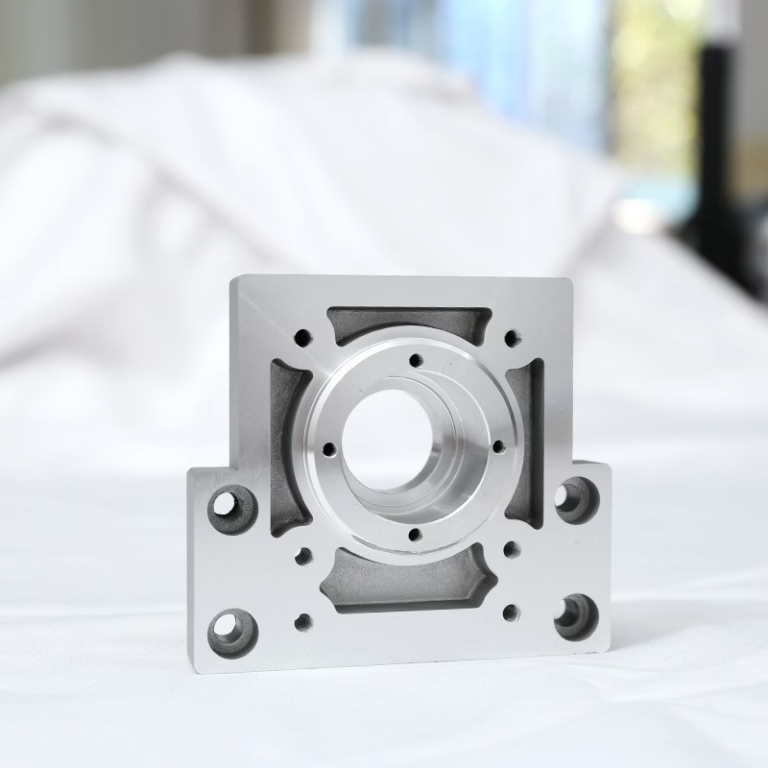
Where the money actually goes in a prototype order
Unit price is one line of a longer list. The rest of the list decides whether the part works.
Written tolerances vs. delivered tolerances
A quote sheet can say ±0.005 in and still ship a part that is 0.003 in out on a bearing bore. That is not fraud, it is capability. Holding a tight tolerance depends on spindle condition, thermal stability, tool wear tracking and how often the machine is checked against a master. A shop running worn spindles in an uncontrolled room will drift through the day, and the first article you approve may not match the fifth part in the run.
Ask what the inspection report actually contains. A single CMM printout on one feature is weak evidence. We record raw material certificates, in-process checks and a final dimensional report so the number on the drawing can be traced back to a measurement. Buyers who skip this step often pay twice: once for the cheap prototype, again for the rework.
Where a cheap quote really bites is the critical feature. A robot end-effector housing with a bore off by 0.002 in will not assemble, no matter how good the rest of the part looks. The fix is a second setup, a new fixture or a scrapped part. None of that appears on the original purchase order.
- 1Ask for the measurement methodCMM, micrometer or gauge pin. Each has a different uncertainty.
- 2Ask who signs the reportAn inspector name and date beats an unsigned PDF.
- 3Ask about machine conditionSpindle runout and calibration records matter more than the brochure.
Material substitution that nobody tells you about
Grade substitution is the quietest way to cut a prototype quote. A 7075-T6 bracket becomes 6061-T6, a 316L medical housing becomes 304, and the part still looks correct in the photo. Machinability improves, tool life goes up, and the shop saves money. The customer finds out during testing, or worse, during a customer demo.
The difference shows up in specific places. 7075-T6 reaches roughly 570 MPa yield; 6061-T6 sits near 275 MPa. For a lightly loaded enclosure that gap never matters. For a structural bracket under vibration, it changes the fatigue life. On the stainless side, 304 and 316L look identical on a bench, but 316L carries the molybdenum that resists chloride pitting in medical and marine service.
A reliable supplier lists the exact grade and heat lot on the certificate and flags any proposed swap before cutting metal. We treat a material change as an engineering decision, not a purchasing one. If the substitute grade is acceptable, say so in writing so the drawing revision matches the part.
- 1Check the certificate grade6061-T6 and 7075-T6 are not interchangeable in fatigue.
- 2Watch stainless families304 and 316L behave differently in chloride service.
- 3Confirm before cuttingA verbal swap is not a specification change.
Surface finish treated as an afterthought
A prototype with the right dimensions and the wrong finish can still fail a fit check. As-machined surfaces land around Ra 1.6–3.2 μm. A sealing face or a sliding bore usually needs Ra 0.8–1.6 μm, and optical or bearing surfaces can call for Ra 0.2–0.8 μm. Those steps cost time, and a stripped quote often leaves them out.
The trap is that finish is invisible on a dimensional report. A part can pass every dimension and still leak at a gland or gall in a bushing. Buyers who need anodizing, hardcoat, electroless nickel or laser marking should price those operations into the prototype, not the production run. Adding them later means a second shipment and a second setup.
Laser marking deserves a specific note. Our minimum character height is 1.5 mm. A part number drawn at 0.8 mm will not reproduce cleanly on a curved or anodized surface. Fix the marking layout at the prototype stage while the CAD is still easy to edit.
- 1Name the finish per faceA whole-part Ra callout is usually too loose or too expensive.
- 2Plan marking earlyMinimum character height is 1.5 mm.
- 3Prototype the coatingAnodize build-up can close a tight thread or bore.
Cheap vs. capable: what changes on the shop floor
Use this as a checklist when you compare two quotes for the same drawing.
| Item | Low-cost quote | Capable prototype shop |
|---|---|---|
| Tolerance claim | ±0.005 in on paper | ±0.005 mm held and reported |
| Material grade | Substituted silently | Listed with heat lot certificate |
| Surface finish | As machined only | Ra 0.2–0.8 μm on request |
| DFM feedback | None before cutting | Free DFM within 12 hours |
| Inspection | Spot check | 100% inspection before shipment |
| Order size | Large batch only | One part to 10,000+ runs |
| Timeline | Vague | Production start within 24 hours |
| Documentation | Invoice only | Material and dimensional reports |
Lead time and DFM feedback decide total cost
A late prototype is expensive in a way the invoice never shows. The design review slips, the tooling order slips, and the launch date moves. Our historical late-delivery probability sits below 2%, and parts normally ship in 3–5 days once production starts. A quote that saves 15% but adds two weeks does not save anything.
Design-for-manufacturability feedback is the other quiet line item. A shop that cuts first and reports problems later forces a redesign after you have already paid for metal. We return a quotation and free DFM analysis within 12 hours, and production can start within 24 hours after approval. That window is where thin walls, deep pockets and unreachable features get caught.
Some geometries should not go to a cheap CNC quote at all. A hollow shell with 0.5 mm walls, an internal lattice, or a part with undercuts on four sides is usually a job for additive or vacuum casting. Pushing those into a low-cost milling quote produces a part that is either distorted or impossible. Match the process to the geometry before you negotiate the price.
- 1Send STEP, not STLA solid model lets the shop check wall thickness and tool reach.
- 2Flag critical featuresMark the two or three dimensions that actually matter.
- 3Ask about process fitSome shapes belong in 3D printing or vacuum casting.
What a prototype shop should be able to show you
Capacity is the fastest way to check whether a low quote is real. GreatLight runs 127 high-precision CNC machines across three wholly-owned plants, including 16 simultaneous 5-axis machining centers, 12 four-axis mills, 27 three-axis machines and 16 mill-turn centers. Maximum processing size reaches 4,000 mm, so a long extrusion or a large fixture plate stays in one setup instead of being split and re-datumed.
Certification tells you which industries the quality system was built for. We hold ISO 9001:2015, IATF 16949:2016, ISO 13485:2016 and ISO 27001:2022. That matters if your prototype is an automotive bracket, a surgical instrument housing or a part under NDA. Uploads are handled as confidential, and an NDA is available on request.
Materials cover the common prototype range: aluminium 6061, 7075 and 6082, stainless 303, 304, 316L and 17-4PH, steel 1018, 1045 and 4140, plus titanium TC4, Inconel, copper alloys, POM, PEEK and carbon fibre. Finishing includes anodizing, plating, powder coating, bead blasting and laser marking. Having those steps in-house is how a cheap quote stops turning into a chain of vendors.
- 1Ask for machine listAxis count and travel decide which parts fit.
- 2Ask for certificatesMatch the quality system to your industry.
- 3Ask about in-house finishingFewer vendors means fewer handoffs and fewer delays.
Questions engineers ask before ordering
Can I get one prototype without a minimum order?
Yes. There is no minimum order quantity, from a single prototype to runs of 10,000+ parts. The first part is usually the most expensive per unit because the setup is spread over one piece, and that is normal.
How fast can a quote and DFM review come back?
Quotation and free DFM analysis are returned within 12 hours. Production can start within 24 hours after you approve the quote and the DFM notes, and parts typically ship in 3–5 days.
What tolerance can you hold on a prototype?
We work to ±0.005 mm (±0.0002 in) where the drawing calls for it. Not every feature needs that, and applying it everywhere raises cost without adding function. Mark the critical dimensions and let the rest run at general tolerance.
How do you protect a design that is not public yet?
Uploads are secure and confidential, and an NDA is available on request. We also hold ISO 27001:2022 for information security, which covers how files and drawings are stored and shared internally.
Which process fits my part better, CNC or 3D printing?
CNC suits solid parts with tight tolerances, threaded features and metal grades such as 7075 or 17-4PH. Additive suits hollow shells, internal channels and lattice geometry that a cutter cannot reach. Vacuum casting covers small bridge runs in urethane. We will say so if your file fits a different process.
What is checked before the parts ship?
Raw material check, in-process monitoring and final inspection, with 100% inspection before shipment. Dimensional and material reports are available on request so your receiving inspection has something to compare against.
Send the drawing, get a real number
Upload your STEP file and we will return a quote with DFM notes within 12 hours.
12-hour quote100% inspectionNo MOQNDA on request









