
China Machine Tool Industry: How to Read a Business Contact Manual
A contact manual for the china machine tool industry is only useful if you know what each listing actually tells you. This page explains how supplier tiers differ, what to verify before you send an RFQ, and when a Dongguan machine shop is the better route than buying a machine. Written for mechanical engineers and sourcing managers who need to make a supplier decision, not collect names.
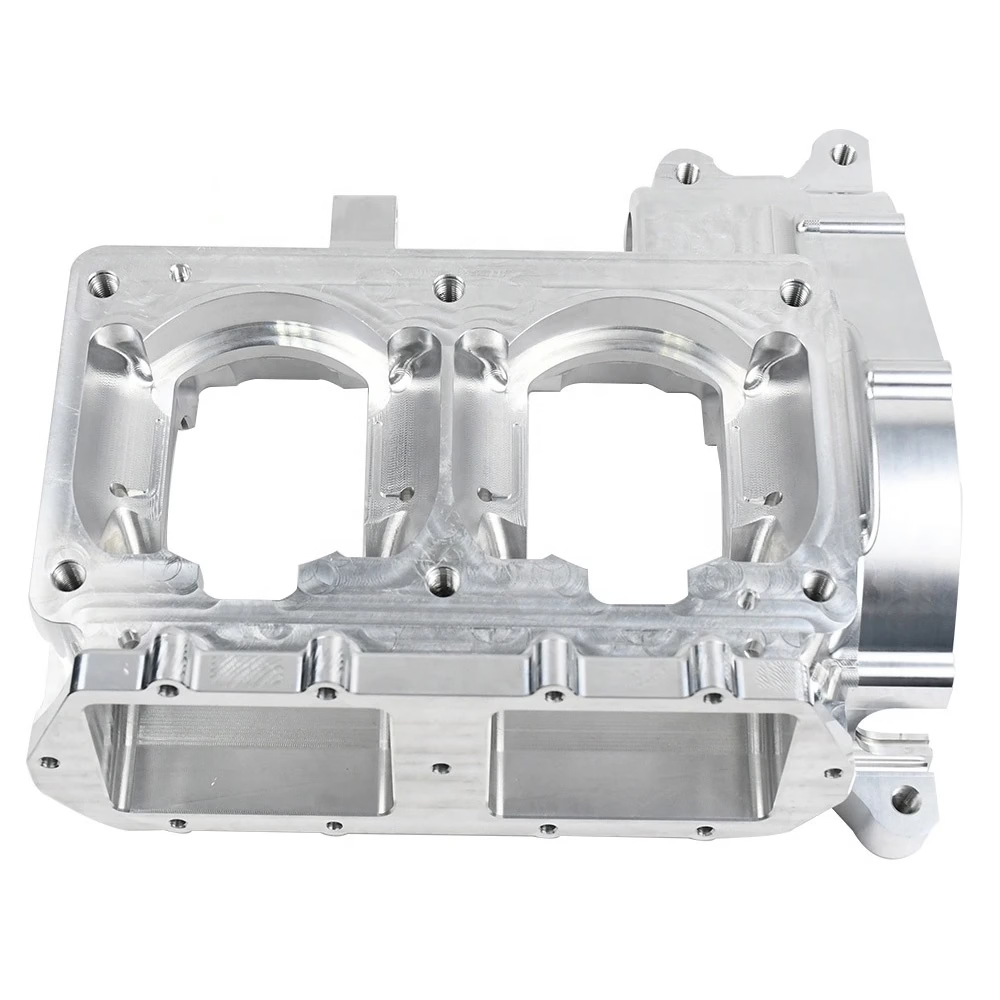
What a contact manual does and does not give you
A list of companies is a starting point. The tier, the process capability and the paperwork decide whether the part arrives to print.
How contact manuals sort companies
Most contact manuals for the china machine tool industry group entries by company type rather than by capability. The three common groups are machine builders, component suppliers and contract machining shops. Builders sell the machine itself: a lathe, a machining center, a grinder. Component suppliers sell spindles, linear guides, ball screws, tool holders and rotary tables. Contract shops take your drawing and return finished parts.
That grouping matters because the buying process is different for each. If you need a machine, you are comparing spindle speed, axis travel, tool magazine capacity and controller. If you need parts, you are comparing tolerance, material range, inspection and lead time. A manual that mixes the two wastes your time.
A third distinction is ownership. State-owned enterprises, private companies and foreign-invested plants behave differently on quoting, payment terms and engineering support. Foreign-invested plants usually answer in English and keep a documented quality system. Private shops in Dongguan and Shenzhen often move faster on prototypes but expect clear drawings before they commit.
Read the manual as a map of who does what. Do not treat it as a vendor list. The entry that fits your part is the one whose process matches your geometry, not the one with the largest factory floor.
- 1Machine buildersSell the tool. Compare travel, spindle, controller, not part tolerance.
- 2Component suppliersSell spindles, guides, screws, holders. Check fit and grade.
- 3Contract machine shopsTake your drawing. Compare tolerance, material and inspection.
What to verify before you send an RFQ
A company name in a manual proves nothing about the plant. Ask for the business license, the quality certificates and the machine list. For the china machine tool industry, the useful documents are ISO 9001 for general quality control, IATF 16949 for automotive work, ISO 13485 for medical devices and ISO 27001 for data handling. GreatLight holds all four.
Then check the machine list against your part. A shop with 16 simultaneous 5-axis machining centers, 16 mill-turn centers and a Ø400 mm rotary table can cut one setup where a 3-axis shop needs four. Fewer setups means tighter position tolerance and less fixture error.
Ask what the largest part is. If your housing is 900 mm long, a shop capped at 500 mm travel cannot quote it. GreatLight runs up to 4,000 mm on the large travel machines, with medium machines at 750 × 1,150 × 550 mm and compact cells at 500 × 500 × 450 mm.
Finally, ask who inspects and what they record. A shop that measures only the first article is not the same as one that inspects 100% before shipment. Request the inspection report format before you place the order, not after.
- 1CertificatesISO 9001, IATF 16949, ISO 13485, ISO 27001 where relevant.
- 2Machine listAxis count, travel, rotary table, spindle, tool magazine.
- 3InspectionFirst article only, or 100% before shipment with reports.
Which route fits which job
Use this to decide whether to buy a machine, buy a component, or send the drawing to a contract shop.
| Job | Best route | What decides it |
|---|---|---|
| High-volume in-house production | Buy the machine | Cycle time, spindle hours per year, controller support |
| Spindle or guide replacement | Buy the component | Mounting interface, grade, lead time |
| Prototype or bridge build | Contract shop | Tolerance, material range, 3–5 day shipment |
| Tight position tolerance | 5-axis contract shop | One setup beats four, less fixture error |
| Large frame or housing | Large-travel shop | Travel must exceed part length plus stock |
| Regulated medical part | ISO 13485 shop | Traceability and process validation records |
What to put in the RFQ package
Most slow quotes come from incomplete drawings, not from a slow shop. Send a 3D file in STEP or IGES plus a 2D drawing with datums, tolerances and surface finish. If a feature is critical, mark it. If a corner is cosmetic only, say so, and the shop can choose a cheaper process.
State the material grade, not just the family. Aluminium 6061-T6 and 7075 behave differently on thin walls. Stainless 304 and 17-4PH need different feeds and different tool wear allowances. For titanium TC4 (Ti-6Al-4V) and Inconel, expect slower cutting and a higher price per part.
Add the finish and the quantity. Anodizing in clear, colour or hardcoat changes lead time. Laser marking needs a minimum character height of 1.5 mm; smaller text will not read cleanly. No minimum order quantity applies here, so one prototype and a 10,000-part run both go through the same quoting path.
Say how many revisions you expect. A shop that knows a design is still moving will quote the first article differently from a frozen print. That single line saves a round of emails.
- 1GeometrySTEP or IGES plus 2D drawing with datums and tolerances.
- 2MaterialExact grade, not just aluminium or stainless.
- 3FinishAnodize type, plating, blasting, marking height.
- 4QuantityPrototype count and expected annual volume.
When a Chinese contract shop is the wrong choice
A contract shop is not always the answer. If your part needs a process the shop does not run in house, the quote will include a subcontractor and the lead time will stretch. Ask which operations are done on site before you commit.
If your volume is high enough to keep a machine busy, buying your own and running it is cheaper over a few years. That is a capital decision, not a sourcing one.
If your design is not stable, every revision restarts tooling and fixturing. A shop can absorb that on a prototype, but not on a production run without cost.
And if the part is simple, flat and loose, a local shop may beat an overseas one once freight and travel are counted. Export machining pays off on complex geometry, tight tolerance and short runs.
Common questions
Do I need to visit the plant before ordering?
Not for a first prototype. Ask for the certificates, the machine list and a sample inspection report instead. Those three documents tell you more than a walk-through.
An audit visit makes sense when the annual volume is large or the part is regulated, such as a medical device or an automotive safety component.
How do I check tolerance capability without sending a job?
Ask for the tolerance the shop holds on a comparable feature. GreatLight works to ±0.005 mm (±0.0002 in) on critical features and states surface finish in Ra bands: Ra 0.2–0.8 μm for fine work, Ra 0.8–1.6 μm for high finish, Ra 1.6–3.2 μm as machined.
Then send one part with a tight feature marked. The measured result tells you whether the shop can hold it repeatably.
What lead time is realistic?
Quotation and a free DFM analysis come back within 12 hours. Production can start within 24 hours of a released order, and parts ship in 3–5 days.
These figures assume the drawing is frozen and the material is standard. A non-standard grade or a multi-step finish adds time.
Which materials are available?
Aluminium 6061, 6061-T6, 2024, 5052, 5083, 6063, 6082, 7075 and ADC12. Stainless 303, 304, 316, 316L, 420, 430, 431, 440C and 17-4PH. Steel 1018, 1045, 4130, 4140, 4340, A36 and tool steel.
Also copper and brass, titanium TA1, TA2 and TC4, Inconel, magnesium AZ31B and AZ91D, and plastics including ABS, PC, POM, PEEK, PA and carbon fibre.
How is confidentiality handled?
Uploads are secure and confidential. An NDA is available on request before drawings are shared.
ISO 27001:2022 covers information security at the company level, which matters if your drawings are controlled.
Is there a minimum order quantity?
No minimum order quantity. The same process handles one prototype or a run above 10,000 parts.
Unit price drops with volume, but the quoting path and the inspection standard stay the same.
Send the drawing, get a real answer
Share your STEP file and 2D drawing. We reply with a quotation and a free DFM analysis within 12 hours, and we hold the tolerance you mark on the print.
12-hour quoteFree DFM analysis100% inspectionNDA on request









