
Chinese Plastic CNC Precision Processing
This page explains how Chinese plastic CNC precision processing actually runs on the shop floor: which engineering plastics machine well, what tolerances hold, and how 5-axis setups cut fixtures. It is written for design engineers and sourcing teams who need to judge a supplier, not just collect quotes.
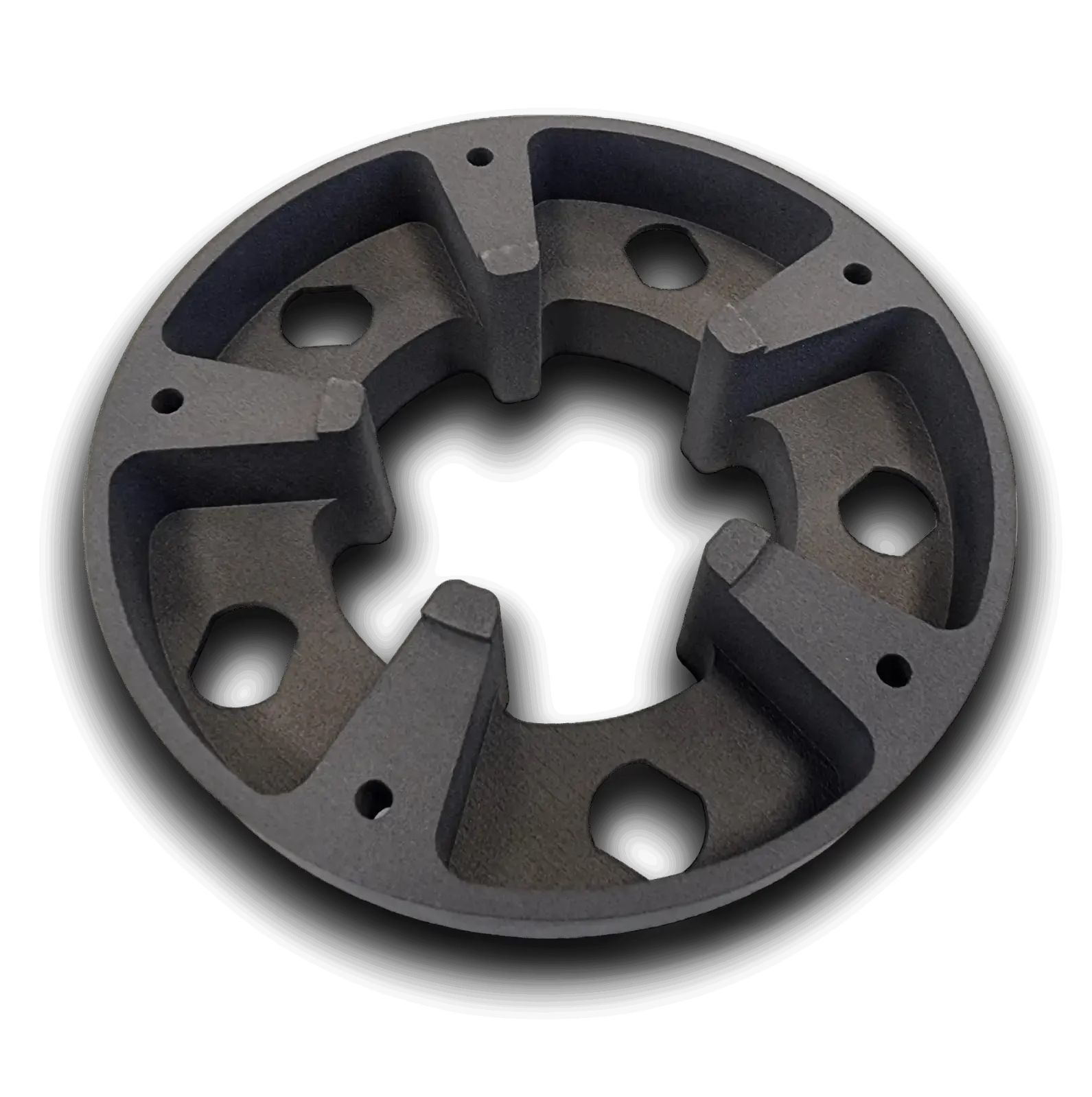
What This Page Covers
Material behavior, tolerance reality, cost drivers, and the questions to ask before you release a PO.
Which Plastics Machine Well and Which Fight Back
Most plastic housings and brackets that reach a CNC machine were never designed for cutting tools. They were designed for injection molding, then pulled forward to machining because volumes were low or the geometry changed. The arrangement works, but the material choice decides whether the job runs clean or turns into a scrap pile.
POM machines best of the common plastics. Chips break, dimensions stay stable, and you can hold ±0.005 mm on a well-fixtured feature. ABS and PC are next: ABS cuts fast and takes a decent finish, PC machines cleanly but scratches easily and needs care at the clamp. HDPE and PP cut soft and cheap, though they deflect under tool pressure, so thin walls need light passes.
PEEK, PA and carbon-fibre-filled grades sit at the other end. PEEK is abrasive and expensive, so tool wear adds real cost. Filled nylon behaves like a composite: the fibre tears rather than shears, and edges chip unless you use sharp carbide and slow feed. Ask for a material-and-finish pairing before you commit.
If your part has thin walls under 1 mm, deep narrow pockets, or a mirror finish on a soft resin, say so up front. Those three features drive fixture design and cycle time more than the plastic itself.
What ±0.005 mm Means on Plastic
Metal and plastic do not hold tolerance the same way. Plastic moves with temperature, absorbs moisture, and springs back after the cutter passes. A shop that quotes ±0.005 mm on an aluminium bracket cannot promise the same number across a 300 mm unfilled PP panel.
GreatLight runs 127 high-precision CNC machines, including 16 simultaneous 5-axis centers, and works to ±0.005 mm on rigid plastics with stable cross-sections. For soft or thin-walled parts we will tell you which features cannot hold that band and why. A straight answer here saves a rejected lot later.
Surface finish follows the same logic. Ra 0.2–0.8 μm suits optical and sealing faces on POM or PC. General machined surfaces land at Ra 1.6–3.2 μm. Bead blasting and tumbling hide tool marks on soft resins that would smear under a polishing pad.
Deeper pockets need longer tools, and long tools deflect. Past roughly four times the tool diameter in depth, expect to step down, add a second setup, or accept a looser floor tolerance. Design reviews catch this before the first cut.
Plastic Machining Quick Reference
Typical shop-floor behavior for common engineering plastics. Values are starting points for quoting, not guarantees for every geometry.
| Material | Machinability | Typical Use | Watch Out For |
|---|---|---|---|
| POM (acetal) | Excellent | Gears, bushings, seals | Chips fly; clamp marks on faces |
| ABS | Good | Enclosures, covers | Heat build-up, stringy chips |
| PC | Good | Lenses, guards, housings | Scratches; stress cracking at clamps |
| PA / Nylon | Fair | Rollers, wear pads | Moisture swell; edge chipping |
| PEEK | Fair | Medical, aerospace, seals | Abrasive; high tool wear and cost |
| HDPE / PP | Fair | Tanks, liners, ducts | Deflects; low stiffness on thin walls |
| PMMA | Good | Windows, display parts | Brittle; crazing near drilled holes |
| Carbon-fibre grade | Difficult | Jigs, structural brackets | Fibre tear-out; rapid tool wear |
Why 5-Axis Changes the Fixture Count
A three-axis machine needs the part repositioned for every face you cut. Each reposition is a new fixture, a new datum, and a new chance to stack error. On a plastic part with four or five functional faces, that adds up fast.
A simultaneous 5-axis center tilts the tool or the table, so you reach undercuts and angled bosses without pulling the part off. Fewer setups means tighter positional tolerance between features. It also means less handling, which matters when the material scratches easily.
GreatLight keeps 16 five-axis centers, 12 four-axis mills, 27 three-axis machines and 16 mill-turn centers, so we can match the machine to the part instead of forcing every job onto one platform. Large panels up to 4,000 mm run on the long-travel machines. Compact parts with tight hole patterns run on the 500 × 500 × 450 mm platforms where rigidity is higher.
One trade-off to know: 5-axis programming takes longer to prepare. For a single simple bracket it can cost more than three setups on a three-axis mill. For a complex housing, it usually wins on total cost and on accuracy.
When Machining Beats Injection Molding
Injection molding wins on unit price once the tool is paid for. Below a few thousand parts a year, that tool rarely pays back, and any design change restarts the cost. Machining carries no tooling, so a revision costs engineering time and material only.
Reach for CNC when the geometry is still moving, when the part is large and the annual volume is low, or when the material is a filled or high-temperature grade that molds poorly. Prototypes and bridge parts fit here too: you can validate fit and function while the mold is being cut.
Stay with molding when the part is small, the volume is steady, and the surface you need is a molded texture rather than a machined one. Machining a 50 mm cover in the thousands is the wrong call, and a supplier who says so is worth keeping.
GreatLight runs from one prototype to 10,000+ part runs with no minimum order quantity, so the first parts can come off a mill and the production parts off a mold later.
How to Check Plastic Parts Without Chasing Ghosts
Plastic moves after it is cut. A part measured hot off the machine can read differently an hour later once it settles. That single fact drives most of the arguments about a rejected lot.
Ask the supplier to stabilize the part before final inspection: let it rest, control the room, and measure on a granite surface with a temperature-compensated CMM. GreatLight inspects 100% of parts before shipment, with raw material checks, in-process monitoring and a final pass, and reports are available on request.
For soft resins, agree on a contact force for any gauge touching the surface. A heavy touch on a PC lens will read undersize and leave a mark. Non-contact measurement is the better route for optical faces.
Define the datum in the drawing, not in the email thread. On a flexible part, datum choice can shift a reading by more than the tolerance you are arguing about.
Common Questions
Can Chinese plastic CNC precision suppliers hold ±0.005 mm on any plastic?
No, and any answer of yes should make you cautious. We hold ±0.005 mm on rigid, stable plastics with good cross-sections, such as POM, PC and filled grades.
On thin walls, soft resins and long unsupported features, the achievable band is wider. We will tell you which dimensions cannot hold before the job starts.
Which file formats and information do you need for a quote?
Send a STEP or IGES model plus a 2D drawing showing datums, tolerances and critical features. A PDF with the key dimensions is enough for an initial read.
Quotation and a free DFM analysis come back within 12 hours. Uploads stay secure and confidential, and we sign an NDA on request.
What is the smallest order you accept?
There is no minimum order quantity. We run one-off prototypes and repeat runs over 10,000 parts on the same floor.
Production can start within 24 hours of a released order, and parts typically ship in 3–5 days depending on material and finishing.
Do you machine carbon-fibre-filled plastics?
Yes, but expect higher cost. The fibre is abrasive and wears carbide quickly, so tool changes add machine time.
Edge quality depends on tool sharpness and feed rate. Tell us which edges are cosmetic so we can plan the toolpath around them.
Can you match a molded surface finish on a machined part?
Partially. Bead blasting and tumbling can approximate a matte molded texture on many resins.
A mirror or high-gloss molded finish is difficult to reproduce by cutting, especially on soft plastics where polishing smears the surface.
Which certifications cover plastic machining work?
GreatLight holds ISO 9001:2015, IATF 16949:2016, ISO 13485:2016 and ISO 27001:2022. The medical and automotive standards matter most for plastic parts.
Tell us your end use at the quote stage so the inspection plan matches the standard you are audited against.
Send Your Plastic Part for a DFM Review
Upload a model and drawing. You get a quotation and a free DFM analysis within 12 hours, plus a straight answer on which tolerances the material can hold.
12-hour quote±0.005 mm tolerance100% inspectionNDA on request









