
CNC 101: Start With Computer Numerical Control
This guide explains what happens between a CAD file and a finished metal part. It is written for design engineers, mechanical engineers and sourcing staff who need to judge whether a part suits CNC, which machine type fits, and what to put on the drawing. No prior machining background is assumed.
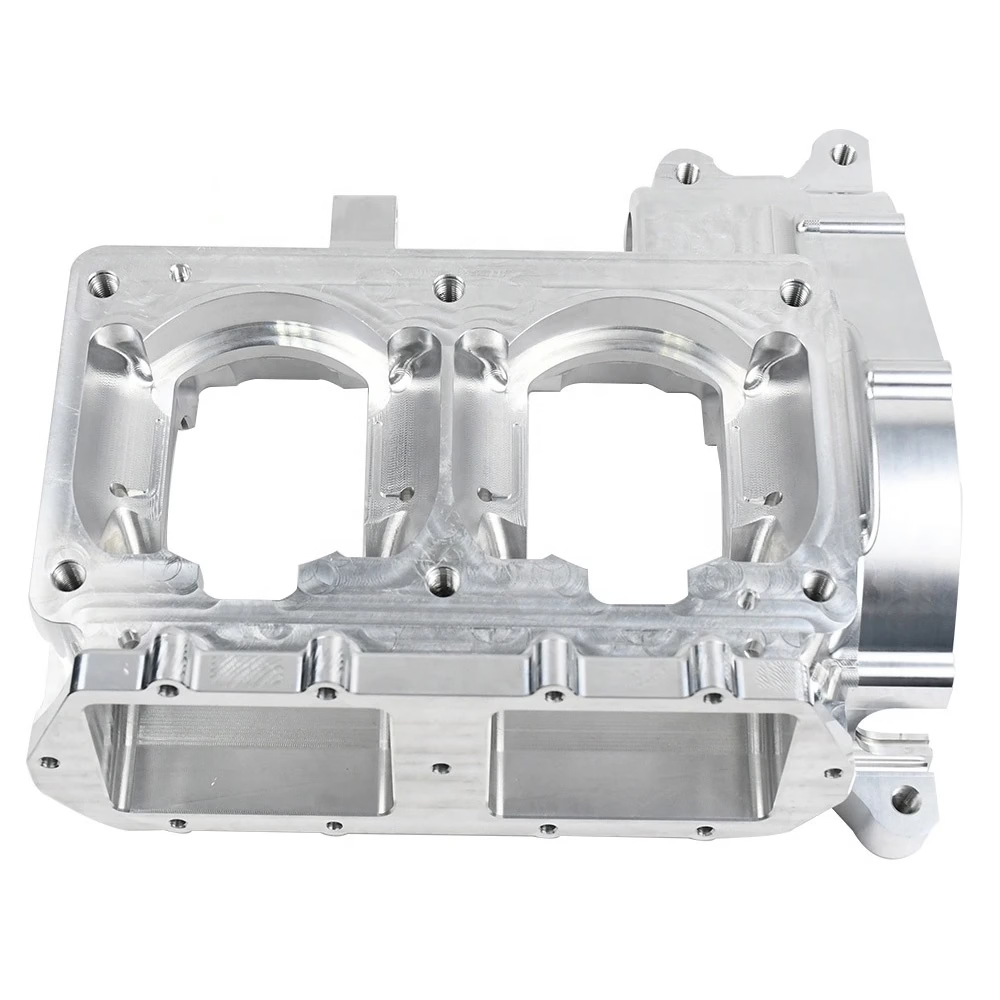
What Computer Numerical Control Actually Is
A CNC machine is a metal-cutting machine whose slide movements come from a stored program instead of a handwheel.
From Punched Tape to the Control Cabinet
Numerical control began in the late 1940s and 1950s, when the US Air Force funded work on machines that could cut complex aircraft contours from a set of coordinates. Those early controls read punched tape. The operator still changed tools by hand and measured every part. The 1960s and 1970s added tool changers and closed-loop feedback, and the arrival of cheap computing in the 1980s put a real controller on the shop floor.
A modern CNC machine has three parts you should be able to name. The controller is the industrial computer that reads the program, runs the look-ahead and decides where each axis goes next. The drives and motors move the slides, usually through ball screws, to the commanded position. The feedback system, typically an encoder on each axis, reports the actual position back so the control can correct the error.
That loop is the whole point. A manual mill depends on the operator's hand and eye. A CNC machine compares commanded position with measured position thousands of times per second. The result is repeatability: the tenth part matches the first, provided the tool, the fixture and the thermal state of the machine stay stable.
So when someone asks what CNC means, the short answer is this. The geometry lives in a file. The controller turns that file into motion. The machine repeats the motion until you tell it to stop.
How a Part Travels From CAD to Chip
The chain starts with a 3D model. A CAM programmer sets the work coordinate system, picks tools, and generates toolpaths. Post-processing turns those toolpaths into G-code for the specific controller, whether that is Fanuc, Siemens, Heidenhain or something else. G-code is mostly coordinates, feed rates, spindle speeds and tool changes. M-code handles the auxiliary actions such as coolant and pallet changes.
At the machine, the setup operator mounts the stock in a vise, chuck or fixture, touches off the tools, and confirms the work offset. The first part is normally cut as a prove-out, often in a softer material or with the feeds pulled back. A CMM or a hand tool then checks the critical dimensions against the drawing.
Once the first article passes, the run is mostly about control. Climb milling versus conventional milling affects surface finish and tool load. Coolant choice affects chip evacuation and heat. Tool wear drifts the size, so an operator offsets the tool radius to hold the tolerance band. On long runs we stop at intervals and re-measure rather than trusting the machine to hold size for hours.
If a feature cannot be reached in one setup, it goes to a second operation. Each extra setup adds a small positional error, so the drawing should call out which dimensions matter and which surfaces are datums. That single piece of information often decides whether a part is easy or expensive.
Which Machine Type Fits the Feature
Three-axis machining moves the part in X, Y and Z while the spindle stays vertical. It handles pockets, slots, faces, holes and most prismatic parts. It is the cheapest option per hour and the easiest to fixture. If your part has features on five faces, three-axis work means multiple setups and multiple chances to lose position.
A fourth axis adds rotation, usually around X. This lets the machine cut several faces in one setup, or index a shaft so flats, keyways and cross-holes stay in phase. If a part is long and round with features along its length, index the rotary table rather than re-fixturing four times.
Five-axis machining adds two rotary axes, so the tool can approach the part from almost any angle. There are two common formats. Table-table machines tilt the part under a fixed spindle. Spindle-tilt machines, or mill-turn centers, move the head instead. The practical payoff is shorter tools, which deflect less, and single-setup access to angled faces, deep pockets and contoured surfaces.
Contouring is where five-axis earns its cost. An impeller blade, a turbine vane or an organic bracket cannot be cut cleanly with a three-axis toolpath because the tool has to reach around the surface. Once the part is simple and prismatic, five-axis adds setup time and programming hours without adding value.
- 1Three-axisFaces, pockets, slots, hole patterns, simple prismatic parts
- 2Four-axisShafts, bushings, parts with features on four sides
- 3Five-axisImpellers, angled faces, deep cavities, contoured surfaces
- 4Mill-turnRound parts with milled features, cut in one setup
Machine Capacity at a Glance
Typical envelope and positioning data across the machine groups we run.
| Machine group | Typical travel | Best for | Note |
|---|---|---|---|
| Three-axis | 500 × 500 × 450 mm | Prismatic plates and housings | Lowest hourly cost |
| Four-axis | 500 × 310 × 200 mm | Shafts and indexed round parts | Rotary table Ø400 mm available |
| Five-axis | 600 × 600 × 600 mm | Angled faces and contour work | 16 simultaneous centers |
| Mill-turn | 750 × 1,150 × 550 mm | Round parts with milled features | One setup for turning and milling |
| Large gantry | 4,000 × 400 × 150 mm | Long extrusions and profiles | 4,000 mm maximum length |
What CNC Cuts Well, and What It Does Not
CNC is a subtractive process, so it suits parts where you need tight tolerances, sharp internal corners, good surface finish and known material properties. Aluminum 6061 and 7075 cut fast and hold size well. Stainless 303 and 304 machine cleanly, though 316L work-hardens if the tool rubs. Titanium TC4 (Ti-6Al-4V) and Inconel need slower speeds, more rigid setups and sharp tooling, which raises cost.
Plastics behave differently. POM and PEEK hold tolerance well. ABS and PP move with heat and clamp pressure, so thin walls can spring. Carbon fiber machines cleanly enough for prototype brackets but the dust must be controlled.
There are shapes CNC should not touch. A hollow part with a large internal void and no parting line is usually better as a casting or an additive build. A thin sheet panel with hundreds of identical holes is faster on a punch or laser. A part with a hundred identical small features in a deep cavity may need EDM or a different design.
A useful test is to count the setups and the tool reaches. One setup, four tools, all faces reachable: CNC will be quick and cheap. Five setups, long slender tools, features that need a 0.5 mm cutter: expect a higher quote and a longer lead time. Redesigning for access often cuts cost more than choosing a different supplier.
What to Put on the Drawing
State the material and temper, not just the alloy family. 6061-T6 is not the same as 6061-O. Call out the tolerance standard you want, and mark only the dimensions that matter as critical. If every dimension carries ±0.005 mm, the part will be inspected slowly and the price will reflect that.
Define datums. A datum tells the machinist what to hold in the fixture and what to measure from. Parts with clear datums get made and checked faster. Add surface finish where it matters, for example Ra 0.8–1.6 μm on a sealing face, and leave the rest as-machined.
Say whether sharp corners are allowed. Internal vertical corners always carry a tool radius, so a note that says corner radius 0.4 mm maximum lets the programmer choose a smaller cutter deliberately instead of guessing. Add a finish note if the part will be anodized, because masking and edge break requirements change the machining step.
Finally, tell us the function. A bracket that holds a cable and a bracket that sets gear mesh look similar on paper and should be toleranced very differently. Function is the fastest way to move a quote from a guess to a number.
How We Run the First Article
GreatLight has been machining since 2011 and now runs 127 high-precision CNC machines across 3 wholly-owned plants in Dongguan and Singapore, totaling 7,600 m². The shop includes 16 simultaneous 5-axis centers, 12 four-axis mills, 27 three-axis machines and 16 mill-turn centers. Maximum processing size is 4,000 mm.
A new order follows a fixed path. We review the model and report manufacturability, usually within 12 hours of receiving files. Production can start within 24 hours of approval, and parts typically ship in 3–5 days. There is no minimum order quantity. One prototype and a 10,000-part run go through the same inspection discipline.
Quality control is not a final step here. Incoming bar stock is checked against the mill certificate. In-process checks run at set intervals on the features that drive fit. Every part is inspected before shipment, and reports are available on request. We hold ±0.005 mm ( ±0.0002 in ) on turned and milled features where the drawing calls for it, and finish down to Ra 0.2–0.8 μm on sealing and bearing surfaces.
The shop is certified to ISO 9001:2015, IATF 16949:2016, ISO 13485:2016 and ISO 27001:2022. Uploads are handled as confidential, and we sign an NDA when a program needs one.
Common Questions
Does a CNC machine need a special computer to run?
No. The controller is built into the machine and runs its own real-time software. You prepare the program on a normal workstation with CAM software, then transfer it by network, USB or drip feed.
A small single-board computer can post-process or send code, but it does not replace the machine control. The control is what closes the position loop and keeps the axes safe.
Why does the same part cost more in five-axis than in three-axis?
Five-axis programming takes longer, the machine hour rate is higher, and setup and verification are more involved. You pay for the ability to reach angled faces and contour surfaces in one setup with a shorter, stiffer tool.
If the part is prismatic and all features are reachable from three directions, five-axis adds cost without adding accuracy.
What tolerance is realistic on a CNC machined part?
We hold ±0.005 mm ( ±0.0002 in ) on features where the drawing requires it. That figure depends on material, feature size, wall thickness and how many setups the part needs.
Long thin parts and thin walls move under clamping and cutting forces. If a feature is 300 mm long and 1 mm thick, talk to us before you lock the tolerance in.
Which file formats should I send for a quote?
STEP and IGES cover most solid models. Native files from SolidWorks, Fusion 360 or Inventor are fine too. Send a 2D PDF drawing alongside the model so tolerances, datums and finish notes travel with the geometry.
If you only have a drawing, we can still quote, but expect a longer review and a note about any feature we cannot confirm from 2D alone.
Can you machine a single prototype without a minimum order?
Yes. There is no minimum order quantity. We routinely cut one part for a fit check and then move to a production run of the same geometry.
For prototypes we can also advise on which tolerances to loosen so the first article ships faster without losing function.
How do you handle confidential designs?
Uploads are treated as confidential. We sign a non-disclosure agreement when a program requires one, and access to customer files is limited to the engineers who need them.
Certification to ISO 27001:2022 covers the information security side of that arrangement.
Send a Model, Get a Real Answer
Upload your files and an engineer will return a quote with manufacturability notes, usually within 12 hours.
12-hour quote100% inspectionNo minimum order









