
CNC 1580 Machining Center Price Guide
This guide is for engineers and buyers who are pricing a 1580-size vertical machining center or comparing it with outsourcing. It breaks the machine price into spindle, structure, controller and tooling, then shows which part sizes actually justify the spend.
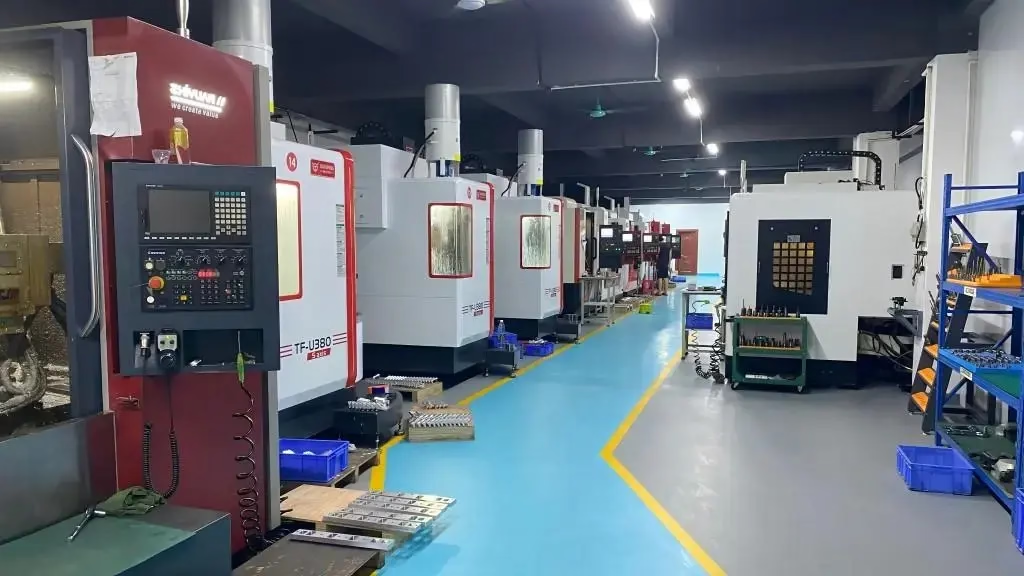
What a 1580 machine actually is
Frame size first, then spindle, then everything else.
Reading the 1580 number before you read the price
The number in CNC 1580 machining center refers to the table and travel envelope. The common layout is roughly 1,500 mm on X, 800 mm on Y and 700 mm on Z, with a table around 1,700 × 800 mm. That is a different class of machine from a 850 or a 1060. The casting weighs several tonnes, and that mass is what keeps a 300 mm face mill from chattering on a steel plate.
Buyers often compare a 1580 against a 1160 and assume the price gap is mostly table size. It is not. A wider Y and a taller Z demand a heavier column and a longer saddle, so the linear guide size, ball screw diameter and servo torque all step up. A 1580 with a 800 mm Y travel can hold
A machine this size also changes how you fixture. A 1,200 mm aluminum plate bolted to the table at four points will bow when you clamp it if the table has a T-slot pattern that does not match the part. Shops that run 1580 work keep a set of modular tombstones and angle plates on hand, because the cost of the machine is partly the cost of the workholding that feeds it.
Where the frame size stops helping is thin, tall parts. A 900 mm tall bracket with a 40 mm wall thickness will deflect under its own cutting load no matter how rigid the base is. In that case the 1580 adds nothing over a smaller machine with a taller column riser.
Where the money goes in a 1580 machine price
There is no list price for a vertical machining center, and any quote you see online is a starting configuration. The four cost centers that move the number most are the spindle, the structure, the controller and the tooling package.
Spindle choice is the single largest swing. A belt-driven 8,000 rpm spindle with BT40 taper is the baseline for general milling. Step up to a 12,000 rpm direct-drive spindle with a bigger bearing set and you pay for the motor, the cooling and the balancing. Add through-spindle coolant and the price climbs again, because the rotary union, high-pressure pump and filtration are separate line items.
Structure follows. A cast iron base with box ways costs more than a welded steel frame with linear guides, but it damps vibration better on heavy cuts. If your parts are mostly aluminum at 6,000 rpm, linear guides are fine and you save weight and money. If you are roughing 4140 steel, box ways on the Z axis pay for themselves.
The controller is the third lever. A three-axis Fanuc or Siemens package is standard. Adding a fourth axis, a rotary table and the drive to run it is a separate purchase, and a Ø400 mm rotary table with a tailstock will add a meaningful percentage to the machine total. The tooling package is the last piece: a 24-tool umbrella magazine versus a 40-tool chain magazine, plus the pull studs, holders and presetters you will need on day one.
1580 machine versus outsourcing the same parts
Rough guide for shops deciding between capital spend and per-part pricing.
| Factor | Buy a 1580 | Outsource to GreatLight |
|---|---|---|
| Upfront cost | Machine, tooling, workholding, install | No capital outlay |
| Lead time to first part | Weeks of install and prove-out | 3–5 days for parts |
| Spindle time at 3 a.m. | You pay for idle hours | Only billed when parts run |
| Large part envelope | Up to your travel limits | Up to 4,000 mm processing size |
| 5-axis work | Needs a 4th or 5th axis option | 16 simultaneous 5-axis centers |
| Maintenance risk | Spindle rebuild at 40,000–50,000 h | Carried by the supplier |
| Low-volume runs | Hard to justify | No minimum order quantity |
| Inspection | Your metrology or a CMM purchase | 100% inspection before shipment |
Which parts belong on this machine
A 1580 earns its keep on parts that are too big for a 40-taper 850 and not large enough to need a boring mill. Think 600 to 1,400 mm long aluminum housings, steel weldments that need all faces machined in two setups, and plate work with dozens of holes and pockets.
Automotive and EV work fits well. Battery tray modules, motor housings, inverter baseplates and suspension brackets all sit inside the envelope and often need a flatness callout that a smaller machine struggles to hold. Aerospace fixture plates and ground support brackets also land here, because they are long, thin and drilled on a pattern that has to stay true across the full length.
Medical and semiconductor work is a harder sell. A 1580 can cut an implant or a vacuum chamber lid, but the part may not need the travel. You are paying for capacity you will not use, and a smaller machine with a finer spindle will usually hit Ra 0.2–0.8 μm more easily.
The honest answer is that the machine size should follow the largest single feature on the part, not the average part in the shop. If one job in twenty needs 1,400 mm of X travel, that job may be better outsourced than bought for.
When outsourcing the same work costs less
For a project-based business, the 1580 price is only the first payment. Power, floor space, coolant disposal, tool consumption and a skilled operator are recurring. A machine that runs 20 hours a week cannot amortize any of that well.
Outsourcing converts those fixed costs into a per-part price that appears only when you have an order. For prototype runs and high-mix, low-volume production, that is usually the better trade. You also get access to capacity you would not buy: a 4,000 mm maximum processing size, 16 simultaneous 5-axis machining centers, 12 four-axis mills and 27 three-axis machines under one roof.
The catch is that outsourcing only works when the supplier can hold your tolerance and document it. Ask for the inspection method before you ask for the price. At GreatLight we machine to ±0.005 mm and inspect 100% before shipment, with raw material checks, in-process monitoring and final reports on request.
Confidentiality matters too. Uploads are secure and confidential, and an NDA is available on request. If your drawings cannot leave the building under a signed agreement, settle that before the first quote.
Material and finish choices that change the quote
The material list for a machine this size is wide. Aluminum grades run from 6061 and 6061-T6 to 7075 and ADC12. Stainless covers 303, 304, 316L, 17-4PH and 440C. Steel includes 1018, 1045, 4130, 4140 and 4340. Copper and brass work covers C101, C110, C36000 and beryllium copper. Titanium and special alloys include TC4 (Ti-6Al-4V), Inconel and magnesium AZ31B. Plastics range from POM and PA to PEEK and carbon fibre.
Each family changes cutting parameters, tool life and therefore price. Titanium and Inconel cut slowly, generate heat and eat carbide. PEEK needs sharp tools and controlled feeds to avoid melting. Magnesium needs coolant discipline and chip handling that most shops do not have on the floor.
Finishing adds another layer. Anodizing in clear, color or hardcoat, electroless nickel, zinc, silver and gold plating, powder coating and black oxide, plus bead blasting, tumbling, brushing and polishing. Laser marking is available down to a minimum character height of 1.5 mm.
None of these are exotic for a 1580. The point is that two quotes for the same drawing can differ by a wide margin if one assumes 6061-T6 as-machined and the other assumes 17-4PH with a hardcoat and a CMM report. Compare quotes on the same material, finish and inspection scope.
Common questions
How long does a 1580 spindle last before rebuild?
With diligent maintenance, 10 to 15 years is a reasonable expectation for the machine as a whole.
Critical components such as the spindle and drives may need replacement after 40,000 to 50,000 operating hours, depending on load and coolant condition.
Can a 1580 hold ±0.005 mm over a 1,200 mm part?
Tolerance is a function of thermal stability, fixturing and the measurement method, not just the machine. A rigid setup and a temperature-stable shop can hold it on a part that size.
On long parts, verify with a CMM or a laser interferometer rather than a hand tool. We inspect 100% before shipment and can supply reports on request.
What is the largest part that fits?
Travel depends on the specific machine, so ask for the work envelope before you design the fixture.
At GreatLight the largest processing size is 4,000 mm. Other envelopes on our floor include 4,000 × 400 × 150 mm, 750 × 1,150 × 550 mm, 600 × 600 × 600 mm, 500 × 500 × 450 mm and 500 × 310 × 200 mm.
Do I need a 4th or 5th axis on a machine this size?
Only if the part has features on multiple faces that cannot be reached in two or three setups. A rotary table adds cost, and a Ø400 mm table with a tailstock is a separate purchase.
If most of your work is prismatic, a three-axis 1580 with good fixtures will outproduce a five-axis machine that spends time indexing.
What does the quote process look like if we outsource instead?
Send the CAD file and we return a quotation with free DFM analysis within 12 hours. Production can start within 24 hours of approval.
Parts typically ship in 3–5 days. There is no minimum order quantity, so a single prototype and a 10,000-part run go through the same process.
Which materials can you machine on this class of machine?
Aluminum, stainless steel, steel, copper and brass, titanium, Inconel, magnesium alloys, engineering plastics and composites.
For critical applications we validate material certification before cutting, and we can supply mill certificates with the parts.
Price the parts before you price the machine
Send your CAD file and get a quotation with free DFM analysis within 12 hours.
12-hour quote100% inspectionNo MOQ









