
CNC Bed Factory Basics: Your Guide to Choosing the Right One
This guide is for engineers and sourcing teams comparing CNC bed factory suppliers for large, rigid parts. It covers how bed structure affects accuracy, what to ask about travel and spindle, and the checks that separate a capable shop from a risky one. Read it before you send a drawing or accept a quote.
Key takeaways
What to compare before you place an order
Use the same criteria for every supplier so the quotes are comparable.
| Criteria | What to ask | Red flag |
|---|---|---|
| Bed and column design | Fixed bed or moving gantry? Casting mass? | No answer on damping or thermal growth |
| Travel envelope | X, Y, Z in mm for your part size | Only quotes the longest dimension |
| Achievable tolerance | ±0.005 mm? On which feature? | Claims tolerance without a feature list |
| Surface finish | Ra range for sealing or bearing faces | One Ra number for the whole part |
| Certifications | ISO 9001, IATF 16949, ISO 13485, ISO 27001 | Certificate expired or out of scope |
| Order quantity | One prototype up to 10,000+ parts | Hidden setup fee per batch |
| Lead time | Quote, first cut, ship date | Verbal dates, nothing in writing |
| Inspection | 100% before shipment? Reports? | Sampling only, no record |
The short version
Pick a CNC bed factory for large, heavy parts that need rigidity and a tight tolerance. Pick a smaller 3-axis shop for small parts, light cuts and short runs. Verify travel in mm, tolerance per feature, and the inspection record before you commit.
Why the bed structure decides your tolerance
On a bed-type vertical mill, the workpiece sits on a large fixed bed while the spindle head travels on the column. The table moves in X and Y, the head moves in Z. Because the heaviest casting stays still, the machine damps vibration instead of amplifying it. On a knee mill the whole table and knee move, so a heavy interrupted cut pushes the part around.
That difference shows up in the cut, not on the spec sheet. Deep pockets in 4140 or 17-4PH push cutting force back into the structure. A rigid bed absorbs it and the tool stays on path. A lighter frame lets the tool deflect, and you see chatter marks or a taper on the wall.
Bed mass also slows thermal drift. A shop running lights-out will see the frame warm up over the first hour. Machines with a heavy bed and a stable base settle faster, which matters when you hold ±0.005 mm across a long part.
None of this helps if the part is small. For a 100 mm bracket, a bed mill is overkill and a 3-axis machine with 500 × 500 × 450 mm travel will do the job faster and cheaper.
- 1Fixed bedBest damping, best for heavy cuts and long parts.
- 2Moving columnLarge envelope in a smaller footprint.
- 3Knee millFine for light cuts, poor under load.
Matching machine travel to your part
Travel is a three-number problem. A machine with 4,000 mm in X but only 400 mm in Y cannot cut a 900 mm wide plate. Read the envelope as a box and lay your part inside it, including the fixture. A vise or a tombstone eats 100 to 200 mm before the tool touches metal.
Z travel is where most quotes go wrong. A tall part may fit in X and Y and still not clear the spindle nose. Add tool length and holder length to the part height, then compare that number to Z travel.
For medium parts, envelopes like 750 × 1,150 × 550 mm or 600 × 600 × 600 mm cover most fixture plates, housings and manifolds. Compact machines at 500 × 500 × 450 mm suit brackets and small enclosures.
If your part needs features on five faces, a 5-axis machine with a Ø400 mm rotary table removes the re-fixturing step. Each refixture adds position error. On a tight-tolerance part that error is often larger than the machine tolerance itself.
- 1Add fixture spaceBudget 100–200 mm for workholding.
- 2Check Z lastPart height plus tool and holder must clear the spindle.
- 3Count the setupsEvery refixture adds stack-up error.
Which parts belong on a bed-type machine
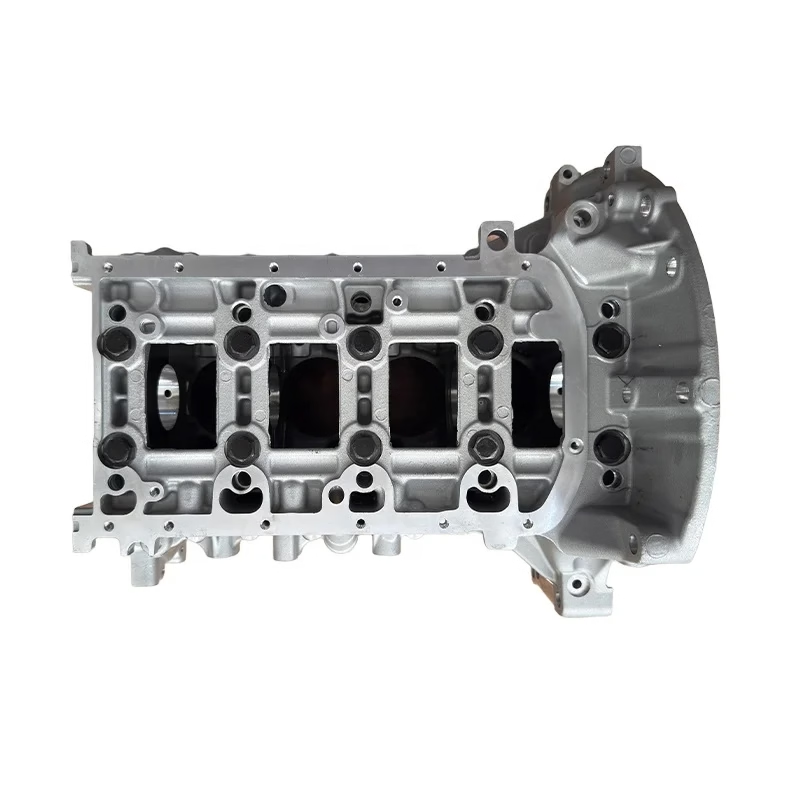
Bed-type machines earn their cost on parts that are large, heavy, or hard to hold. Think engine blocks, transmission housings, mold bases, structural brackets, and medical imaging frames. These parts share one trait: the cut force is high and the tolerance is tight.
Aluminium 6061 and 7075 cut fast on these machines and hold finish well. Stainless 316L and 17-4PH machine slower but reward rigidity with better tool life. Titanium TC4 and Inconel push the hardest, and this is where a stiff bed pays for itself in fewer broken tools.
Some parts do not belong here. Thin-walled shells, small batches of tiny parts, and geometry that fits in a 200 mm cube are cheaper on a 3-axis mill or a lathe. Sending that work to a large bed machine raises the hourly rate without improving the result.
Material choice also drives the finishing plan. A sealing face may need Ra 0.8–1.6 μm, while a cosmetic panel can stay at Ra 1.6–3.2 μm as machined. Write the Ra value per surface on the drawing. Otherwise you pay for a fine finish on faces that never touch anything.
- 1Good fitLarge housings, mold bases, structural and engine parts.
- 2Poor fitSmall thin-wall parts and short runs of tiny components.
Judging a CNC bed factory, not just the machine
Machine size is easy to verify. Process control is not. Ask how the shop handles first-article inspection, in-process checks, and final inspection. A supplier that inspects 100% before shipment and can send dimensional reports on request is a different risk profile from one that samples a batch.
Ask what happens when the part is out of tolerance. A clear answer involves measurement data, a root cause, and a rework or remake plan. A vague answer usually means you will hear about it after the ship date.
Confidentiality matters if your drawings carry IP. Look for a shop that treats uploads as secure and confidential and will sign an NDA on request. This is standard practice, not a special favor.
Finally, check how the shop reads a drawing. A useful DFM reply points at specific features: a corner radius that needs a smaller tool, a thread that should be a different pitch, a wall too thin to hold. That reply tells you more than any equipment list.
- 1Inspection recordAsk for the report on your part, not the certificate on the wall.
- 2Rework policyWho pays, and on what timeline?
- 3NDAAvailable on request before you send files.
Step by step: how to vet a CNC bed factory
Run these in order. Each step removes a class of risk before you commit tooling time.
- 11. Define the part envelope and toleranceWrite down X, Y, Z including fixture space, the tightest tolerance per feature, and the Ra value per surface. A 4,000 × 400 × 150 mm envelope and ±0.005 mm on a bearing bore are different asks.
- 22. Send the drawing and request DFMAsk for a quotation and a DFM analysis. A shop that replies within 12 hours has engineering staff reading the file, not a sales desk guessing.
- 33. Confirm machine fit in writingAsk which machine will run the part and its travel. If the answer is a machine class instead of a number, ask again. Get mm.
- 44. Check certifications against your industryISO 9001:2015 covers general quality. IATF 16949:2016 fits automotive and EV. ISO 13485:2016 fits medical. ISO 27001:2022 covers data handling.
- 55. Agree on the inspection planState which features get measured, with what tool, and whether a report ships with the parts. 100% inspection before shipment should be the baseline.
- 66. Settle quantity and lead timeConfirm the run size from one prototype to 10,000+ parts, and the quote, first-cut and ship dates. Parts shipping in 3–5 days is normal for a well-loaded shop.
- 77. Sign the NDA and release filesDo this before sending CAD. Keep a revision log so the shop and your team work from the same drawing number.
Common questions
What is the difference between a CNC bed factory and a regular CNC shop?
A bed-type machine keeps the workpiece on a fixed bed and moves the spindle head in Z, with the table moving in X and Y. That layout gives more damping and rigidity than a knee mill.
A general CNC shop may run only 3-axis machines with smaller envelopes. A bed factory is set up for large, heavy parts and deep cuts.
How do I know if my part is too small for a bed-type machine?
If the whole part, plus fixture, fits inside roughly 500 × 500 × 450 mm and the cuts are light, a 3-axis mill will usually be faster and cheaper.
Large machines carry a higher hourly rate. Using one for a small bracket does not improve the part.
What tolerance and finish should I expect?
A capable shop can hold ±0.005 mm (±0.0002 in) on critical features. Finish ranges from Ra 0.2–0.8 μm on a fine-ground or polished face to Ra 1.6–3.2 μm as machined.
Put the tightest value only on the features that need it. A blanket tolerance on the whole drawing raises cost.
Do I need to order a large quantity?
No. Runs can start from a single prototype and scale to 10,000+ parts. The setup and inspection steps stay the same, so the first part carries most of the cost.
Ask how the shop handles a one-off before you assume there is a minimum.
How fast can parts ship?
A quotation and free DFM analysis can come back within 12 hours, and production can start within 24 hours of approval. Parts ship in 3–5 days for typical work.
Complex geometry, special material or a new finish will add time. Ask for the date in writing.
Which materials are common on these machines?
Aluminium 6061-T6, 7075 and 2024, stainless 303, 304, 316L, 17-4PH, steel 1018, 1045, 4140 and 4340, plus titanium TC4, Inconel and engineering plastics like POM and PEEK.
Match the material to the function first. The machine can handle most of them, but tool life and cycle time change a lot.
Send your drawing for a DFM review
We reply with a quotation and free DFM analysis within 12 hours, and inspect 100% of parts before shipment.
12-hour quote100% inspectionNo MOQNDA on request
More from the shop floor
We publish setup notes, tooling trials and inspection data from the factory floor.











