
CNC Belfast Expert: How 5 Axis Work Is Quoted and Run
This page explains what happens between a STEP file and a finished metal part. It covers setup count, datum choice, tolerance stack-up and inspection, so you can judge whether a quote is realistic before you place the order.
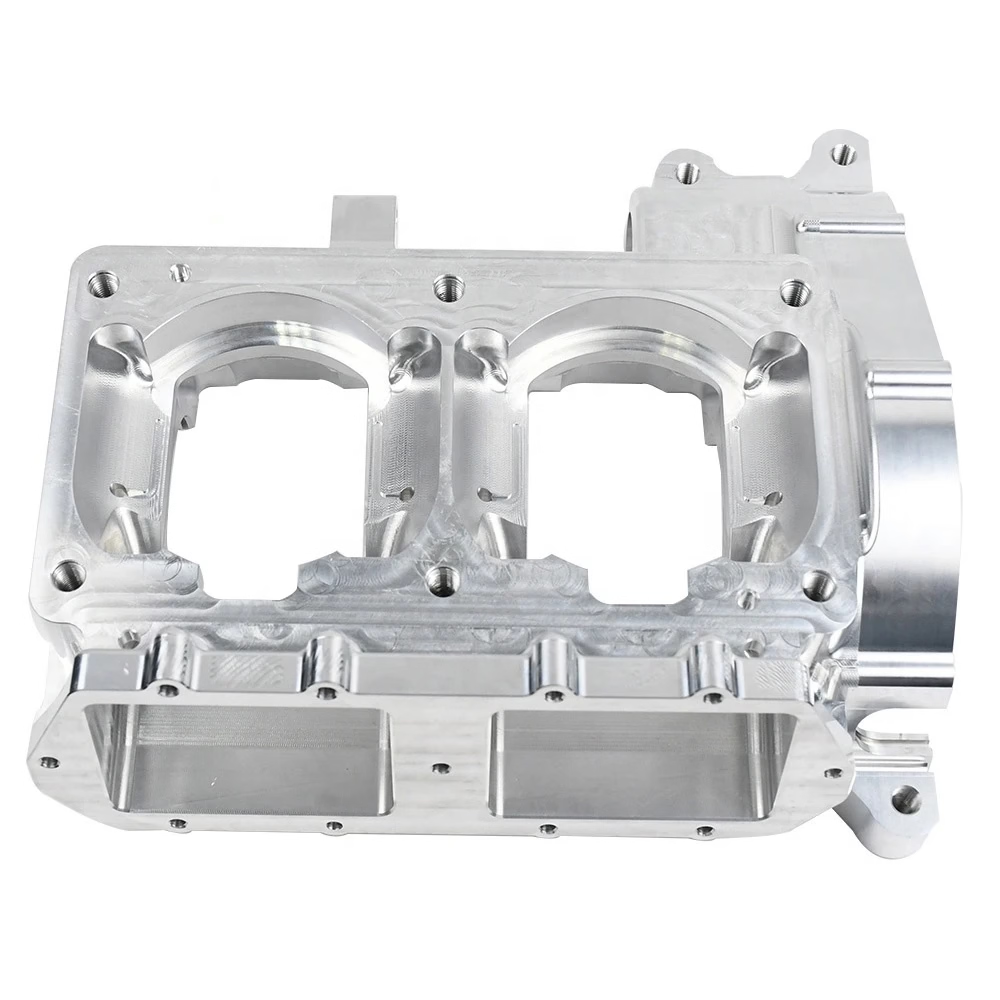
What Five Axis Actually Buys You
A three-axis machine moves the tool in X, Y and Z. Every face that needs work has to be reached by rotating the part. Take a bracket with features on five sides: it often needs four or five separate setups, and each setup adds a re-clamp, a new datum and a fresh chance for error.
Five-axis work adds two rotary motions, so the tool can approach a face from an angle instead of the part being moved. A housing with ports on three sides can often be cut in two setups instead of five. The gain is not speed on a single face. The gain is fewer times the part leaves the vise.
That matters most when features must stay in relation to each other. Bore to bore distance, port angle to mounting face, bolt pattern to a machined spigot: these hold up better when the part is not re-clamped between them.
The trade is real. Five-axis setups need more planning, longer CAM time and often a custom fixture. If your part is a flat plate with holes drilled from one direction, a three-axis machine will usually be cheaper and just as accurate.
Why the Datum Decides the Result
Every measurement on a drawing is taken from something. If the machinist picks a different reference than the designer did, the part can be in tolerance on each feature and still not assemble. This is the most common cause of a first article that fails at the customer's plant.
The fix is boring and effective: state the datum on the drawing, and use it in the fixture. If face A is the assembly face, face A should sit on the fixture and be the zero for the probe. When a part has no obvious datum, the quote should say which one we plan to use and why.
Softer materials make this sharper. Aluminium 6061 and 5052 move when you clamp them hard, and a datum that shifts 0.02 mm under clamping pressure will drag every feature with it. Light clamping and a rough-then-finish pass usually cost less than chasing the problem later.
Thin walls are the same story. Below about 1.5 mm wall thickness on aluminium, cutting forces push the wall away from the tool, and spring passes are needed. That is a machining decision, not a design failure, but it has to be priced in.
Reading a Tolerance Before You Promise It
±0.005 mm is a shop floor number, not a catalog number. We hold it on features that are reachable, stable and measured with the right tool. A deep bore 120 mm from the spindle nose is not the same job as a face at the front of the vise.
Ask what the feature does. A bearing seat needs a tight diameter and a good surface finish. A clearance hole for an M6 bolt needs position, not size. Splitting the drawing this way lets the tight tolerance go where it earns its cost.
Surface finish and tolerance are linked. Ra 0.2–0.8 μm on a sealing face needs a fine finish pass and a sharp tool. Ra 1.6–3.2 μm as machined is enough for most brackets, and it is faster. Calling out a fine finish everywhere on the print only adds cost.
One more thing: stack-up. If three features each carry ±0.05 mm and the assembly gap is 0.1 mm, the numbers do not work. Do the sum before the drawing is released, not after the parts arrive.
Material Choice Changes the Process
Aluminium 6061-T6 and 7075 cut cleanly and hold a good finish. Stainless 304 and 316 work-harden, so the tool has to keep moving and the feed cannot be timid. Titanium TC4 (Ti-6Al-4V) and Inconel generate heat at the cutting edge, and tool life is measured in minutes, not hours.
Copper and brass machine fast but burr heavily, so deburring is part of the price, not an extra. Plastics like POM and PEEK need sharp tooling and air blast rather than coolant, or the chips weld back onto the cut.
Finishing follows the same logic. Anodizing adds a few micrometres per surface and can change a press fit. Hardcoat anodizing adds more. If a bore must stay at size after coating, mask it or cut it undersize before the finish.
Laser marking is limited by character height. We mark down to 1.5 mm character height. Smaller text fills in and becomes unreadable, so put the serial number where it has room.
Three Axis vs Five Axis vs Mill-Turn
Match the part geometry to the machine before you ask for a price.
| Part feature | Three axis | Five axis | Mill-turn |
|---|---|---|---|
| Faces to machine | 1–2 | 3–5 | 2–6 plus turning |
| Typical setup count | 2–4 | 1–2 | 1–2 |
| Angled holes and ports | Needs an angle plate | Cut in one setup | Cut in one setup |
| Round and prismatic mix | Two separate jobs | Two separate jobs | One machine, one setup |
| Best for | Flat plates, simple blocks | Housings, brackets, impellers | Shafts with milled flats |
| Cost driver | Fixtures and re-clamps | CAM time and probing | Bar stock and cycle time |
The short version
If your part has features on three or more faces or any angled port, pay for five-axis work and skip the angle plates. If it is a flat plate or a simple block, ask for three-axis and put the money into inspection instead.
Questions engineers ask next
How do you quote a part you have never made before?
We read the STEP file and the drawing together, then list the features that drive cost: faces, angled holes, tight bores, thin walls and finish callouts. A quotation and a DFM note come back within 12 hours.
The DFM note flags anything that will be slow or risky, such as a 0.4 mm slot in stainless or a tolerance that cannot be measured on the finished part. You can change the design before cutting starts.
What is the smallest order you accept?
There is no minimum order quantity. We run one prototype and we run 10,000+ part runs on the same floor.
For prototypes we usually start production within 24 hours of a confirmed order, and parts ship in 3–5 days. The fixture and program carry over when the part goes to volume, which keeps the first article valid.
Which certifications cover the work?
The plants hold ISO 9001:2015, IATF 16949:2016, ISO 13485:2016 and ISO 27001:2022. That covers automotive, medical device and information security requirements.
Inspection is 100% before shipment, with raw material check, in-process monitoring and a final report. Reports are available on request.
How do you handle confidential designs?
Uploads are treated as confidential and an NDA is available on request before files are shared.
If your program needs a named signatory or a specific data handling clause, tell us at the quote stage so it is in place before the first drawing is transferred.
What happens if the first article fails?
We measure the failed feature against the datum, not against the nominal, and trace it back to the setup or the drawing. In most cases the cause is a datum mismatch or clamping distortion.
The correction is either a fixture change or a drawing change. Both are quicker and cheaper to fix at the first article than after a full run.
Can you machine parts up to 4,000 mm?
Yes. The largest travel is 4,000 × 400 × 150 mm, and medium travels cover 750 × 1,150 × 550 mm and 600 × 600 × 600 mm.
Long parts usually need support at the free end, so tell us the length at the quote stage and we will plan the setup before the material is cut.
Send the drawing, get a real number
Upload your STEP file and drawing. You get a quotation and a DFM analysis within 12 hours, with the datum and setup plan written down.
12-hour quote100% inspectionNDA on request
More from GreatLight
We publish setup notes, tooling trials and inspection data from the factory floor.











