
CNC Factory in Russia: How to Vet a Supplier Before You Order
Engineers and buyers comparing a CNC factory in Russia need to check tolerance, lead time, MOQ and certification before the first PO. This guide gives the checks we use, the numbers that matter, and the points where a quote quietly falls apart.
In this article
- 1
- 2
- 3
- 4
- 5
- 6
- 7
- 8
What decides a good supplier
Sourcing checklist for a CNC factory in Russia partner
Use these rows to score every supplier on the same sheet.
| Check | What to ask | A number that passes |
|---|---|---|
| Tolerance | Which machine holds the tight dimension? | ±0.005 mm or ±0.0002 in |
| Surface finish | As-machined or fine finish on sealing faces? | Ra 0.2–0.8 μm when needed |
| Lead time | Quote, start and ship as separate dates? | Quote 12 h, start 24 h, ship 3–5 days |
| MOQ | Can you run one prototype first? | No minimum order quantity |
| Certification | Which standard fits my industry? | ISO 9001:2015, IATF 16949:2016 |
| Inspection | Is every part measured before shipping? | 100% inspection, reports on request |
| Size range | Largest part the shop can hold? | Up to 4,000 mm maximum processing size |
| Confidentiality | NDA before drawings are shared? | NDA available on request |
Pick the shop that answers with specifics
A supplier who names the machine, the setup count and the measurement method is a lower risk than one who quotes fastest. Start with one prototype, then scale.
Start with tolerance and part geometry, not price
A quote looks cheap until you read the tolerance block. A shop that lists ±0.1 mm on a bearing bore will scrap the part or ship it oversized. Ask which machine will cut the tight feature and how the shop will measure it. Any answer that stays general is a warning sign.
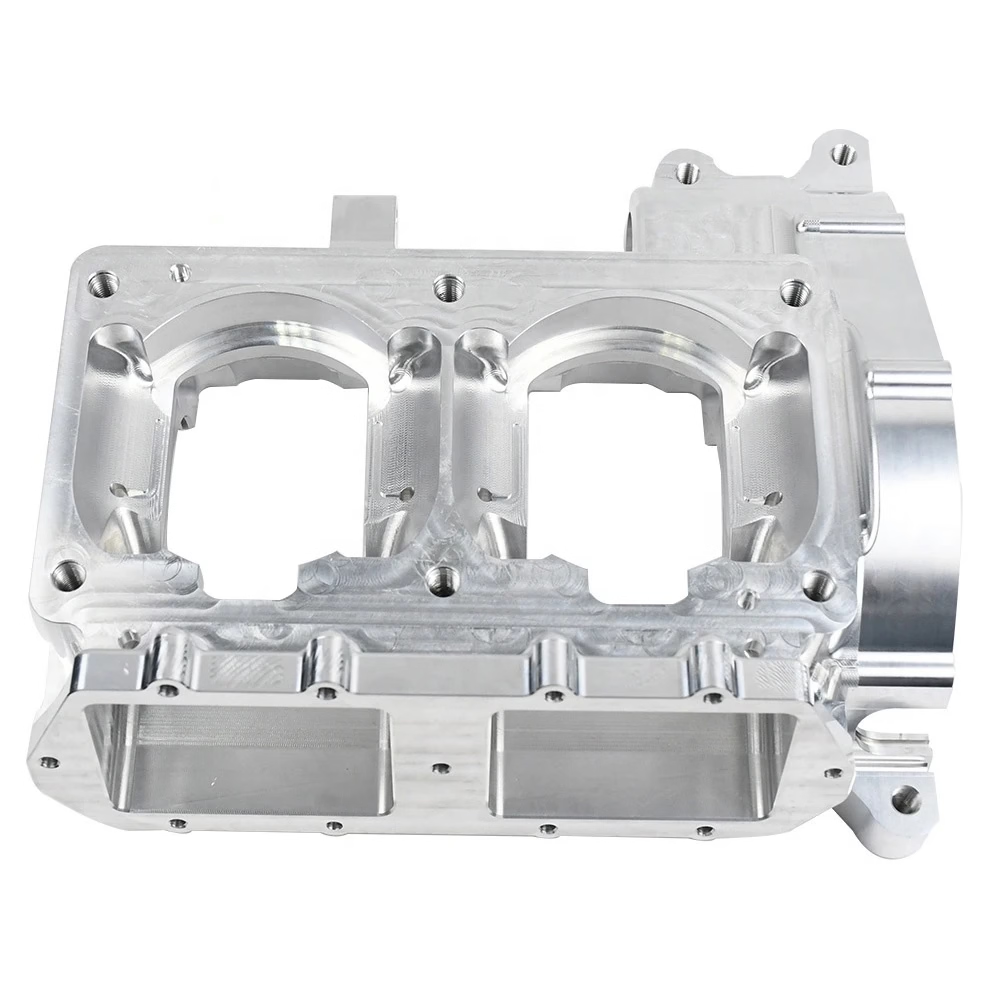
Geometry decides the machine. A bracket with holes on one face runs on a three-axis mill. A part with undercuts, deep pockets or features on five sides needs simultaneous five-axis work, because each extra setup adds stack-up error. If the drawing has a true position callout across two datums, the setup count matters as much as the spindle.
Wall thickness is the other quiet limit. Thin aluminum walls vibrate and deflect, so the shop has to slow the cut or add support. That changes the price. A supplier who flags this before quoting has actually read the drawing.
- 1One face, simple holesThree-axis milling is enough and usually the lowest cost path.
- 2Features on four or five sidesFour-axis or simultaneous five-axis cuts setups and protects position tolerance.
- 3Long, slender partsCheck the travel envelope before you assume it fits.
Match material and finish to the working environment
Material choice drives both cost and lead time. Aluminum 6061-T6 machines fast and takes anodizing well, which suits housings and brackets. Stainless 316L resists corrosion but work-hardens, so feeds and speeds must be dialed in or tool life drops. Titanium Ti-6Al-4V and Inconel cut slowly and cost more per hour, so reserve them for parts that genuinely need heat resistance or strength-to-weight.
Finish is a functional decision more often than a cosmetic one. A sealing face may need Ra 0.8–1.6 μm to hold a gasket. A sliding surface may need Ra 0.2–0.8 μm. A non-critical cover can stay as-machined at Ra 1.6–3.2 μm and save a finishing step. Name the requirement by function, not by look.
Anodizing, electroless nickel, plating, powder coating and black oxide all add a separate process step with its own queue. Hardcoat anodizing changes the dimension slightly, so call it out on the drawing if the tolerance is tight.
- 1Enclosure or bracket6061-T6 with clear or colored anodizing usually covers it.
- 2Medical or food contact316L plus passivation and full material traceability.
- 3Laser markingMinimum character height 1.5 mm so the mark stays legible.
Read the lead time as three separate clocks
A single lead-time number hides the real risk. Break it into three: time to quote, time to start cutting, and time to ship. A shop can quote in 12 hours, start production within 24 hours and ship parts in 3–5 days. That is a chain, and any weak link shows up as a late PO.
Ask what happens when the first article fails inspection. A shop with in-process monitoring catches the drift mid-run; a shop that only measures at the end finds it after the whole batch is cut. The second one loses a week.
Quotingscope matters too. Compare prices on the same drawing revision, the same material condition and the same inspection level. Otherwise you are comparing two different jobs.
- 1Quote clockQuotation and free DFM analysis within 12 hours.
- 2Start clockProduction can start within 24 hours of PO and material release.
- 3Ship clockParts ship in 3–5 days for standard runs.
Certification, NDA and the paperwork trail
Certificates are not decoration. ISO 9001:2015 covers a basic quality system. IATF 16949:2016 is what automotive and EV programs expect. ISO 13485:2016 applies to medical devices. ISO 27001:2022 covers information security, which matters when you upload CAD files. Match the certificate to the market you sell into, not to the longest list.
Ask for the inspection record format before the PO, not after. A shop that inspects 100% before shipment and can send reports on request gives you a paper trail for incoming inspection. If your own QA needs first article reports, say so at quoting time so it lands in the price.
Confidentiality is a process, not a promise. Uploads should be secure, and an NDA should be available before drawings leave your network. For early-stage programs, a supplier willing to sign first is usually the one that has done it many times.
- 1Automotive or EVIATF 16949:2016 plus PPAP-style documentation.
- 2Medical devicesISO 13485:2016 and material traceability.
- 3Any sensitive designISO 27001:2022 and an NDA on request.
Where the money actually goes in a machined part
Machine time is only part of the price. Setup, fixturing, tool wear, inspection and finishing each add their own line. A part with one setup and a loose tolerance can be cheap. The same envelope with five faces, a ±0.005 mm bore and hardcoat anodizing will not be.
Volume changes the equation. One prototype is dominated by programming and setup, so the per-piece price looks high. At 10,000 pieces the setup is spread thin and material and cycle time dominate. A supplier with no minimum order quantity lets you test the design at one piece before committing to a run.
Watch for quotes that omit inspection or finishing. The missing cost reappears later as a second PO, a slower schedule or a rejected lot.
- 1Prototype stageExpect programming and setup to carry most of the cost.
- 2Production stageMaterial, cycle time and finishing drive the number.
- 3Hidden costInspection and finishing left off the quote come back later.
How to vet a CNC supplier in seven steps
Run these in order. Each step can end the conversation.
- 1Send the real drawingInclude the revision, material condition, tolerance block and finish callout. A STEP file alone hides the datum scheme.
- 2Ask for DFM feedback with the quoteA useful reply flags thin walls, deep pockets and features that need a fifth axis. If nothing is flagged, ask again.
- 3Name the tight featurePoint to the dimension that must hold ±0.005 mm and ask which machine cuts it and how it is measured.
- 4Split the lead timeGet three dates in writing: quote, production start and ship. Compare shops on the same three.
- 5Confirm MOQ and first articleOrder one piece first. No minimum order quantity means the prototype path is open.
- 6Match the certificateISO 9001:2015, IATF 16949:2016, ISO 13485:2016 or ISO 27001:2022, depending on your market.
- 7Lock inspection and finishingAgree on 100% inspection before shipment, report format and which finish steps sit in the price.
Questions buyers ask before the first PO
Can a supplier hold ±0.005 mm on every feature?
No. That tolerance is realistic on specific features with the right machine, fixturing and temperature control.
Ask which dimensions need it. Applying it to a whole drawing raises cost without improving function.
What is the smallest order I can place?
With a shop that carries no minimum order quantity, one prototype is a valid order.
That lets you check fit and finish before committing to a 10,000-part run.
Which materials are usually available?
Aluminum 6061, 7075 and 2024, stainless 303, 304, 316L and 17-4PH, steels such as 4140 and 4340, titanium Ti-6Al-4V, plus brass, copper and engineering plastics like POM and PEEK.
If your alloy is unusual, ask before quoting so the shop can confirm stock and machinability.
How do I compare two quotes fairly?
Use the same drawing revision, material condition, tolerance block, finish and inspection level.
Then check whether DFM notes, fixturing and inspection are inside the number or added later.
Is an NDA possible before I share CAD files?
Yes. An NDA can be signed on request, and uploads are handled as confidential.
For early programs, settle this before the first file transfer so nothing is shared informally.
Send your drawing and get a checked quote
Upload a STEP file and a 2D drawing with the tolerance block. You get a quotation and free DFM analysis within 12 hours.
12-hour quote100% inspectionNo MOQ
More from the shop floor
We publish setup notes, tooling trials and inspection data from the factory floor.











