
CNC HMC: Increase Productivity Now
A horizontal machining center cuts cycle time by doing more faces in one setup, not by spinning the spindle faster. This page explains how to use a CNC HMC to increase productivity now, where the limits sit, and how to tell whether your part belongs on a horizontal or stays on a vertical.
In this article
- 1
- 2
- 3
- 4
- 5
CNC HMC increase productivity now: how the horizontal spindle changes the cycle
A vertical machining center drops chips onto the part and onto the fixture. A horizontal spindle throws them down and away. That single geometry difference is the root of most HMC productivity claims. Chips leave the cut zone under gravity, so the tool is not recutting them, coolant reaches the edge more cleanly, and the operator is not stopping to clear a nest of swarf between passes.
The second difference is access. On a vertical, the top face is easy and the four sides are a fixture problem. On a horizontal with a rotary table, the part indexes around the B axis and the spindle reaches four faces without a re-clamp. A Ø400 mm rotary table indexed in 0.001° steps turns a four-operation part into a one-operation part. Every re-clamp is a chance to lose position and a guaranteed block of dead time.
The third difference shows up in the numbers, not the brochure. Cutting time may only drop 15 to 30 percent. Non-cutting time often drops by half or more, because tool changes, pallet swaps, and part handling all happen while the spindle is still cutting. If your current job spends 40 percent of its clock time not cutting, that is where the gain lives.
So when engineers ask how to use a CNC HMC to increase productivity now, the honest answer is: stop optimizing the cut first. Map the setup time. The horizontal wins on setup count, chip evacuation, and unattended running, and those three things are usually the real bottleneck.
- 1Gravity chip clearingChips fall away from the cut instead of piling on the part.
- 2Four faces per setupRotary table indexing replaces repeated re-clamping.
- 3Pallet swappingLoad the next part while the spindle keeps cutting.
Which parts actually gain from a horizontal
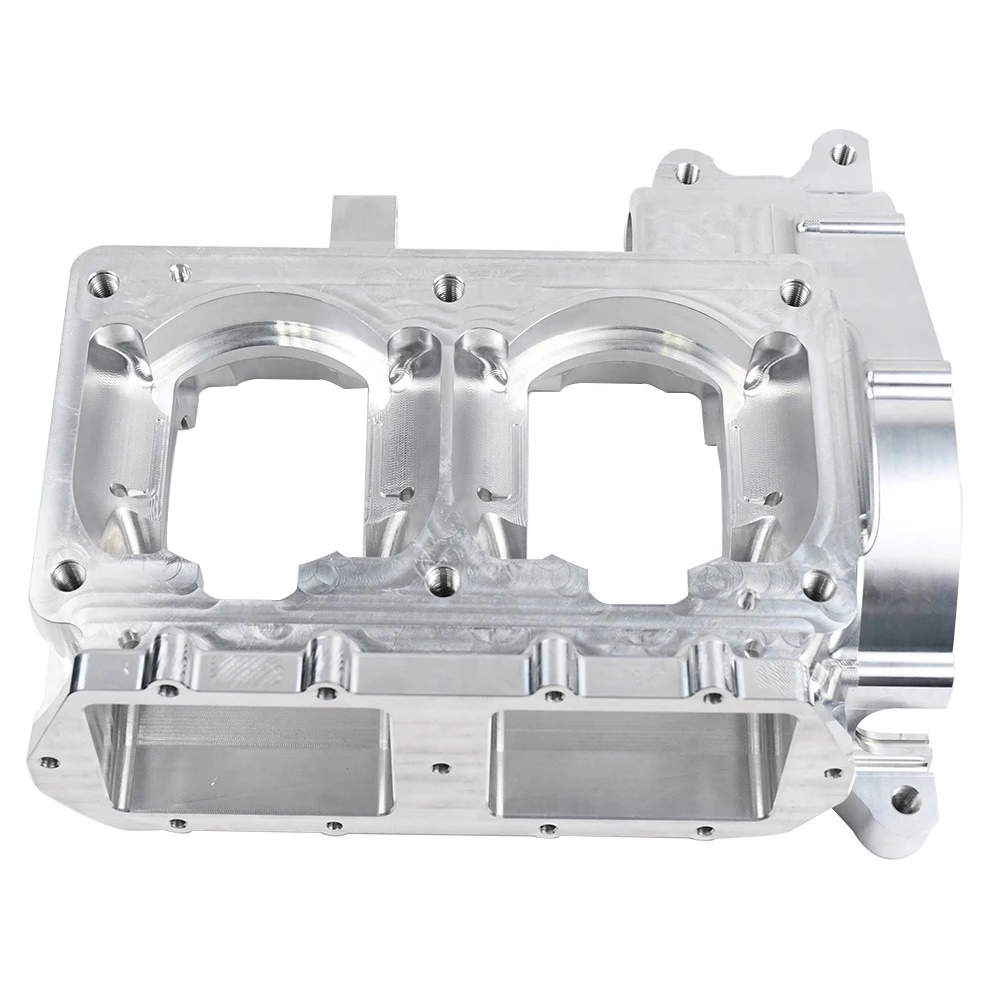
HMCs are not universal. They earn their floor space on prismatic parts with features on three or more faces, moderate to high volume, and a weight the table can carry. A gearbox housing, a hydraulic manifold, a valve body, an engine mount: these all have bores and faces pointing in several directions, and each one is a setup on a vertical.
The part size window matters as much as the shape. Compact HMC travels of 500 × 500 × 450 mm cover a lot of automotive and medical work. At the other end, a 4,000 × 400 × 150 mm travel envelope handles long, narrow parts like rails and structural extrusions that will not fit a standard VMC table at all. Weight capacity on the larger beds runs to roughly 2,000 kg, which rules out heavy castings above that.
Volume is the other gate. A one-off bracket with two faces of work is cheaper on a three-axis mill. The HMC setup, fixture build, and program prove-out are real costs, and they only amortize across a run. As a rough rule, if the part needs three or more setups on a vertical and you are making more than a few dozen, the horizontal math starts to work.
Materials do not change the decision much. Aluminium, stainless, tool steel, Inconel, and titanium all run on the same platform. What changes is the cutting data and the coolant strategy, not whether the machine is horizontal.
- 1Good fitPrismatic housings, manifolds, and long rails with multi-face features.
- 2Poor fitFlat plates, single-face parts, and very low quantities.
- 3Weight ceilingUp to about 2,000 kg on the larger beds.
Tolerance and repeatability: what fewer setups buys you
Every re-clamp adds stack-up error. The fixture locates the part, the part moves slightly under clamping pressure, and the next operation starts from a datum that has already shifted a few microns. On a four-setup part, those small errors add. On a one-setup part, they do not exist, because the datums never change.
That is why a horizontal holds ±0.005 mm (±0.0002 in) more reliably than the same part run across several vertical operations. The machine is not magically stiffer. It simply has fewer opportunities to lose position. For bores that must align, like gear bores or fluid seal seats, this is the difference between a passing assembly and a rework pile.
In-process probing closes the loop. A touch probe checks a critical bore or face between passes, the control applies the offset, and the next part starts from a corrected datum rather than a drifting one. This is what keeps a long run stable at hour eight and not just at hour one.
Surface finish follows the same logic. Ra 0.8–1.6 μm is a normal as-machined target on a stable setup; Ra 0.2–0.8 μm is reachable on finishing passes with the right tool and coolant. A setup that shifts will not hold either number no matter how good the insert is.
- 1Fewer datumsOne setup means one coordinate frame, no stack-up.
- 2ProbingMid-cycle checks correct drift before it becomes scrap.
- 3FinishRa 0.8–1.6 μm as machined; Ra 0.2–0.8 μm on finishing passes.
Spindle-on time: where the real throughput comes from
The metric that matters on an HMC is spindle utilization: the share of the shift the tool is actually in the cut. A well-run horizontal with pallet changing and a tool magazine that covers the whole job can push that number well past what a manual-load vertical reaches, because the machine never waits for the operator to walk over.
Pallet systems are the core of it. Two pallets, one cutting and one loading, mean the operator's handling time overlaps with the cut instead of adding to it. Add lights-out or lightly attended running and the same machine produces across a night shift without a person standing at the door.
Tool life and tool count matter too. A large magazine lets the job run without stopping for a manual tool change, and balanced cutting data keeps inserts from chipping early. Neither is exciting. Both show up directly in parts per shift, which is what a CNC HMC is supposed to increase productivity now, in the current quarter, on the current job.
Maintenance is the quiet risk. Predictive checks on spindle vibration, coolant concentration, and way lubrication prevent the unplanned stop that erases a week of good utilization. A machine that runs at 85 percent for a month beats one that hits 95 percent for a week and then sits dead.
- 1Spindle utilizationMeasure cutting time as a share of the whole shift.
- 2Pallet overlapLoad the next part while the current one cuts.
- 3Preventive checksVibration, coolant, and lubrication on a schedule.
Horizontal vs vertical: when each one wins
Use this as a first filter, not a final answer.
| Factor | Horizontal HMC | Vertical VMC |
|---|---|---|
| Faces per setup | Three to four with rotary table | One or two |
| Chip clearing | Gravity-assisted, chips fall away | Chips collect on the part |
| Best part shape | Prismatic housings and manifolds | Flat plates and single-face work |
| Volume sweet spot | Dozens to 10,000+ parts | Prototypes and low runs |
| Setup time share | Low, with pallet changing | Higher, manual load |
| Tool access | Side access, long reach tools | Top access, short tools |
| Floor space | Larger footprint | Compact |
| Typical tolerance | ±0.005 mm on multi-face parts | ±0.005 mm on single-face parts |
The short version
If your part has features on three or more faces and you are making more than a few dozen, run it on a horizontal and stop paying for re-clamps. If it is a flat plate or a handful of prototypes, keep it on a vertical and save the fixture cost.
Questions engineers ask before switching
How does a horizontal hold ±0.005 mm across several faces?
It holds that tolerance by not moving the part. The rotary table indexes the workpiece to the spindle, so the coordinate frame stays fixed from the first face to the last.
On a vertical, each re-clamp resets the datum and adds stack-up error. Fewer datums means less accumulated misalignment, which matters most on aligned bores and seal seats.
What part sizes fit on your horizontal platforms?
Compact travels run 500 × 500 × 450 mm and 500 × 310 × 200 mm. Medium platforms cover 750 × 1,150 × 550 mm and 600 × 600 × 600 mm.
For long parts, the large envelope reaches 4,000 × 400 × 150 mm. Beds on the larger machines carry parts up to roughly 2,000 kg.
Which industries see the clearest gain?
Aerospace engine mounts, energy valve bodies, automotive cylinder blocks, and hydraulic manifolds are the classic cases. Each has multi-face features and enough volume to amortize the fixture.
Any department running large batches of prismatic metal parts is a candidate. Single-face plate work is not.
Does a horizontal replace five-axis work?
Not always. A four-axis horizontal with a rotary table handles most prismatic parts. Five-axis simultaneous motion is for contoured surfaces, angled holes, and undercuts that a rotary table alone cannot reach.
GreatLight runs 16 simultaneous five-axis centers alongside 12 four-axis mills, so the process is chosen per part, not per preference.
How fast can parts move through the shop?
Quotation and free DFM analysis come back within 12 hours. Production can start within 24 hours, and parts ship in 3–5 days.
No minimum order quantity applies, so a single prototype and a 10,000+ part run use the same quoting path. Uploads stay confidential and an NDA is available on request.
What inspection comes with the parts?
Every order gets a raw material check, in-process monitoring, and a final inspection before shipment. Inspection reports are available on request.
The shop runs at a 99.99 percent qualification rate, backed by ISO 9001:2015, IATF 16949:2016, ISO 13485:2016, and ISO 27001:2022.
Send us the part that keeps missing schedule
Upload a drawing and we will tell you whether it belongs on a horizontal, what the fixture looks like, and where the cycle time actually goes.
12-hour quote100% inspectionNo MOQ
More from the shop floor
We publish setup notes, tooling trials and inspection data from the factory floor.











