
CNC Machine Tool Cost: The Top Factor Buyers Get Wrong
Most buyers fixate on the machine price tag. The real driver of cnc machine tool cost is how the part is fixtured, cut and inspected over its full life. This guide is for engineers and purchasing teams comparing machines, suppliers and quote structures. Read it and you will know which cost items to check before you sign.
In this article
- 1
- 2
- 3
- 4
- 5
- 6
- 7
Key takeaways
Which cost driver matters most
Ranked by effect on cost per good part, not on the invoice total.
| Driver | What it changes | Typical impact |
|---|---|---|
| Part geometry | Number of setups and tool reach | Highest |
| Tolerance band | Gauging, in-process checks, scrap risk | High |
| Setup and fixturing | Labor hours before the first cut | High |
| Material grade | Tool wear, cutting speed, stock price | Medium |
| Order volume | Amortization of setup and programming | Medium |
| Surface finish | Extra passes and hand work | Medium |
| Machine class | Hourly rate on the floor | Medium |
| Inspection scope | Report type and sampling level | Low to medium |
The top factor in cnc machine tool cost is part geometry
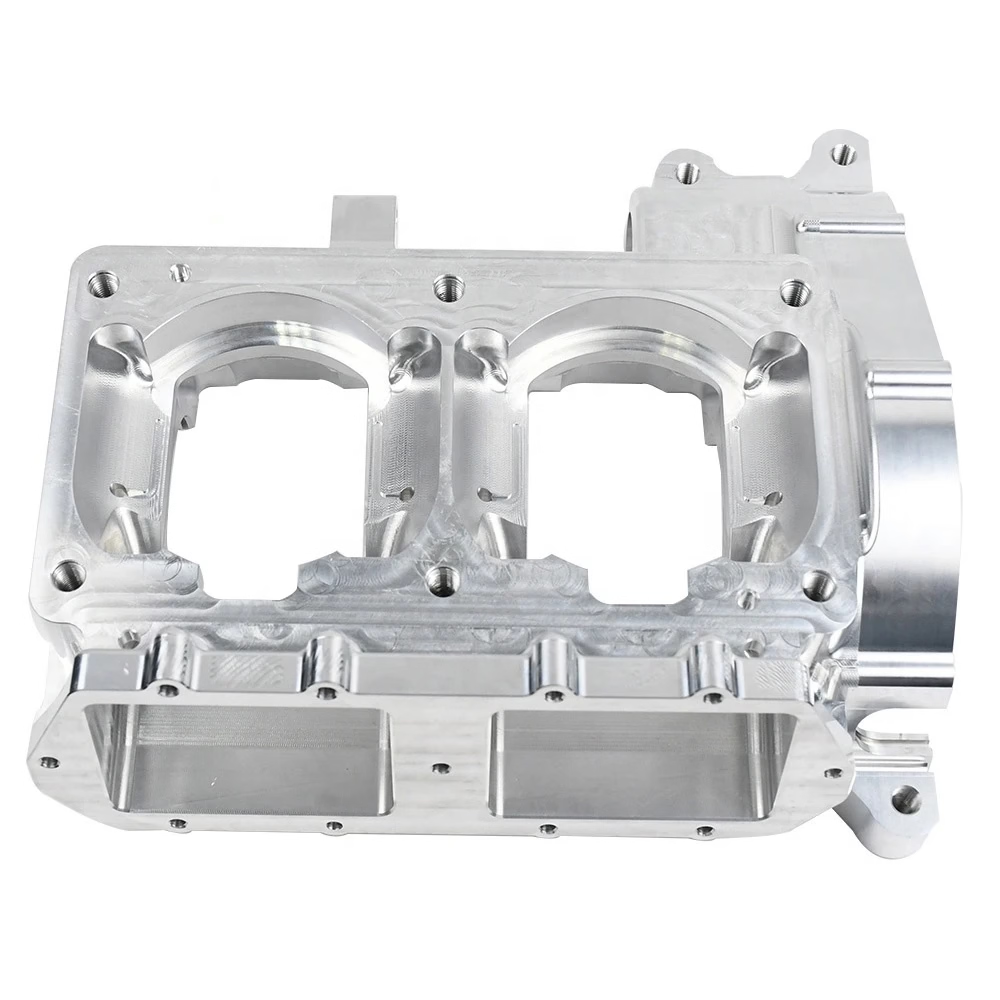
Geometry decides how many times a part must be re-fixtured. Every extra setup adds an operator touch, a re-datum and a chance to lose position. A housing that machines in two setups costs less than the same housing split across five. This is true on any machine, so the first question is not which spindle you buy but how many faces the part needs.
Reach and rigidity follow. Deep pockets, thin walls and long overhangs force slower feeds and lighter depths of cut. A tool holder that reaches 250 mm into a cavity will chatter long before the same tool at 60 mm. The fix is often a different approach angle, not a bigger machine.
Undercuts and angled holes push work toward 4-axis or simultaneous 5-axis. That is a real cost step. GreatLight runs 16 simultaneous 5-axis centers, 12 four-axis mills and 27 three-axis machines, so we can match the class to the geometry instead of quoting every part on the most expensive platform.
- 1Count the setupsTwo or three usually beats four or more.
- 2Check tool reachOverhang above 4× diameter raises chatter risk.
- 3Flag thin wallsBelow 1 mm walls need light passes and support.
Tolerance and inspection set the second cost layer
Tolerance is a specification with a price. At ±0.05 mm, a caliper or a basic micrometer may be enough on the floor. At ±0.005 mm (±0.0002 in), the process needs temperature control, a stable fixture and a CMM check. The cutting time grows, but the gauging and documentation grow faster.
Surface finish behaves the same way. As-machined surfaces sit around Ra 1.6–3.2 μm. A sealing face at Ra 0.8–1.6 μm adds a finishing pass and a different insert. Below Ra 0.8 μm, you are usually buying a separate operation, not a slower spindle.
Ask for the inspection plan before the quote. If the drawing calls for a first-article report, a material certificate and 100% dimensional checks, those hours belong in the price. GreatLight inspects 100% before shipment and issues reports on request, so the scope is visible up front.
- 1±0.05 mmStandard milling, simple gauges.
- 2±0.02 mmControlled process, sampled CMM checks.
- 3±0.005 mmStable setup, climate control, full gauging.
Machine class, volume and material interact
A 5-axis center has a higher hourly rate than a 3-axis mill. On a part with five open faces, it wins anyway because it removes three fixtures and two operators. On a flat bracket, it loses. The break-even point is not a fixed number; it moves with batch size and part count.
Volume changes the math. Setup and programming are one-time costs, so a 10-part run spreads them over few parts while a 10,000-part run barely notices them. That is why a mold or a casting may beat machining at high volume, and why machining wins for one prototype. GreatLight has no minimum order quantity and runs from a single prototype to 10,000+ part batches.
Material ties the two together. Aluminum 6061 and 7075 cut fast and hold finish well. Stainless 316L and 17-4PH work-harden, so feeds must stay high enough to cut under the hardened layer. Titanium Ti-6Al-4V and Inconel need lower speeds, more coolant and shorter tool life. Those tool changes land in the unit price.
- 1AluminumFast cutting, low tool wear, good finish.
- 2StainlessWork-hardening; keep the feed up.
- 3Titanium and InconelSlow speeds, short tool life, higher cost.
How to read and compare supplier quotes
Two quotes for the same drawing are rarely comparable. One may include material certification, deburring and an inspection report. The other may list them as options. Put both on one sheet with the same line items before you compare the totals.
Check the process assumptions too. A quote that assumes a 3-axis mill on a part with angled holes is either wrong or it hides a second operation. A quote that names the machine class, the number of setups and the finishing steps is easier to trust.
Lead time and confidentiality belong in the same review. Ask when the quote is issued, when production can start and how files are handled. GreatLight returns a quotation and free DFM analysis within 12 hours, can start production within 24 hours and signs an NDA on request.
- 1Line itemsCompare material, machining, finishing, inspection apart.
- 2Process notesMachine class and setup count should be stated.
- 3TermsCheck lead time, NDA and file handling.
Step by step: cost review before you place an order
Work through these in order. Stop at the first item that is unclear.
- 1Read the drawing for setupsCount the faces that need machining. If it is four or more, ask how many setups the supplier plans and on which machine.
- 2Split the tolerance bandsMark critical dimensions at ±0.005 mm and free dimensions at ±0.05 mm or looser. Tolerancing everything tight raises cost with no benefit.
- 3Confirm the material and stock formPlate, bar or casting changes stock cost and setup. Ask for the grade and the cert before quoting.
- 4List the finishing stepsAnodizing, plating or powder coating are separate lines. State the color, thickness and masking needs so the quote is not revised later.
- 5Define the inspection scopeSay whether you need a first-article report, material certs, or 100% dimensional checks. Reports on request should be named in the quote.
- 6Compare lead time and volumeAsk for quote turnaround, production start and shipping days at your batch size. A 10-part run and a 10,000-part run have different schedules.
- 7Settle confidentialitySend files only after the NDA is in place if the design is sensitive. Secure handling should be confirmed in writing.
Frequently asked questions about cnc machine tool cost
Does a higher machine price mean a higher part price?
Not always. A 5-axis center costs more per hour, but it can remove two or three setups on a complex part. If the geometry needs five faces, the higher-rate machine often produces the cheaper part.
On simple parts, the opposite holds. A flat bracket on a 3-axis mill avoids paying for rotary motion it never uses.
What is the cheapest way to lower cnc machine tool cost?
Loosen tolerances that do not matter and cut the number of setups. Both changes remove hours from the process, not just a few percent off the material bill.
A second lever is finishing. If a surface is not functional, leave it as machined at Ra 1.6–3.2 μm instead of specifying a polished face.
How does order volume change the price per part?
Setup, programming and fixturing are one-time costs. At 10 parts, they dominate the unit price. At 10,000 parts, they are almost invisible.
That is why prototyping and production are quoted differently, and why a casting or molding may win above a certain volume.
Should I compare quotes on the unit price alone?
No. Material certs, finishing, inspection and packaging may sit outside the unit price in one quote and inside another.
Put both quotes on one sheet with identical line items, then compare. The lower total is not always the lower cost.
How fast can a quote and first parts arrive?
GreatLight issues a quotation and free DFM analysis within 12 hours. Production can start within 24 hours, and parts ship in 3–5 days.
The historical late-delivery probability is below 2% across our order book.
Which certifications should a supplier hold for regulated parts?
ISO 9001:2015 covers the quality system. IATF 16949:2016 applies to automotive work, ISO 13485:2016 to medical devices and ISO 27001:2022 to information security.
Match the certificate to your industry before you order, and ask for a copy with the quote.
Send the drawing, get a cost breakdown
Upload your files and we will return a quotation with free DFM analysis within 12 hours. No minimum order quantity, from one prototype to 10,000+ parts.
12-hour quoteNo MOQ100% inspectionNDA on request
More from GreatLight
We publish setup notes, tooling trials and inspection data from the factory floor.











