
CNC Machining Services: How to Choose the Right Supplier for Your Parts
This guide is written for engineers and sourcing staff comparing quotes for machined parts. It covers axis count, working envelope, achievable tolerance, order quantity and certification, so you can tell whether a shop can actually hold your drawing before you send a purchase order.
In this article
- 1
- 2
- 3
- 4
- 5
- 6
- 7
- 8
Key takeaways
Which machine class fits your part
Use the geometry, not the price, as the first filter.
| Part feature | Machine class | Typical use | Watch out for |
|---|---|---|---|
| Flat plates, pockets, through holes | 3-axis mill | Brackets, covers, base plates | Re-fixturing for a second face |
| Holes and slots on multiple faces | 4-axis mill | Shaft collars, manifolds | Rotary table swing clearance |
| Undercuts, compound angles | 5-axis simultaneous | Impellers, medical housings | Programming and setup time |
| Round parts with milled flats | Mill-turn center | Fittings, valve bodies | Bar stock diameter limits |
| Long narrow profiles | Large-envelope machine | Rails, beams, frames | Straightness after clamping |
| Tight bores, fine finish | Mill-turn or 5-axis | Bearing seats, bushings | Heat growth during long cuts |
Start with axis count, not with price
Most quotes fail on geometry before they fail on cost. A part with holes on four faces and a compound angle cannot be made on a 3-axis machine without multiple setups. Each extra setup adds a fixture, a re-zero, and a chance for position error to stack up. That is the real reason a 5-axis quote sometimes looks higher and still wins.
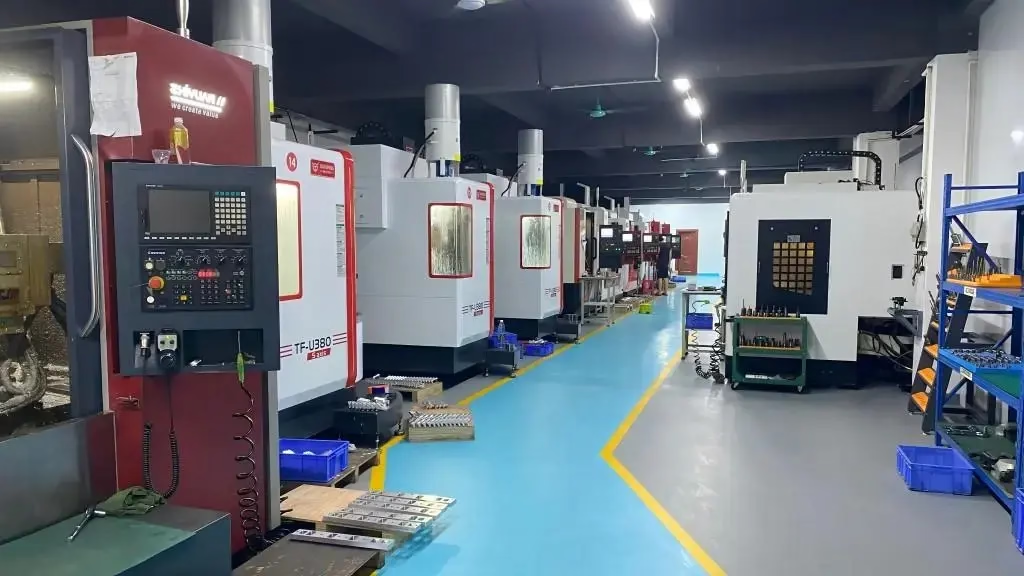
A 3-axis mill holds the part on one face and works the top. It is fast and cheap for plates, pockets and through holes. A 4-axis machine adds a rotary table, usually Ø400 mm class, so the spindle can index to a new face without an operator touching the part. A 5-axis center tilts the tool or the table so the cutter reaches undercuts and draft angles in a single pass.
Pick the lowest axis count that still reaches every feature in one or two setups. Beyond that, extra axes add programming hours and do not shorten cycle time. For a simple bracket, a 5-axis quote is usually wasted money.
- 13-axisFlat parts with features on one or two faces.
- 24-axisFeatures around a part that can be indexed.
- 35-axisUndercuts, compound angles, deep cavities.
Read the working envelope and tolerance together
A machine's travel is a hard limit. If your part is 1,200 mm long and the shop's largest table is 750 mm, no amount of skill helps. Ask for the travel figures on the machines that will actually run your job, not the plant maximum. A shop may list a 4,000 mm envelope while your part goes to a smaller cell with a 500 × 500 × 450 mm table.
Tolerance is where quotes get vague. ±0.005 mm (about ±0.0002 in) is achievable on a well-maintained 5-axis center under stable temperature, but that figure applies to specific features, not every dimension on a large part. On a 500 mm aluminum housing, thermal growth alone can move a bore by more than 0.01 mm over a long cut.
Surface finish follows the same logic. Ra 0.2–0.8 μm needs a finishing pass with a sharp tool and a rigid setup. As-machined Ra 1.6–3.2 μm is fine for most brackets and covers. Specify the finish only where it matters: sealing faces, bearing seats, sliding surfaces.
The practical question is not what the machine can do on a test block. It is what the shop can hold across a full run, on your material, at the quoted price.
- 1EnvelopeAsk for travel on the assigned machine, not the plant maximum.
- 2ToleranceName the tight features; do not assume a blanket number.
- 3FinishSpecify Ra only on functional surfaces.
Check whether the shop actually cuts your material
A shop that runs mostly aluminum will quote stainless and titanium, but the cycle times and tool life are different. 6061-T6 cuts fast and holds tolerance easily. 17-4PH stainless work-hardens if the feed is too light, so the shop needs the right tooling and a rigid setup. Inconel and Ti-6Al-4V (TC4) generate heat at the cutting edge and need lower speeds and coolant control.
Ask what materials the shop stocks and machines weekly. A supplier that runs 304 and 316L daily will have the inserts and the speeds dialed in. One that runs titanium twice a year will learn on your part.
Material choice also drives the process. Die-cast or vacuum-cast parts make sense at higher volumes with a fixed geometry. Machined parts make sense when the design may still change, when the quantity is under a few thousand, or when the tolerance is tighter than a casting can hold. Rapid prototyping sits in front of both when you need a fit check before committing to a process.
If the shop quotes a material it does not normally run, ask what the first-article plan is. A clear answer is a good sign.
- 1Aluminum6061, 7075, 2024, 6082 — fast and stable.
- 2Stainless303 and 304 cut cleanly; 17-4PH needs correct feeds.
- 3Titanium and InconelHeat and tool wear drive the cost, not the material price.
Lead time, MOQ and the quote itself
Lead time promises are easy to make and hard to verify. Ask for the sequence, not just the number. A realistic shop will say when the quote and DFM notes land, when the first chips are cut, and when the parts ship. A vague answer usually means the job will sit in a queue.
Minimum order quantity matters more than it looks. A shop with no MOQ can run one prototype and then 10,000 parts from the same process, so the second order does not repeat the setup cost. A shop that enforces a high MOQ will either reject your prototype or quote it at a rate that hides the fixture cost.
Read how the quote is structured. A line-item quote shows material, machining, finishing and inspection separately, which lets you see where the cost sits. A single lump sum hides the assumptions. If the quote does not name the material grade, the finish and the tolerance, you are comparing guesses.
Finally, confirm how inspection is handled. A shop that inspects every part before shipment and can send reports on request is easier to work with than one that only checks the first article.
- 1Quote structureLine items beat a lump sum.
- 2MOQNo minimum keeps prototype and volume pricing consistent.
- 3InspectionAsk what is measured and what reports you get.
Match certification to your industry
Certification is not a marketing badge. It tells you which quality system governs the shop's records, traceability and corrective actions. For general industrial parts, ISO 9001:2015 is the baseline. For automotive and EV work, IATF 16949:2016 adds the production and service requirements that OEM programs expect.
Medical device work sits under ISO 13485:2016, which covers design, production, installation and servicing of devices. If your part touches a regulated device, the shop's system needs to match. For work where drawings and IP are sensitive, ISO 27001:2022 covers information security management, which matters when files move between countries.
Ask for the certificate scope, not just the logo. A certificate that covers the site doing your work is worth more than a group-level certificate for a different plant. If confidentiality is a concern, an NDA can be set up before files are shared, and secure upload handling should be standard.
- 1ISO 9001:2015Baseline quality system for general parts.
- 2IATF 16949:2016Automotive and engine hardware programs.
- 3ISO 13485:2016Medical device production and servicing.
- 4ISO 27001:2022Information security for drawings and data.
Seven checks before you place the order
Run these in order. The first two eliminate most mismatches.
- 1Check the working envelope against your largest partSend the bounding box and the longest single feature. Confirm travel on the assigned machine, not the plant maximum. A 4,000 mm envelope only helps if your part is routed there.
- 2Confirm the axis count reaches every featureList features by face. If a hole or slot sits on a face the spindle cannot reach without re-fixturing, ask how many setups the quote assumes.
- 3Name the tight tolerances and finishesMark the features that need ±0.005 mm and the surfaces that need Ra 0.8–1.6 μm. Leave the rest at general tolerance so the shop is not pricing precision you do not need.
- 4Ask what materials the shop runs weeklyAluminum, stainless, tool steel, titanium and engineering plastics each need different tooling and speeds. A shop that runs your grade daily will quote it tighter.
- 5Read the quote structure and the MOQLook for line items covering material, machining, finishing and inspection. Confirm the minimum quantity for the first order and whether pricing holds when volume rises.
- 6Match the certificate to your industryISO 9001 for general work, IATF 16949 for automotive, ISO 13485 for medical, ISO 27001 where data security is in scope. Ask for the site scope.
- 7Agree on inspection and reporting up frontDecide which dimensions are measured, whether reports ship with the parts, and who signs off the first article. This avoids a dispute at receiving.
Frequently asked questions
How many axes do I actually need?
Use the lowest count that reaches all features in one or two setups. Flat plates and pockets run fine on 3 axes. Add a rotary table when features wrap around the part.
Go to 5-axis only for undercuts, compound angles or deep cavities that would otherwise need three or more fixtures.
Is ±0.005 mm realistic on a large part?
It is achievable on specific features under stable temperature, not as a blanket callout on a 500 mm part. Thermal growth during a long cut can move a bore by more than 0.01 mm.
Mark the tight features on the drawing and let the rest run at general tolerance.
What does no MOQ actually mean?
It means the shop will run a single prototype and then a 10,000-part batch from the same process and fixtures. You do not pay a separate setup penalty when volume arrives.
Ask whether the prototype process matches the production process. If it does not, the second order is a new job.
Which certification do I need to ask for?
ISO 9001:2015 for general industrial parts. IATF 16949:2016 when the part feeds an automotive or EV program. ISO 13485:2016 for medical devices.
Where drawings and IP are sensitive, ISO 27001:2022 covers information security. Always check the certificate covers the site doing your work.
How do I compare two quotes that look different?
Normalize the inputs first: same material grade, same tolerance callouts, same finish, same inspection scope. Then compare line items.
A lower quote that omits finishing or inspection is not cheaper. It just moved the cost to your receiving dock.
When should I choose casting or 3D printing instead?
Die casting and vacuum casting make sense at higher volumes with a frozen geometry. Machining wins when the design may still change or the tolerance is tighter than a casting can hold.
Rapid prototyping sits in front of both for a fit check before you commit to a process.
Send the drawing and get a quote with DFM notes
We review your files, flag the features that drive cost, and come back with a line-item quote and a realistic lead time. No minimum order quantity, from one prototype to 10,000+ part runs.
Quote and DFM within 12 hours100% inspection before shipmentNDA on request
More from the shop floor
We publish setup notes, tooling trials and inspection data from the factory floor.











