
CNC Machining Mass Production: The Rules That Changed
For engineers and buyers who need parts in the thousands, not the tens. This page explains what actually shifted in CNC machining mass production, where the limits still are, and how to judge whether a part belongs on a mill, a lathe, or a die caster. Read it before you release a drawing for volume.
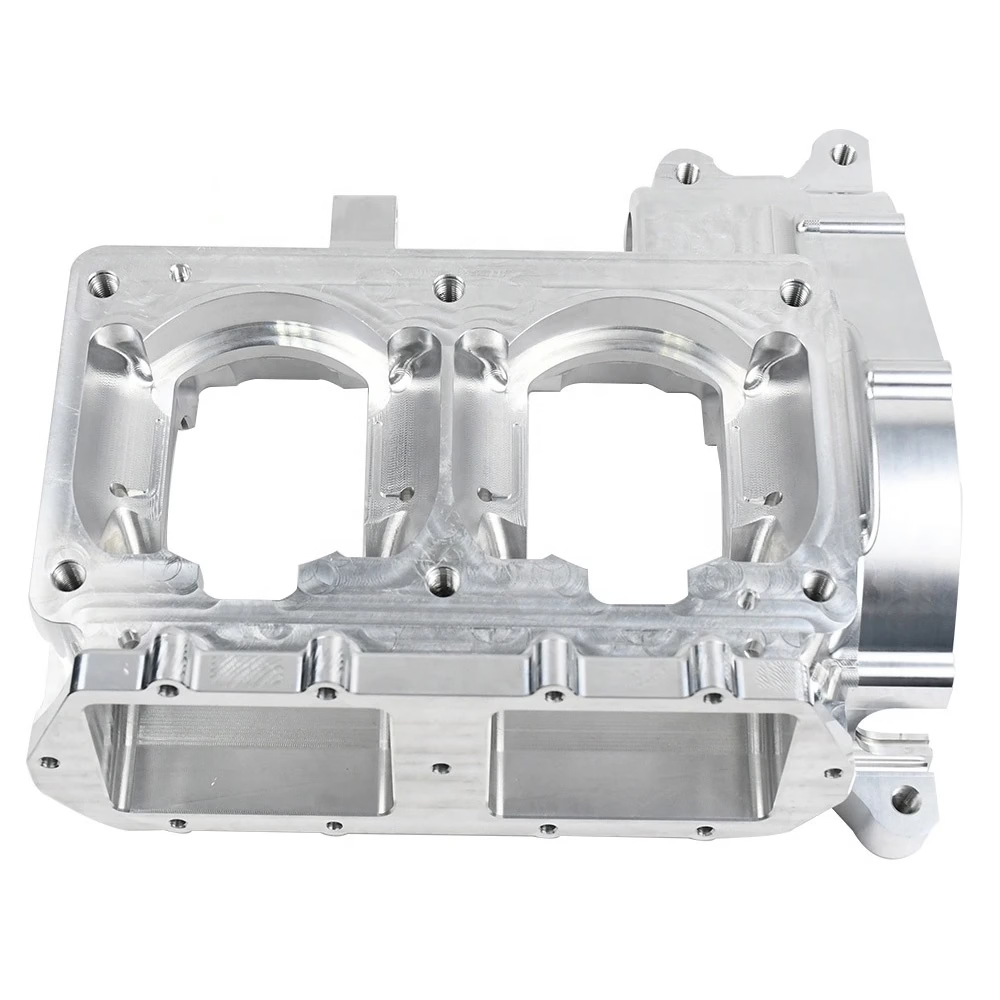
What really changed in CNC machining mass production
For decades, volume meant one thing: build a mold, then amortize it. That still holds for simple plastic housings and thin sheet parts. It stopped holding for machined metal somewhere around the time five-axis work stopped being a specialty service and became an ordinary production asset. The change was not a single breakthrough. It was the combination of faster spindles, better thermal control, and CAM that can post a five-axis toolpath without a specialist rewriting it by hand.
Consider what a mold commits you to. You pay for the tool up front, you wait weeks for it, and every design revision either costs a weld-and-remachine cycle or a new tool. For a part that will run for years without change, that math is fine. For a bracket that gets revised twice during a product launch, the mold is a liability. CNC machining mass production has no tool to scrap. A revision is a new program and a new setup sheet.
The second shift was machine density. A shop that once had three machines and one operator per machine now runs pallet pools, tool magazines with 60 or more positions, and lights-out shifts. Setup time that used to dominate a job now gets amortized across a pallet of parts. When setup drops from two hours to twenty minutes, the volume at which machining beats casting moves down sharply.
None of this makes machining the answer for everything. Sand casting and die casting still win on very large parts, on hollow geometry, and on unit cost at high volume when the design is frozen. The honest question is not which process is modern. It is where your part sits on the curve of volume, geometry, and revision risk.
Why five-axis and mill-turn cut the cost of volume
On a three-axis machine, every new face of the part needs a new orientation. That means a new fixture, a new zero, and a new chance to stack tolerance. A part with features on six sides might need four or five setups. Each setup adds labor, adds queue time, and adds error. Five-axis work does not remove the setups by magic. It removes most of them by tilting the tool and the table instead of moving the part.
The gain is largest on parts with compound angles, contoured pockets, and ports that meet at odd angles. A hydraulic manifold is the classic case. On three axes it is a puzzle of custom fixtures and pluggable holes. On a simultaneous five-axis center it is one program and one or two setups. That is where the labor savings come from, and labor is the cost that dominates at moderate volume.
Mill-turn centers change the arithmetic differently. When a part starts as bar stock and needs both turning and milling, a mill-turn center does both in one cycle. The part never leaves the spindle, so concentricity between the turned diameter and the milled feature is set by the machine, not by a fixture. A hydraulic fitting with cross-drilled ports and a threaded bore is a good fit. Two machines and two queues become one.
There is a limit. Five-axis does not fix a part that is too flimsy to hold, and it does not fix a feature that a tool simply cannot reach. If the geometry needs a tool with a length-to-diameter ratio beyond about 6:1, deflection will cost you more than the extra axis saves. At that point the design, not the machine, is the problem.
Holding ±0.005 mm across a production run
A tolerance on a drawing is a claim about every part, not the first one. The first part off a warm machine is usually good. The trouble starts on part 400, after the spindle has grown 15 µm and the coolant has warmed the casting. Thermal drift is the largest single source of out-of-tolerance parts in a long run, and it is invisible on a single-part inspection report.
The practical controls are unglamorous. Warm up the machine before the first cut. Run a probe cycle on a master artifact at fixed intervals and let the control compensate. Keep the shop at a stable temperature rather than chasing it with the doors open. Use in-process probing on the critical feature rather than trusting the setup. These steps cost cycle time. They cost far less than a scrapped batch.
Material matters too. Aluminium 6061 and 7075 move differently after stress relief, and thin-wall parts move after every roughing pass. A roughing allowance of 0.5 mm per side, followed by a stress-relief pause on tight parts, is often cheaper than trying to hold the final dimension in one pass. On stainless and titanium, tool wear shifts the effective cutting edge over a long run, so a tool-change interval tied to part count beats changing tools on a schedule.
We hold ±0.005 mm on production parts, and we inspect 100% before shipment, with raw material checks, in-process monitoring, and a final inspection report available on request. That number is a process capability, not a promise about every feature of every drawing. A deep bore with a 10:1 ratio will not hold it. A ground flat will hold it easily.
Where the money actually goes in a volume run
Buyers often expect unit price to fall in a straight line as quantity rises. It does not. At low volume, price is mostly setup and programming. At mid volume, it is mostly cycle time and labor. At high volume on a machining job, it is mostly material and machine hours, because setup has been amortized to near zero. Knowing which regime you are in tells you what to negotiate.
If you are at 50 parts, the lever is setup. Send a drawing with clear datums, tolerances that reflect function rather than habit, and a STEP file that matches the print. A tight tolerance on a non-functional cosmetic face costs money for nothing. If you are at 5,000 parts, the lever is cycle time and material yield. Reducing one roughing pass or nesting parts more efficiently on the bar can matter more than a rate discussion.
Fixture design is the quiet variable. A dedicated fixture costs money up front but pays back across a long run and protects tolerance repeatability. Soft jaws on a vise are fine for 20 parts and wrong for 2,000. The decision is usually obvious once you write down the batch size and the tolerance. It becomes murky when the batch size is a guess, which is why an honest forecast helps both sides.
GreatLight runs 127 high-precision CNC machines across three wholly-owned plants, including 16 simultaneous 5-axis centers and 16 mill-turn centers, with a maximum processing size of 4,000 mm. That mix exists because no single machine type covers the range of parts that arrive. When you send a part, the question we ask first is not how many you need. It is what has to be true about the part when it arrives.
When CNC is the wrong answer
CNC loses on hollow parts. If the inside of your part is a cavity that a tool cannot reach without a long, thin cutter, machining will be slow and expensive, and casting or molding will win. It also loses on very large thin panels, where the part deflects under its own weight and no fixturing fully solves it. Sheet metal fabrication handles those parts better.
It loses again when the surface finish across a whole part must be uniform and cosmetic. A machined surface carries tool marks that follow the toolpath. Bead blasting or anodizing hides most of it, but if the requirement is a mirror finish over a large curved area, polishing time can exceed machining time. That is a real cost, not a detail.
The third case is the one people miss. If the design is genuinely frozen for years and the annual volume is high, the per-part savings from a casting or forging tool will eventually overtake machining. The crossover is not a fixed number. It depends on part size, geometry, and how much post-machining the cast part still needs. A casting that needs three faces machined afterwards may never beat a machining job.
The right move in that case is usually a hybrid. Use CNC for the first production batches to validate the design and start shipping, then move to a tool once the revision rate drops. CNC machining mass production and tooled production are not competitors in that sequence. They are two stages of the same ramp.
Which process fits your volume and geometry
Use this to narrow the choice before you request a quote.
| Situation | Better fit | Why | Watch out for |
|---|---|---|---|
| 1 to 500 parts, design may change | 3-axis or 4-axis CNC | No tooling cost, revision is a reprogram | Setup cost per batch |
| Complex angles, 6-sided features | 5-axis CNC | Fewer setups, one zero point | Needs CAM support and probing |
| Turned body plus cross features | Mill-turn center | One cycle, concentricity held by machine | Bar size limits part envelope |
| Frozen design, 10,000+ units, simple shape | Die casting or casting | Lower unit cost at true volume | Tool cost, lead time, revision risk |
| Thin walls under 0.8 mm | Reconsider design | Chatter and distortion dominate | No process fixes bad stiffness |
| Deep bores over 6:1 ratio | Design review first | Tool deflection breaks tolerance | May need EDM or a split part |
| Prototype plus production in one shop | CNC from 1 to 10,000+ | Same program scales, no re-qualification | Confirm capacity before ramp |
The short version
If your design may still change, or you need parts this month, machine them. If the design is frozen for years and the volume is high and simple, tool up. Most products need both, in that order.
Questions engineers ask before a volume run
At what quantity does CNC stop being economical?
There is no fixed number. It depends on part size, geometry, and how much post-machining a cast or molded part would still need. A small simple part with a frozen design can justify a tool at a few thousand units. A large complex part may stay on CNC for tens of thousands because the tool would be expensive and the cast part would still need machining on critical faces.
Can you hold ±0.005 mm on 5,000 parts, not just on one?
We hold ±0.005 mm on production parts and inspect 100% before shipment, with raw material checks, in-process monitoring, and a final report on request. The honest caveat is that capability depends on the feature. A ground flat or a bored hole holds it easily. A deep bore with a 10:1 length-to-diameter ratio will not, and we will say so during DFM review rather than after the run.
What is the minimum order quantity?
There is no minimum order quantity. We run from one prototype to 10,000+ part runs. The reason is practical rather than generous: the same program and fixture logic scales, so a prototype does not need to be re-qualified when it moves into volume.
How fast can a volume order start?
Quotation and free DFM analysis come back within 12 hours. Production can start within 24 hours of approval, and parts ship in 3–5 days. Historical late-delivery probability is below 2%. Those numbers assume the drawing and material are settled; a material that needs sourcing will move the start date.
Do you sign an NDA before I send drawings?
Yes. Uploads are secure and confidential, and an NDA is available on request before you share files. For regulated programs we work under ISO 9001, IATF 16949, ISO 13485, and ISO 27001, and we can align inspection documentation with your quality system.
Should I send a print or a 3D model?
Send both, and make sure they agree. The model defines geometry; the print defines datums, tolerances, and finish. When they conflict, we flag it during DFM review instead of guessing. A tight tolerance on a cosmetic face that does not need it is the most common way a quote comes back higher than expected.
Send the drawing and the volume forecast
We will come back within 12 hours with a quotation and a free DFM analysis, including any feature that will not hold your tolerance.
12-hour quote100% inspectionNo MOQNDA on request
More process notes from the shop floor
We publish setup notes, tooling trials and inspection data from the factory floor.











