
CNC machining in Malaysia: its advantages guide
This page explains what actually drives precision, cost, and lead time when you source CNC machining in Malaysia, and where the model stops working. It is written for design engineers and sourcing managers comparing Southeast Asian suppliers against other options. After reading, you can judge whether a Malaysian quote fits your part geometry, volume, and tolerance band.
In this article
- 1
- 2
- 3
- 4
- 5
- 6
- 7
- 8
Key takeaways
What CNC machining in Malaysia actually is
CNC machining in Malaysia is the same subtractive process you run anywhere else: a rotating cutter follows a toolpath generated from your CAD model, removing material from a billet, casting, or extrusion until the part matches the drawing. The differences sit in the surrounding system, not in the physics. Malaysia built its machining base to serve electrical and electronics assembly, then automotive and medical device production followed. That history shows up in the mix of shops you will meet.
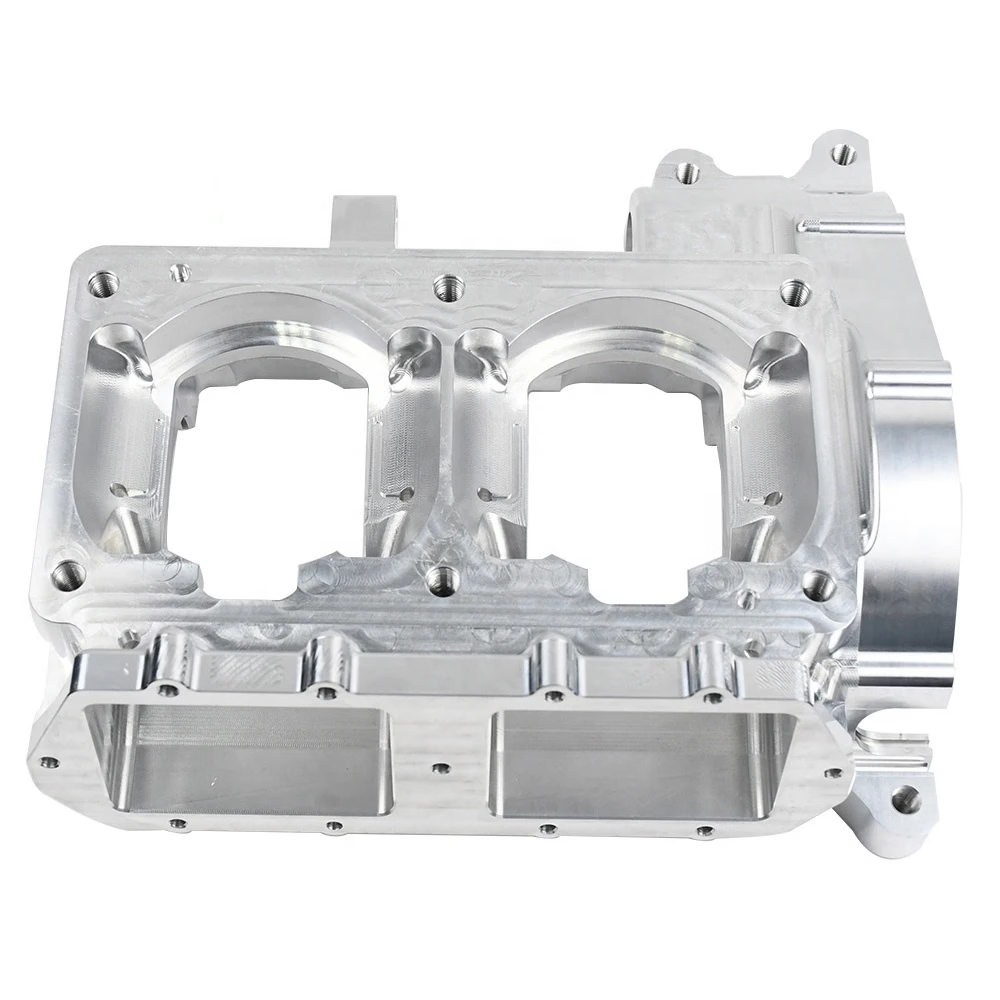
Most suppliers run 3-axis vertical mills and turning centers as the backbone. A smaller group operates 4-axis mills, mill-turn centers, and simultaneous 5-axis machines for impellers, housings, and parts with undercuts that would otherwise need two or three setups. When an engineer asks whether a Malaysian shop can hold a tolerance, the honest answer is that it depends on which of those groups you are talking to.
The country is not a single supply base. Penang, Johor, and the Klang Valley each carry a different density of shops, tooling suppliers, and finishing houses. A shop in a dense cluster can outsource anodizing or electroless nickel and get parts back in days. A shop outside a cluster may need to ship parts across the country for the same operation, which adds handling risk.
That is the practical meaning of the phrase. You are not buying a country. You are buying a specific machine list, a specific inspection routine, and a specific logistics chain.
- 1Backbone equipment3-axis mills plus turning centers handle most prismatic and round parts.
- 2Complex geometry4-axis, mill-turn, and 5-axis centers reduce setups and fixture error.
- 3Cluster effectFinishing and material suppliers nearby shorten total lead time.
Why the advantages exist: setups, labor, and supply density
Every extra setup adds error. When a part moves from one fixture to another, the datum shifts slightly, and the operator must re-indicate the workpiece. A 5-axis machine can reach five faces in one setup, so the cumulative position error stays inside a tighter band. That is the mechanical reason multi-axis work holds ±0.005 mm more reliably than a sequence of 3-axis operations on the same part.
Labor structure matters in a different way. Malaysia has a large pool of machine operators and CAM programmers who have worked in electronics and automotive contract manufacturing. Wages sit below Singapore, Japan, and Western Europe, but above Vietnam and Indonesia for equivalent skill. The result is a middle position: you pay more than the cheapest option and less than the most expensive one, and you get a workforce that already understands first-article inspection reports.
Supply density is the third lever. A part is rarely finished when it leaves the machining center. It may need heat treatment, anodizing, laser marking, or bead blasting. In a mature cluster, those steps happen within a few kilometers, so parts spend hours in transit instead of days. Each handoff is a chance to scratch a surface or lose a batch, so fewer handoffs mean fewer rejects.
None of this is unique to Malaysia. What makes it a real option is that all three levers are present at once, at a cost level that sits comfortably between low-cost regions and high-cost ones.
- 1Setup countFewer fixtures mean less stacked tolerance and shorter cycle time.
- 2Skill poolExperienced operators read drawings and inspection reports without hand-holding.
- 3Handoff distanceShort transport between machining and finishing cuts damage risk.
Materials and finishes you can specify
Aluminium dominates. 6061 and 6061-T6 are the default for housings, brackets, and fixtures because they machine fast and hold a good surface finish. 7075 gives higher strength for aerospace brackets and drone frames, though it is less weldable. 2024 machines well but corrodes without protection, so it usually gets anodizing. ADC12 appears when you start from a die-cast blank and only need to machine critical faces.
Stainless covers a wide range. 303 is the free-machining grade for shafts and fittings. 304 and 316L handle food contact and mild corrosive exposure. 17-4PH (SUS630) gives high strength after aging and is common in valve bodies and medical instruments. 440C suits wear surfaces such as bearing races and pump components. Each grade changes your cutter selection, feed rate, and the risk of work hardening.
Steel grades matter for structural parts. 1018 and 1045 are general-purpose. 4130, 4140, and 4340 appear in automotive and aerospace load paths where hardness and fatigue life matter. Titanium TC4 (Ti-6Al-4V) and Inconel are machinable but slow, and they wear tooling quickly, so budget cycle time accordingly. Magnesium AZ31B and AZ91D are chosen for weight, with chip-fire precautions during cutting.
On the plastics side, POM and PEEK hold tight tolerances, while ABS, PC, PMMA, and PA are common for enclosures and covers. Finishing options include anodizing in clear, color, hardcoat, and conductive types, plus electroless nickel, zinc, silver, and gold plating. Powder coating and black oxide handle wear and appearance. Laser marking can go down to 1.5 mm character height if your label needs to fit a small face.
- 1Aluminium first6061-T6 for general parts, 7075 when strength drives the design.
- 2Stainless by environment303 for machinability, 316L for corrosion, 17-4PH for strength.
- 3Superalloys cost timeInconel and titanium need slower feeds and more tool changes.
Where the cost actually goes
Material is the first line. A 6061 block for a 200 × 150 × 50 mm housing may cost less than the machining time it consumes, but a titanium or Inconel blank can flip that ratio. Buyers who focus only on hourly rates miss this. The material certificate, the stock size you order, and the amount of material removed all shift the quote before a spindle ever turns.
Setup and programming are the second line. A one-off part carries the full cost of CAM programming, fixture design, and first-article inspection. That is why a 5-piece order costs far more per part than a 500-piece order of the same geometry. If you can keep the fixture design reusable across revisions, you pay that cost once instead of every time the drawing changes.
Cycle time is the third line. It is set by the volume of material removed, the number of tools, and the feed and speed the material allows. Aluminium removes quickly. Stainless and titanium remove slowly, and tools wear faster. A part with deep pockets and thin walls may need multiple light passes to control deflection, which adds minutes that never appear on the drawing.
Inspection and finishing close the loop. A 100% inspection routine with reports adds labor but prevents a bad batch from reaching your assembly line. Anodizing or plating adds a vendor step and a queue. When you compare two quotes, compare the inspection scope and the finish specification, not just the bottom line.
- 1MaterialStock size, grade, and removal volume set the baseline.
- 2SetupProgramming and fixtures are fixed costs spread over the batch.
- 3Cycle timeHard alloys and thin walls add minutes per part.
- 4InspectionReports and 100% checks add labor, not risk.
How to judge tolerance and inspection claims
A tolerance claim means nothing without the machine and the metrology behind it. Ask which machine will run the part and how many axes it has. A ±0.005 mm callout on a 5-axis center with a temperature-stable shop is achievable. The same callout on a manual mill is not. Ask for the machine list, not a brochure sentence.
Ask how the first article is measured. Calipers and micrometers cover simple outside dimensions, but a true position callout on a bolt pattern needs a coordinate measuring machine or an optical comparator. If the shop cannot describe its measurement method, the tolerance number is a guess.
Ask about in-process monitoring. A shop that checks only at the end discovers a drift after the whole batch is cut. A shop that measures during the run can correct the offset and keep the rest of the parts in tolerance. This is where a 99.99% qualification rate comes from, not from heroic final inspection.
Certificates matter when your customer requires them. ISO 9001:2015 covers general quality management. IATF 16949:2016 applies to automotive production. ISO 13485:2016 applies to medical devices. ISO 27001:2022 covers information security, which matters when you share CAD files under NDA. Match the certificate to the industry you sell into.
- 1Machine listAxis count and machine model decide what tolerance is realistic.
- 2Measurement methodCMM or optical comparator for position, not calipers.
- 3In-process checksCatch drift mid-run instead of scrapping a batch.
- 4Certificate matchIATF for auto, ISO 13485 for medical, ISO 27001 for data.
Lead time, shipping, and the hidden delays
Quotation speed is the first test of a supplier. A shop that returns a quote and a DFM analysis within 12 hours is set up to review drawings fast. A shop that takes a week is probably not. Speed here reflects internal process, not necessarily part quality, but it predicts how the rest of the project will go.
Production start follows quickly. If material is in stock and the fixture design is simple, production can start within 24 hours of approval. Parts often ship in 3–5 days for standard geometries. Those numbers assume a clean drawing and a material that is available locally. A specialty titanium grade may need to be ordered, and that alone can add days.
Shipping is where buyers lose time. Air freight from Malaysia to Europe or North America takes a few days in transit but adds customs clearance. Sea freight costs less and takes weeks. For a bridge run that feeds an assembly line, air freight is often the right call even at higher cost. For a stock build, sea freight is fine.
The real risk is not transit. It is the handoff between machining, finishing, and packing. If the shop manages those steps in-house or with a trusted neighbor, the schedule holds. If the part travels between three vendors, each one adds a queue and a chance for damage. Ask who owns the finishing step before you approve the order.
- 1Quote speed12-hour quote and DFM review signals a tuned process.
- 2Start speedProduction can begin within 24 hours when stock is ready.
- 3Freight choiceAir for line-feed parts, sea for stock builds.
- 4Handoff countEach vendor transition adds queue time and damage risk.
When CNC machining in Malaysia fits, and when it does not
Match your part profile to the row that describes it best.
| Part profile | Fits Malaysia | Better alternative | Why |
|---|---|---|---|
| Prototype, 1–50 pcs | Yes | 3D printing for non-functional shapes | No tooling cost, fast setup |
| Bridge run, 500–5,000 pcs | Yes | Die casting later | Machined parts validate before tooling spend |
| ±0.005 mm, 5 faces | Yes | None at this tolerance | 5-axis holds position in one setup |
| 100k+ simple part | No | Die casting or forging | Cycle time per part dominates cost |
| Tight cosmetic Anodize | Yes | Local cluster shop | Nearby finishing reduces handling marks |
| Large weldment 4,000 mm | Sometimes | Sheet metal fabrication | Machining a weldment can relax stress |
| Regulated medical implant | Yes | ISO 13485 shop only | Audit trail and process validation required |
| Hollow thin-wall part | Careful | Casting then finish machining | Chatter and distortion rise below 1 mm wall |
The honest verdict
Choose CNC machining in Malaysia when you need machined parts at ±0.005 mm with a fast quote and no tooling cost, especially for prototypes and bridge runs up to a few thousand pieces. Choose die casting or forging when your annual volume passes roughly 100,000 simple parts, because cycle time per part then outweighs the savings of a machining-only route.
Questions engineers ask next
Is CNC machining in Malaysia cheaper than China?
It depends on the part, not the country. Malaysian labor sits above Vietnam and Indonesia but below Singapore and Western Europe for equivalent skill. China's advantage comes from a larger and more vertically integrated supply base, which shortens lead time for complex assemblies.
For a simple aluminium bracket, the two regions land close together once freight and duty are included. For a part that needs 5-axis work plus anodizing plus laser marking, the cluster around the shop often matters more than the hourly rate.
What tolerance can a Malaysian shop realistically hold?
On a simultaneous 5-axis center with a temperature-controlled shop, ±0.005 mm (about ±0.0002 in) is achievable on critical features. That number assumes the datum scheme is clean and the part is rigid enough to survive cutting forces.
Thin walls, deep pockets, and long slender features push the achievable tolerance wider. In those cases, plan for an intermediate semi-finish pass and a stress-relief step if the material is prone to movement.
Which materials are easy to source locally, and which are not?
Aluminium 6061, 6061-T6, 2024, 7075, and the common stainless grades such as 303, 304, and 316L are usually in stock. Steel grades like 1018, 1045, 4140, and 4340 are also common.
Titanium TC4, Inconel, and magnesium AZ31B or AZ91D may need to be ordered, which adds days to the schedule. If your design allows an aluminium substitute for the prototype, you can validate geometry before committing to a slower superalloy run.
How do I protect my design when sending files overseas?
Ask for a non-disclosure agreement before you upload anything. A shop that holds ISO 27001:2022 has a documented information security management system, which covers how files are stored, who can access them, and how they are deleted.
Keep the upload channel secure and limit the drawing package to what the shop needs to quote. If a feature is not machined, you do not need to share it at the quotation stage.
Can a Malaysian shop handle both prototyping and production?
Yes, and that is often the point. A shop with no minimum order quantity can cut one prototype, then scale to a 10,000-piece run on the same fixtures. That continuity avoids a second first-article inspection when you move from prototype to production.
The caveat is process capability. A shop that excels at one-off prototypes may not have the cycle-time discipline for a high-volume run. Ask for the production machine list and the inspection plan before you commit the volume.
What finishes are available without shipping parts elsewhere?
Anodizing in clear, color, hardcoat, and conductive types is widely available. Electroless nickel, zinc, silver, and gold plating are also common, along with powder coating and black oxide.
Bead blasting, tumbling, brushing, and polishing cover most cosmetic needs. Laser marking handles part numbers and logos down to a 1.5 mm character height. Availability depends on the cluster the shop sits in, so confirm the finishing step before you approve the order.
Send your drawing, get a quote in 12 hours
Share your CAD file and we return a quotation with a free DFM analysis within 12 hours. Production can start within 24 hours, and parts ship in 3–5 days with 100% inspection before they leave.
12-hour quote100% inspectionNo minimum order quantityNDA on request
More machining notes
We publish setup notes, tooling trials and inspection data from the factory floor.











