
CNC machining: is it easy?
The short answer depends on the part, not the machine. Here is how setup, tooling, tolerances, and inspection decide whether a job runs smoothly, so engineers can judge difficulty before promising a lead time.
In this article
- 1
- 2
- 3
- 4
- 5
- 6
- 7
- 8
Why CNC machining is it easy to misjudge
A CNC machine follows a program. Load stock, press cycle start, and the toolpath repeats the same way every cycle. That repeatability is real, and it is why a stable process can hold ±0.005 mm on a good day. The machine does not get tired or distracted.
The program, though, was written by someone who had to choose tool order, speeds, feeds, workholding, and stock allowance. Every one of those choices carries a failure mode. So when someone asks CNC machining is it easy, the honest response is that cutting the part is easy and cutting it right is the work.
Difficulty rarely comes from the controller. It comes from geometry that cannot be reached, material that moves after cutting, or a tolerance tighter than the setup can support. Those three problems account for most of the scrap we see on incoming RFQs.
This page is written for design engineers, manufacturing engineers, and buyers who need to estimate risk before placing an order. We will not tell you every job is simple. We will show you which parts are easy, which parts are not, and what evidence tells you which is which.
Setup and workholding decide most of the difficulty
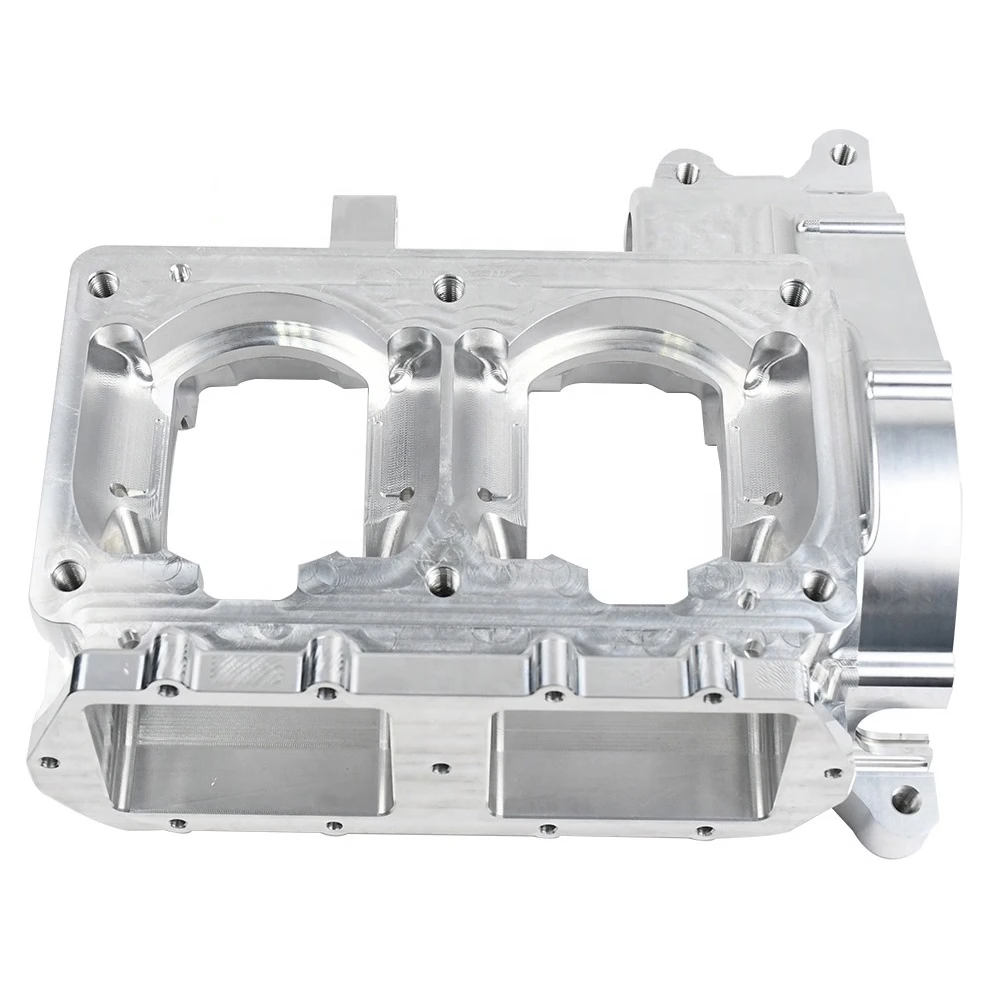
A part with flat faces and open edges is easy. Clamp it in a vise, touch off the corners, and run. A part that needs five sides, thin walls, or access from underneath is a different conversation. Each additional setup multiplies the chance of a datum shift.
Workholding is where the invisible work lives. Thin walls deflect when a vise closes on them. Long slender parts chatter unless you support them. Round parts need a collet, a chuck, or a custom fixture. On a Ø400 mm rotary table you get more reach, but you also need a strategy that keeps the part from lifting.
When we quote a part, we look at how many times it must be re-fixtured. A three-axis machine may need six setups for a complex housing. A simultaneous five-axis center might do it in two. That difference is not marketing. It shows up as cost, cycle time, and variation between parts.
The practical test is simple. Can every feature be reached without re-clamping? If yes, the job is closer to easy. If no, budget for fixtures and plan the datums before the first cut.
- 1Open geometryFlat plates, bushings, brackets, and shafts are the easy end of the range.
- 2Deep pocketsNeed long tools, reduced feed, and often a second operation.
- 3Thin wallsBelow about 1 mm, expect deflection and light finishing passes.
Material behavior changes the answer
Aluminium 6061 cuts fast and holds a good finish. That is why prototyping work gravitates toward it. 7075 is stronger but more prone to distortion after heavy material removal. 2024 machines well but is less corrosion resistant without a finish.
Stainless steel separates shops that know what they are doing from those that do not. 303 is free-machining. 304 work-hardens if you dwell or rub instead of cut. 316L is common in medical work and needs sharp tools and steady feed. Slow down and use coolant, or the surface will work-harden under the tool.
Titanium TC4 (Ti-6Al-4V) and Inconel sit at the difficult end. Low thermal conductivity keeps heat in the cutting zone. Tool life drops, cycle time rises, and the process needs conservative parameters. These are not impossible materials, but they are not easy either.
Plastics bring a different problem. POM and PA move with temperature. PEEK is stable but abrasive. ABS and PC scratch easily, so handling matters as much as cutting. The material choice often decides whether a part is easy before the geometry is even considered.
Tolerance and finish raise the bar
A general machining tolerance of ±0.1 mm is routine. Tightening to ±0.005 mm changes the process. Thermal growth matters. Tool wear matters. The machine must be probed and the shop must control temperature. None of that is exotic, but it costs time and attention.
Surface finish follows a similar curve. As-machined Ra 1.6–3.2 μm is normal. Ra 0.8–1.6 μm needs a finishing pass with a sharp tool and stable setup. Ra 0.2–0.8 μm is achievable on the right material and geometry, usually on a dedicated finishing operation.
Tolerance and finish interact. A tight tolerance on a thin wall is harder than the same tolerance on a solid block, because the wall moves while you cut it. A fine finish on a deep pocket is harder than the same finish on an open face, because the tool deflects.
The point is not that tight work is impossible. It is that calling a job easy depends on what you are asking the process to hold. A drawing with ±0.005 mm everywhere is not the same as one with a single critical bore at that limit.
Inspection is where easy jobs get caught
A part is not done when the cycle ends. It is done when it measures correctly. First article inspection compares the first part against the drawing before the run continues. Skipping it is how a whole batch ends up out of spec.
We inspect raw material on arrival, monitor the process while cutting, and check the final part before shipment. Reports are available on request. That routine is boring, and boring is the point. It catches drift before it becomes scrap.
Measurement itself can be the hard part. A tight tolerance on a thin section may be hard to measure without distorting the part. A deep bore may need a specific gauge. If the feature cannot be measured reliably, the tolerance is not meaningful.
This is why we ask for the full drawing and the function of each critical dimension. Knowing which number actually matters lets us focus the process and the inspection where it counts.
Matching the process to the part
Three-axis machining is the default for flat plates, pockets, and simple profiles. It is fast, widely available, and easy to inspect. If the part can be cut from one direction plus a flip, this is usually the right call.
Four-axis and five-axis centers earn their place when the part has features on multiple faces or complex contours. A simultaneous five-axis machine can cut an impeller or a housing in fewer setups, which reduces datum error. It is not automatically better, just better suited to certain geometry.
Mill-turn centers handle parts that need both turning and milling, like shafts with cross-holes or flats. Doing both on one machine avoids re-fixturing and keeps concentricity. Again, this is a fit question, not a quality question.
For prototypes, we often start on three-axis and move to five-axis only if the geometry demands it. For production runs, the setup count and cycle time drive the choice. The material and finish requirements narrow it further.
What to check before you commit
Before you place an order, confirm three things. First, the drawing shows every critical dimension and the datum scheme. Second, the tolerance is realistic for the geometry, not copied from a template. Third, the finish callout matches the function, not a habit.
Ask how many setups the part needs. Ask where the datum is taken. Ask how the critical feature will be measured. A shop that can answer these questions clearly is a shop that has thought about the job. A shop that cannot is quoting on hope.
If the part is complex, request a DFM review before cutting metal. Small changes, like opening a corner radius or relaxing a non-critical tolerance, can turn a hard job into a routine one. That review costs nothing and often saves a revision.
CNC machining is it easy? For a flat bracket, yes. For a thin-walled titanium housing with a ±0.005 mm bore, no. The difference is knowable before the first chip, and that is what a good quote should tell you.
Which parts are easy, and which are not
Use this to estimate risk before you request a quote.
| Part feature | Difficulty | What it needs |
|---|---|---|
| Flat plate, open edges | Easy | Vise, three-axis, one setup |
| Round shaft, turned OD | Easy | Collet or chuck, single op |
| Deep pocket, L/D over 5 | Moderate | Long tools, reduced feed, step-down |
| Thin wall below 1 mm | Moderate | Light finishing passes, support |
| Undercut or hidden feature | Hard | Five-axis or custom fixture |
| Titanium or Inconel | Hard | Rigid setup, conservative speeds |
| ±0.005 mm on a long span | Hard | Temperature control, probing |
| Fine finish Ra 0.2–0.8 μm | Moderate | Finishing pass, correct tool |
The verdict on difficulty
If your part has open geometry and standard tolerances, treat it as easy and move fast. If it has hidden features, thin walls, or exotic material, treat it as hard and plan the setup and inspection before you promise a date.
Questions engineers ask next
Is CNC machining easy to learn?
Running a program is teachable in weeks. Choosing toolpaths, feeds, and workholding for a new part takes years of practice. The gap between operating and process planning is where most of the skill sits.
What makes a part hard to machine?
Three things dominate. Features the tool cannot reach, material that moves or work-hardens, and tolerances tighter than the setup can hold. Any one of them turns an easy job into a careful one.
Can you hold ±0.005 mm on every feature?
We can hold ±0.005 mm on critical features with the right setup, control, and inspection. Applying that tolerance everywhere raises cost without adding function. Put it only where the design needs it.
How do I know if my design is machinable?
Send the STEP file and drawing. We review tool access, wall thickness, corner radii, and datum structure. You get feedback before cutting, usually within 12 hours.
Does material choice really change difficulty?
Yes. Aluminium 6061 is forgiving. Titanium TC4 and Inconel need conservative parameters and shorter tool life. Stainless 304 work-hardens if the feed is too light. Material often decides the cycle time more than geometry does.
What is the easiest part to machine?
A simple prismatic part with open faces, one datum, and general tolerances. Think brackets, spacers, and plates. These run on three-axis machines with minimal fixturing and inspect quickly.
Get a clear answer on your part
Send your drawing and we will tell you which features are easy and which need attention, with a quote and DFM feedback in 12 hours.
12-hour quote100% inspectionNo minimum order
More from the shop floor
We publish setup notes, tooling trials and inspection data from the factory floor.











