
CNC Machining of Delrins Precise Parts: How Acetal Cuts
Delrin (homopolymer acetal, POM-H) is the material we reach for when a part needs to slide, snap or seal without lubrication. It is also one of the easiest plastics to scrap. This page explains what happens at the cutter, which geometries hold tolerance, and when acetal is the wrong call.
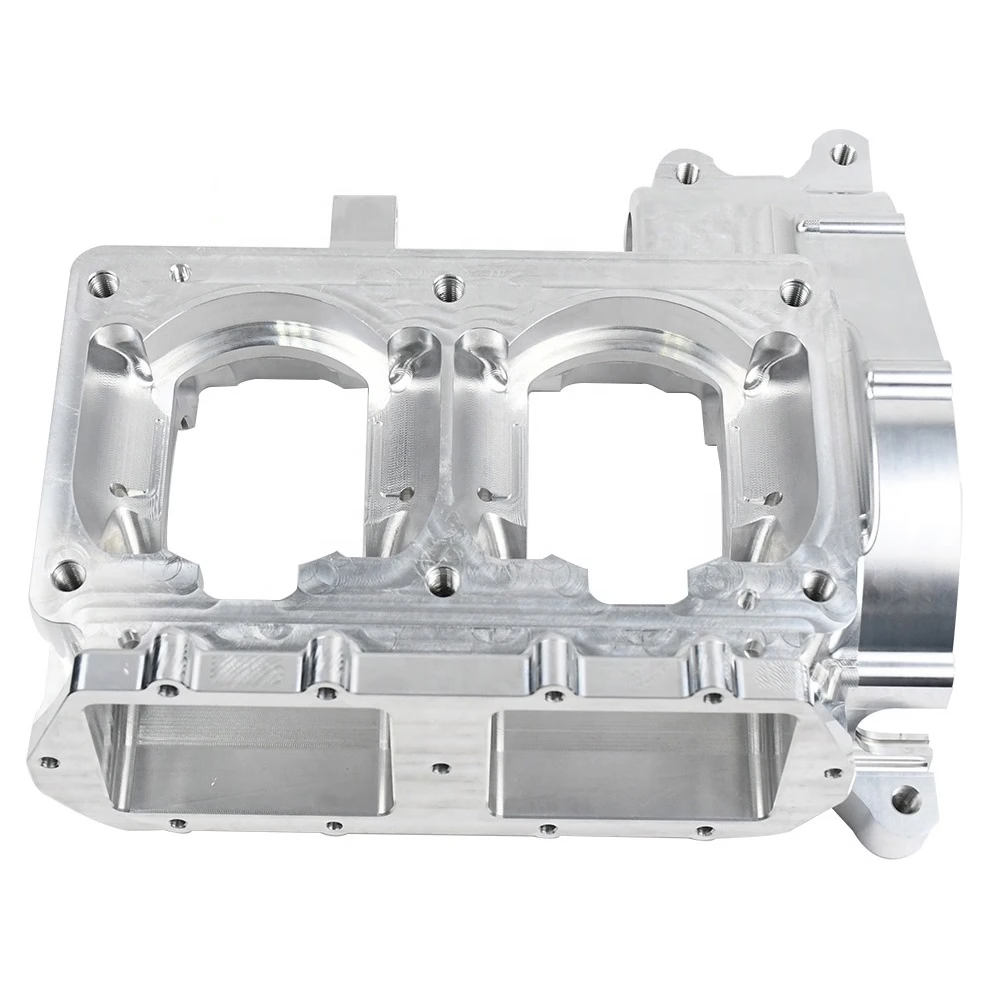
Why Delrins Precise Parts Machine Differently From Metal
Delrin is a semi-crystalline homopolymer. Its crystals melt over a range rather than at one temperature, and its thermal conductivity is roughly one thousandth that of aluminum. Heat generated at the cutting edge has nowhere to go. It builds in the chip and in the surface layer of the part.
That single fact explains most of what goes wrong in the CNC machining of delrins precise parts. A sharp tool running at metal speeds will rub instead of cut, and friction heat softens the material right at the tool nose. The result is a smeared surface, a built-up edge, and a dimension that measures correctly while warm and shrinks after the part cools.
Acetal also has a low glass transition and a sharp crystalline melting range. Between roughly 80 °C and 150 °C the material loses stiffness fast. If the tool edge sits in the cut and dwells, that local soft zone deflects away from the cutter instead of shearing cleanly. You get chatter marks and a tapered wall.
The practical consequence is that feed per tooth matters more than spindle speed. Plastics need a thick chip to carry heat away. When the chip is thin, the edge rubs and the heat stays in the workpiece. So we run aggressive feed and moderate rpm, not the reverse.
- 1Heat pathAlmost all cutting heat enters the chip or the part, not the tool.
- 2Chip loadToo light a chip means rubbing, not cutting.
- 3Thermal windowStiffness drops sharply above roughly 80 °C.
Tool Geometry, Feeds and Speeds That Work
For the CNC machining of delrins precise parts, tool geometry is the first lever. Two-flute carbide end mills with a high helix, polished flutes and a sharp positive rake cut acetal cleanly. Uncoated carbide is usually better than a coated tool. Coatings add surface roughness, and smooth flutes evacuate the stringy chip faster.
Spindle speeds typically sit between 2,000 and 8,000 rpm for small end mills, with feed per tooth around 0.05 to 0.15 mm. The exact number depends on radial depth. When we take a full-width slot, we slow the feed and accept a lower chip load. When we take a light radial pass at high feed, the chip stays thick and the surface comes out clean.
Cooling is mostly air. Flood coolant can help on deep pockets because it flushes chips and carries heat out of the cut. But acetal does not like thermal shock, and wet chips cling to the vise and the table. Compressed air through a vortex tube is often the better answer.
Roughing and finishing should be separate operations. Leave 0.3 to 0.5 mm of radial stock for the finish pass. A finishing pass with a fresh edge and a consistent chip load gives Ra 0.8–1.6 μm off the machine. Sanding a machined acetal surface usually makes it worse, because it embeds grit and rounds the edges you just held.
- 1FlutesTwo flutes, high helix, polished, uncoated carbide.
- 2Feed per tooth0.05–0.15 mm, higher is generally better than higher rpm.
- 3Finish stockLeave 0.3–0.5 mm radial for the finishing pass.
Workholding, Stress Relief and Dimensional Drift
Extruded acetal bar carries internal stress from the extrusion process. When you remove material from one side, that stress rebalances and the part bows. The classic symptom is a flat plate that measures flat on the machine and curves after it leaves the vise. For delrins precise parts, this is the most common reason a first article fails.
The fix is sequencing. Rough the part, then release the clamps and let it sit. For tight work, stress-relieve the blank before machining. A slow anneal cycle in a controlled oven, followed by a slow cool, relaxes the bar. It costs a day but saves the lot.
Clamping pressure is the second trap. Acetal is about twenty times more compliant than steel. A vise tightened like you would for 6061 will squeeze the part oval, and the cut will be round only while the jaws are closed. Soft jaws bored to the part diameter spread the load. Light clamping plus a stop pin beats a heavy vise every time.
Thin walls need support, not heroics. Below roughly 0.8 mm, unsupported acetal deflects under normal cutting forces. You can machine it, but you may need to leave a sacrificial web, or plan the toolpath so the wall is supported until the last pass.
- 1Stress reliefAnneal extruded stock before tight-tolerance work.
- 2ClampingSoft jaws, light pressure, support on both sides of thin walls.
- 3Wall limitBelow about 0.8 mm, plan support into the toolpath.
When Acetal Fits and When It Does Not
Match the property to the job before you commit to POM-H.
| Requirement | Delrin (POM-H) | Better alternative |
|---|---|---|
| Sliding wear, low friction | Excellent, self-lubricating | PEEK only if temperature is high |
| Tight tolerance, small part | Good, ±0.05 mm achievable | Aluminum 6061 for ±0.005 mm |
| Continuous service above 90 °C | Poor, stiffness drops | PEEK or PPS |
| Strong acids or bases | Poor, attacked | PTFE or PVDF |
| Impact and snap fits | Excellent, high fatigue life | Nylon 6/6 for higher load |
| Food or medical contact | Check resin grade | PEEK or PEI with documentation |
| Large flat part, thin section | Warping risk from stress | Stress-relieved POM or metal |
| Cost per part | Low material cost | Metals win only on stiffness |
The Short Version
If the part slides, snaps, or seals and stays under about 80 °C, machine it in Delrin. If it must hold ±0.005 mm, carry real load, or run hot and wet, choose metal or PEEK.
Common Questions
What tolerance can acetal actually hold?
On a stable part with a supported wall, ±0.05 mm is realistic and repeatable. Tighter than that, thermal drift and moisture uptake start to dominate. The material absorbs and releases moisture slowly, so a dimension that is right in a dry shop can move after a week in a humid one.
Metal is the honest answer when the drawing calls for ±0.005 mm. We machine 6061, 7075 and 17-4PH to that band daily. Acetal is a wear and sealing material, not a metrology material.
Should I anneal the bar stock first?
For a flat part, a long part, or anything with a tolerance band under ±0.1 mm, yes. Extruded bar holds residual stress, and removing material from one side releases it. Rough, anneal, finish.
For a small bushing or a simple spacer, skip it. The geometry is stiff enough that stress does not show up in the measurement.
Why does the surface look smeared instead of cut?
Smeared surfaces mean the tool is rubbing. Raise the feed per tooth, check that the flutes are clear, and confirm the edge is sharp. A dull tool on acetal does not wear gradually the way it does on steel. It goes from cutting to burnishing in a few minutes.
Also check runout. Even 0.02 mm of runout means one flute does all the work and the others rub.
Can acetal be machined on a 5-axis machine?
Yes, and it helps on parts with undercuts or angled faces that would otherwise need two setups. Each setup change is another chance to squeeze the part out of round, so fewer setups usually means better geometry.
We run 16 simultaneous 5-axis centers. For acetal, the benefit is setup count and tool access, not the ability to cut harder material.
Does acetal need a specific surface finish callout?
State it. As-machined acetal from a good finishing pass lands around Ra 0.8–1.6 μm. If the part seals against an O-ring, that is usually enough. If it slides against another acetal face, a slightly rougher surface can actually hold lubricant film better.
Do not spec a polished finish unless you need it. Polishing acetal by hand heats the surface and can pull it out of tolerance.
What about moisture and storage?
Acetal takes on moisture slowly. A part that measures at nominal in a dry, air-conditioned shop can grow a few microns after weeks in a humid warehouse. For a long-life assembly with a tight fit, measure after conditioning, not straight off the machine.
Ship parts in sealed bags with desiccant when the fit is critical. It is a cheap habit that prevents a lot of arguments.
Send the Drawing, Get a Real Answer
Upload your Delrin part and we will return a quote plus a free DFM analysis within 12 hours. One prototype or ten thousand, no minimum order quantity.
12-hour quote100% inspectionNDA on request
Follow GreatLight
We publish setup notes, tooling trials and inspection data from the factory floor.











