
CNC Machining Parts Supplier: 7 Essential Checks Before You Send a PO
This guide is for mechanical engineers and sourcing buyers who need a CNC machining parts supplier for production parts, not a one-off sample. It covers the checks that change the outcome: tolerance capability, machine mix, inspection evidence, certifications, MOQ, quote format and confidentiality. Read it before you compare quotations.
In this article
- 1
- 2
- 3
- 4
- 5
- 6
- 7
- 8
Key takeaways
CNC Machining Parts Supplier Comparison: What to Check
Ranges come from GreatLight's own capacity list, not from an industry average.
| Check | What to ask for | Good sign | Red flag |
|---|---|---|---|
| Tolerance | Written capability per feature | ±0.005 mm with a stated method | "As tight as you need" with no number |
| Machine list | Model mix and travels | 5-axis, mill-turn, 4,000 mm travel | All work subcontracted out |
| Inspection | Sample report before PO | In-process plus final records | Final check only, no data |
| Certifications | Scoped certificates | ISO 9001, IATF 16949, ISO 13485 | Certificate with no scope page |
| MOQ | Minimum billable quantity | From 1 prototype to 10,000+ parts | MOQ quoted after you send CAD |
| Lead time | Quote, start and ship dates | Quote in 12 h, ship in 3-5 days | Vague "2-4 weeks" answer |
| Quote format | Unit price, setup, material, finish | Line items you can compare | One lump sum, no breakdown |
| Confidentiality | NDA position in writing | NDA available on request | Refuses to sign anything |
The Short Version
Pick the supplier that answers with a machine number, an inspection record and three separate dates. Everything else is a brochure.
Tolerance: What a CNC Machining Parts Supplier Can Actually Hold
Tolerance is the first number buyers compare, and the easiest one to misread. A supplier can hold ±0.005 mm on a 40 mm aluminum bracket and fail the same callout on a 900 mm steel weldment. The limit comes from the machine, the fixturing and how much heat the cut puts into the part, not from the quotation sheet.
Ask which machine will run your part and what the setup looks like. A 5-axis center holding a part in one setup removes the datum stack that builds up when a job moves across three machines. On thin walls, a 0.8 mm floor will deflect under a heavy radial cut no matter how good the control is.
Finish travels with tolerance. Ra 0.8-1.6 μm is a normal machined surface on most alloys. Ra 0.2-0.8 μm usually means a separate finishing pass, a smaller stepover and more time in the cut. If your drawing calls for that finish on one bore only, say so.
The practical test is a capability question, not a yes-or-no question. Send one critical feature, the material and the quantity, and ask what the supplier would do to hold it. A vague answer tells you more than a tight number.
Machine Mix and Size Limits at a CNC Machining Parts Supplier
A supplier with a narrow machine list will outsource whatever does not fit. Every outside operation adds a queue, a second setup and a second party who can lose your tolerance. Ask for the machine list before you send CAD.
Size is the fastest filter. GreatLight runs 127 high-precision CNC machines, including 16 simultaneous 5-axis machining centers, 16 mill-turn centers, 12 four-axis mills and 27 three-axis machines. The largest travel is 4,000 × 400 × 150 mm, with medium platforms at 750 × 1,150 × 550 mm and 600 × 600 × 600 mm.
Mill-turn matters more than buyers expect. A shaft with a milled flat, a cross-hole and a turned journal can be finished in one cycle instead of three. Turning a part into two setups doubles the chance of a concentricity error.
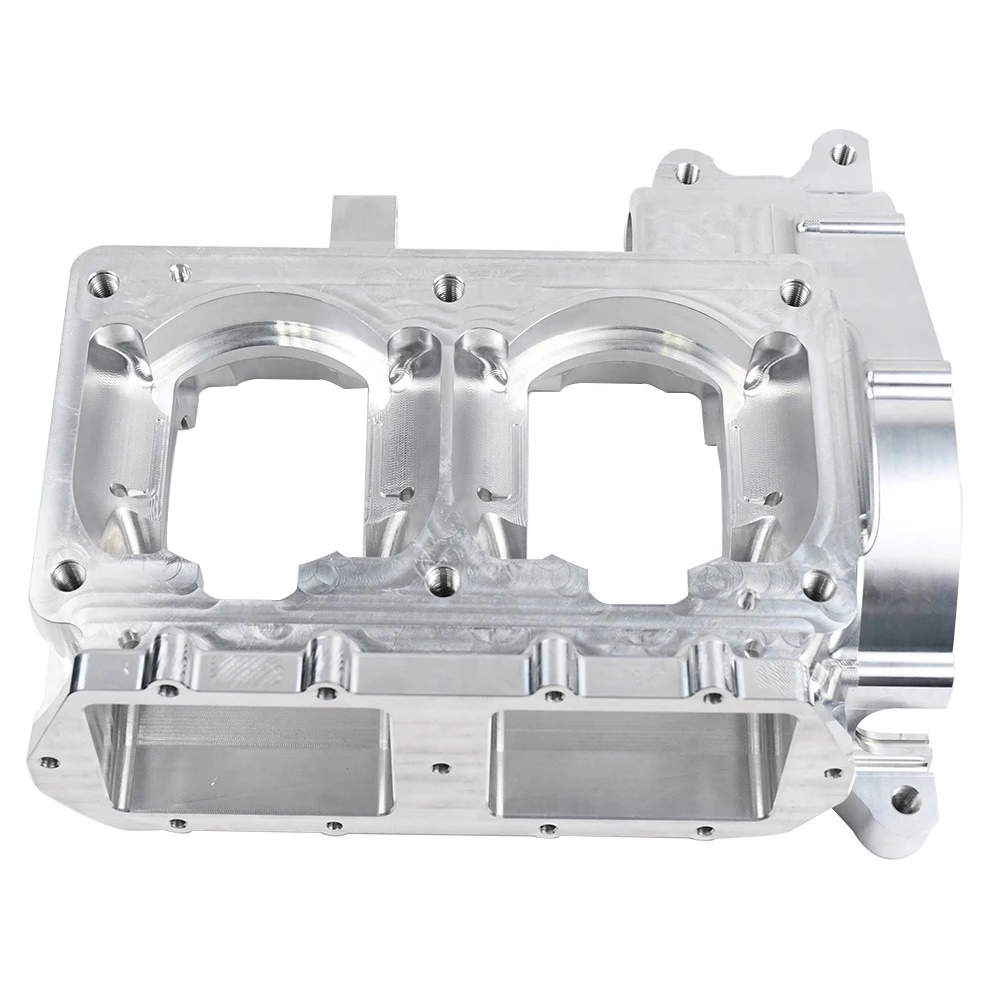
If your part is a 4,000 mm extrusion with a few drilled holes, a large 3-axis machine is the cheap answer. If it is a compact housing with features on five faces, a 5-axis center is the only answer that avoids repositioning. Match the machine to the geometry.
Inspection, Certifications and What They Cover
Certificates tell you a system exists. Inspection records tell you your parts are correct. Buyers often accept the first and never ask for the second.
Ask what happens between the first cut and the shipping box. A workable flow is raw material verification, in-process monitoring on critical dimensions, and a final inspection before shipment, with reports available on request. If a supplier can only describe a final check, the process drift was never caught.
Scope matters on certificates too. ISO 9001:2015 covers general quality management. IATF 16949:2016 applies to automotive production. ISO 13485:2016 covers medical devices. ISO 27001:2022 covers information security, which is the one that matters when your CAD files leave your network.
Match the certificate to the part, not to the marketing page. A medical housing needs ISO 13485 in scope. A bracket for an industrial machine does not, and paying for that overhead is wasted money.
MOQ, Lead Time and How Quotes Are Priced
Minimum order quantity is a cash-flow question early in a program. A prototype run of one part should not carry the same per-unit overhead as a 10,000-piece run. Suppliers with no minimum order quantity let you validate the design before you commit tooling budget.
Break the lead time into three dates: when the quote lands, when the spindle starts, and when the parts ship. A quotation and DFM analysis within 12 hours, a production start within 24 hours and shipping in 3-5 days are the numbers to compare against. Anything quoted as a single block hides where the delay sits.
Read the quote line by line. Unit price, setup, material, finish, inspection and freight should each be visible. A lump sum cannot be compared with a competitor's lump sum, and it hides the setup charge you pay again on every reorder.
Late delivery risk is worth asking about directly. A supplier tracking its own on-time data, such as a historical late-delivery probability below 2%, is measuring something. A supplier that has never counted it is guessing.
Materials, Finishes and Confidentiality
Material coverage decides whether a supplier can quote your drawing without a broker. Common aluminum grades such as 6061-T6, 7075 and 6082 behave very differently in the cut. Stainless 17-4PH and titanium Ti-6Al-4V need slower speeds and sharper tooling. Plastics like PEEK and POM need fixtures that do not crush the part.
Finish is where quotes drift apart. Anodizing, electroless nickel, zinc and silver plating, powder coating, black oxide, bead blasting and polishing are separate operations with separate queues. Ask which operations run in-house and which are sent out.
Confidentiality is a procurement issue, not a legal formality. Uploads should be handled as secure and confidential, and an NDA should be available on request. If your parts carry a patent or a customer program name, settle this before the first drawing is uploaded.
Put materials, finishes and confidentiality in the same conversation. They usually sit with the same program engineer, and fixing them late is what pushes a first article into a second week.
How to Qualify a CNC Machining Parts Supplier: 7 Steps
- 1Send one critical feature, not the whole assemblyPick the tightest dimension and the material you will actually use. A single feature quote returns in 12 hours and tells you how the supplier reads a drawing.
- 2Ask for the machine that will run itGet the model and the travel. If the answer is "a CNC mill", ask again until you hear 5-axis, mill-turn or 3-axis with a size.
- 3Request a sample inspection reportOne page of real in-process data beats a certificate PDF. Look for the dimension, the nominal, the actual and the instrument.
- 4Confirm the certificate scopeISO 9001:2015, IATF 16949:2016, ISO 13485:2016, ISO 27001:2022. Match scope to your industry, not to the logo wall.
- 5Test the MOQ claim with a real quantityAsk for pricing at 1, 100 and 10,000 pieces. A no-minimum supplier will quote all three without changing the answer.
- 6Split the lead time into three datesQuote, production start, ship date. Compare 12 hours, 24 hours and 3-5 days against what you actually receive.
- 7Settle confidentiality before uploadingRequest the NDA first. Then upload files through a channel the supplier treats as secure and confidential.
Frequently Asked Questions
How do I know if a supplier can hold ±0.005 mm?
Ask which machine and which setup will hold it, then ask for an inspection report from a similar part. Tolerance comes from the machine, the fixture and the thermal conditions, so a supplier that names the machine is answering the real question.
A supplier that answers with a number but no method has not answered. The parts may still pass, but you will not know until the first article arrives.
Is a lower price per part worth a longer lead time?
It depends on where the cost sits. A cheaper unit price with a two-week queue can cost more than a higher unit price that ships in 3-5 days, once you count the line downtime or the air freight you book to recover.
Run the two scenarios with your own carrying cost. For prototype iterations, speed usually wins. For a stable annual volume, unit price wins.
Do I need an IATF 16949 supplier for a non-automotive part?
No. IATF 16949:2016 is built around automotive production requirements such as traceability and change control. A bracket for industrial machinery does not need that overhead, and you should not pay for it.
Match the certification to the end use. Medical housings point to ISO 13485:2016. Parts with sensitive drawings point to ISO 27001:2022 for information security.
What should a quotation include?
Unit price, setup, material, finish, inspection and freight as separate lines. If the part has more than one operation, ask for the operations to be listed so you can see what drives the cost.
A lump sum cannot be compared against another lump sum. You will end up choosing on the total and never knowing which line was inflated.
How do I protect my design when I request a quote?
Ask for an NDA before the first upload, and confirm in writing that files are treated as secure and confidential. Keep the first exchange to the minimum geometry needed for pricing if the NDA is still in review.
This is standard practice for a CNC machining parts supplier serving aerospace, medical and automotive programs. A supplier that resists the request is telling you something.
Can one supplier handle a prototype and a 10,000-piece run?
Yes, if the process is the same. A supplier with no minimum order quantity and a machine list that covers both small and large travels can move from one part to a production run without re-qualifying a second source.
Ask how the prototype setup carries into production. If the fixture and the program are reused, the first article data stays valid. If everything is rebuilt, you pay for a second qualification.
Send One Part, Get a Real Answer
Upload a drawing and we return a quotation with DFM analysis within 12 hours. No minimum order quantity, from one prototype to 10,000+ parts.
12-hour quoteNo MOQ100% inspection
More From the Shop Floor
We publish setup notes, tooling trials and inspection data from the factory floor.











