
CNC Machining Service New York: How to Choose Before You Order
This guide is for engineers, product managers and purchasing teams in New York State who need machined parts and want to judge a supplier before sending a PO. A CNC machining service New York team can be compared on seven checks that actually change part quality, cost and schedule: tolerance, geometry, DFM feedback, lead time, order size, certification and inspection paperwork. Read it once and you can compare quotes on the same basis instead of on price alone.
In this article
- 1
- 2
- 3
- 4
- 5
- 6
- 7
- 8
Key takeaways
How to match a CNC machining service New York supplier to your part
Use the left column to find your part type, then read across for the process, the tolerance you can realistically hold, and the check that matters most.
| Part type | Best process | Realistic tolerance | Check first |
|---|---|---|---|
| Small bracket, 1–50 pcs | 3-axis milling | ±0.01 mm | Setup count and fixture cost |
| Housing with features on 5 faces | 5-axis milling | ±0.005 mm | Simultaneous 5-axis capacity |
| Shaft with turned and milled detail | Mill-turn center | ±0.005 mm | One-hit vs. two-machine routing |
| Long frame up to 4,000 mm | Large 3-axis gantry | ±0.05 mm | Machine travel and thermal drift |
| Thin wall under 1 mm | 5-axis with light passes | ±0.02 mm | Chatter control and workholding |
| Prototype before tooling | 3-axis or 5-axis, no MOQ | ±0.01 mm | DFM feedback turnaround |
| Aerospace bracket, Ti-6Al-4V | 5-axis, carbide tooling | ±0.005 mm | Material certs and traceability |
| Medical housing, 316L | Mill-turn, Ra 0.8–1.6 μm | ±0.005 mm | ISO 13485 and passivation |
Tolerance and geometry: what a CNC machining service New York shop can actually hold
Tolerance numbers on a drawing are a request, not a promise. What decides the real result is the machine, the fixture and the number of setups. A three-axis mill holding a small aluminum bracket at ±0.01 mm is routine. The same ±0.01 mm across five faces of a housing usually means re-clamping, and every re-clamp adds stack-up error. If the part needs tight position between features on different faces, five-axis work is the cheaper way to hold it, not the expensive one.
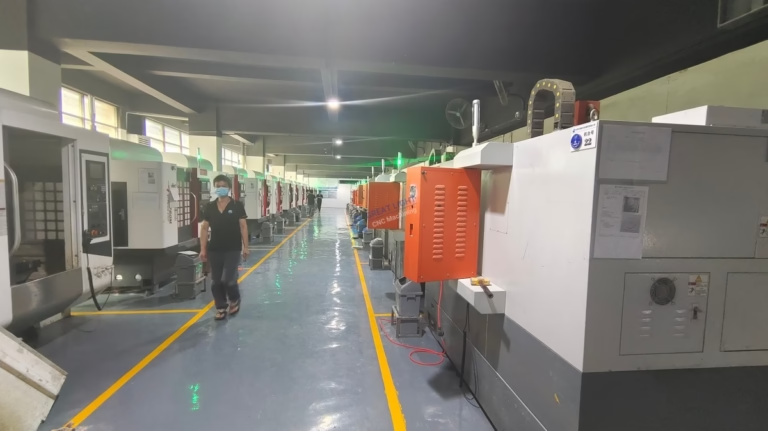
GreatLight runs 16 simultaneous 5-axis machining centers, 12 four-axis mills, 27 three-axis machines and 16 mill-turn centers. That mix matters at quoting time. A shop with only three-axis machines will quote a five-face part with extra setups and may still miss the tolerance. The published capability here is ±0.005 mm, or ±0.0002 in, on parts that fit the machine envelope.
Size changes everything. Maximum processing size is 4,000 mm, with travels of 4,000 × 400 × 150 mm on the large gantry, 750 × 1,150 × 550 mm and 600 × 600 × 600 mm on the medium machines, and 500 × 500 × 450 mm on the compact ones. A Ø400 mm rotary table covers round parts that need milling on the circumference. Ask which machine your part will run on. If the answer is vague, the tolerance is vague too.
- 1Tight tolerance across facesAsk for simultaneous 5-axis, not more setups.
- 2Long parts4,000 mm travel exists, but plan for thermal growth over a long cycle.
- 3Round parts with flatsA Ø400 mm rotary table removes a second op.
- 4Thin wallsBelow 1 mm, expect light passes and custom workholding.
DFM feedback: the part of the quote that saves money
A quote without manufacturability notes tells you the price of the drawing, not the price of the part. The useful output is a short list: this pocket is too deep for a 3 mm cutter, this corner radius forces a 6 mm tool, this hole breaks into a wall and needs support. Fixing those in CAD costs a few hours. Fixing them after the first article costs a week.
GreatLight returns a quotation and free DFM analysis within 12 hours. For a buyer in New York, that timing matters because it lands inside the same working day. You can still change the model before the supplier starts cutting.
Read the DFM notes for what they leave out, too. If a shop flags nothing on a part with a 0.5 mm internal radius and a 40 mm deep pocket, they either plan to use a very small tool with a long cycle, or they have not looked closely. Both outcomes show up later as cost or scrap.
One practical rule: send the STEP file and the 2D drawing together. The 3D model defines geometry, the drawing defines tolerance, finish and datum scheme. Quotes built from only one of the two are usually revised later.
Lead time, order size and what 'no MOQ' really means
Lead time has three separate clocks: quoting, material and machining. Quoting can be 12 hours. Production can start within 24 hours once the order is released. Parts ship in 3–5 days for standard work. Those numbers assume the material is in stock and the drawing is frozen. If you change the model after release, the clock restarts.
Treat the 3–5 day figure as a machining and inspection window, not a delivery date. Freight from Dongguan or Singapore to New York adds transit time you should plan for separately. Ask the supplier to separate the two numbers in writing so you can compare them with a local shop on equal terms.
No minimum order quantity is the most useful commercial term for a New York team. You can buy one prototype, measure it, and only then commit to a 10,000+ part run. It also means you are not paying for tooling you have not validated. For parts that will eventually be cast or molded, that first machined article is the cheapest test you will run.
GreatLight operates three wholly-owned plants and a 7,600 m² facility with 150 technicians. Capacity of that size is what allows a one-off and a 10,000-piece run to sit in the same queue without the small job being pushed to the back. Ask any supplier how a single prototype is scheduled against production orders. The answer tells you whether your prototype will actually ship in a week.
Certifications: match the certificate to the industry
Certificates are not a ranking. Each one answers a different question. ISO 9001:2015 covers a general quality management system. IATF 16949:2016 adds automotive-specific process control and traceability. ISO 13485:2016 covers medical device manufacturing. ISO 27001:2022 covers information security, which matters when you upload proprietary CAD files.
GreatLight holds all four. For an automotive bracket, the IATF certificate is the one that matters, because it speaks to PPAP-style documentation and change control. For a surgical instrument housing, ISO 13485 is the relevant one. For a consumer electronics enclosure, ISO 9001 plus an NDA is usually enough.
Ask for the certificate scope, not just the logo. A certificate that covers machining of aluminum parts does not automatically cover a plating line. If your part needs anodizing or electroless nickel, confirm whether that step is in scope or subcontracted.
Materials and finishes should be checked at the same time. The material list here spans 6061, 7075 and ADC12 aluminum, 303, 316L and 17-4PH stainless, 4130 and 4140 steel, titanium TC4 and Inconel, plus ABS, POM, PEEK and carbon fiber. Finishes include anodizing, plating, powder coating, bead blasting and laser marking with a minimum character height of 1.5 mm. If a finish you need is missing from the list, that is a question, not a rejection.
- 1AutomotiveAsk for IATF 16949 and the PPAP documentation path.
- 2MedicalAsk for ISO 13485 and how cleaning and passivation are handled.
- 3Any proprietary designAsk for ISO 27001 and an NDA before uploading files.
- 4General industrialISO 9001 plus a documented inspection plan is the baseline.
Inspection and quoting: the paperwork that protects you
Inspection is where cheap quotes and good quotes separate. GreatLight inspects 100% of parts before shipment, with raw material checks, in-process monitoring and final inspection, and reports are available on request. The qualification rate is 99.99%. Ask what is measured, on which instrument, and whether the report carries the values or just a pass stamp.
For a New York buyer, the inspection report is the only thing you can review before the box arrives. If a first article is critical, request dimensional values for the callouts that matter, not a general statement. A report with numbers lets you approve the part without waiting for incoming inspection to finish.
Quotingscope matters as much as price. A useful quote lists material grade, machine class, number of setups, finish, inspection level and quantity breaks. A quote that gives one number for one quantity cannot be compared with anything. Ask for a breakdown at 1, 50, 500 and 10,000 pieces if you expect volume later.
Uploads should be treated as confidential. GreatLight keeps uploads secure and confidential and offers an NDA on request. If your drawings carry export-controlled or unreleased product data, settle the NDA before the first file transfer, not after.
Step by step: how to vet a supplier in one week
Run these in order. Each step produces a document you can compare across suppliers.
- 1Send STEP plus 2D drawingInclude material grade, tolerance callouts, surface finish and quantity breaks. Missing any one of these usually triggers a revised quote.
- 2Read the DFM notes before the priceLook for tool-radius warnings, deep-pocket comments and suggested datum changes. A 12-hour DFM return is a reasonable target.
- 3Confirm the machine classAsk which machine will run the part: 3-axis, 4-axis, 5-axis or mill-turn. For five-face work, expect a simultaneous 5-axis center.
- 4Check the tolerance against the envelope±0.005 mm is realistic on parts that fit the machine. On a 4,000 mm frame, agree on ±0.05 mm or accept the cost of a slower cycle.
- 5Order one piece firstNo MOQ means you can measure a real part before committing. Check the critical callouts yourself, not just the report.
- 6Verify certificates by scopeMatch ISO 9001, IATF 16949, ISO 13485 or ISO 27001 to your industry, and confirm whether finishing steps are in scope.
- 7Separate machining time from freightParts ship in 3–5 days from release. Ask for the transit estimate to New York separately so you can plan the build.
- 8Agree on the inspection report formatRequest measured values for critical dimensions on the first article, and a sampling plan for production quantities.
Questions buyers in New York ask before ordering
Can a CNC machining service New York supplier hold ±0.005 mm on every part?
No. ±0.005 mm is the capability limit on parts that fit the machine envelope and have a stable setup. It applies to features measured in a controlled way, not to every dimension on the drawing.
On large parts or thin walls, the practical limit is looser. Agree on which callouts need the tight tolerance and let the rest run at a standard band. That single decision often removes a setup and cuts cost.
How fast can a first article be delivered?
Quotation and free DFM analysis come back within 12 hours. Production can start within 24 hours after release, and parts ship in 3–5 days.
That covers machining and inspection. Freight to New York is a separate leg and should be quoted separately so you can compare with a local supplier honestly.
Is there a minimum order quantity for prototypes?
There is no minimum order quantity. One prototype and a 10,000+ part run are both accepted, using the same process controls.
For most teams the practical path is one part to validate geometry, then a small batch to check the process, then the production run.
Which certifications should I ask for?
Ask for ISO 9001:2015 as the baseline. Add IATF 16949:2016 for automotive work, ISO 13485:2016 for medical devices, and ISO 27001:2022 if you are uploading proprietary files.
Check the scope statement, not just the certificate number, especially if your part needs plating or anodizing done outside the machining cell.
How do I compare two quotes that look different?
Put both on the same sheet: material grade, machine class, number of setups, finish, inspection level and quantity. If one quote omits the finish or the inspection level, it is not cheaper, it is incomplete.
Ask for a quantity break at 1, 50, 500 and 10,000 pieces so you can see how the unit price moves before you commit.
What materials and finishes are available?
Aluminum grades include 6061, 7075, 5052 and ADC12. Stainless includes 303, 316L, 17-4PH and 440C. Steel includes 1018, 4140, 4130 and tool steel. Titanium TC4, Inconel, copper alloys and engineering plastics such as POM, PEEK and ABS are also available.
Finishes cover anodizing, electroless nickel, zinc, silver and gold plating, powder coating, black oxide, bead blasting, polishing and laser marking down to 1.5 mm character height.
Send your drawing and get a comparable quote
Upload a STEP file and 2D drawing and we will return a quotation with free DFM analysis within 12 hours, plus a quantity break so you can compare suppliers on the same basis.
12-hour quoteNo MOQ100% inspectionNDA on request
More from the shop floor
We publish setup notes, tooling trials and inspection data from the factory floor.











