
CNC Machining Time Estimator: What Actually Drives Cycle Time
A CNC machining time estimator turns geometry, material and toolpath into minutes. This page shows which inputs move the number, which are noise, and where a calculated estimate drifts from the real part. Written for design engineers and sourcing engineers comparing quotes.
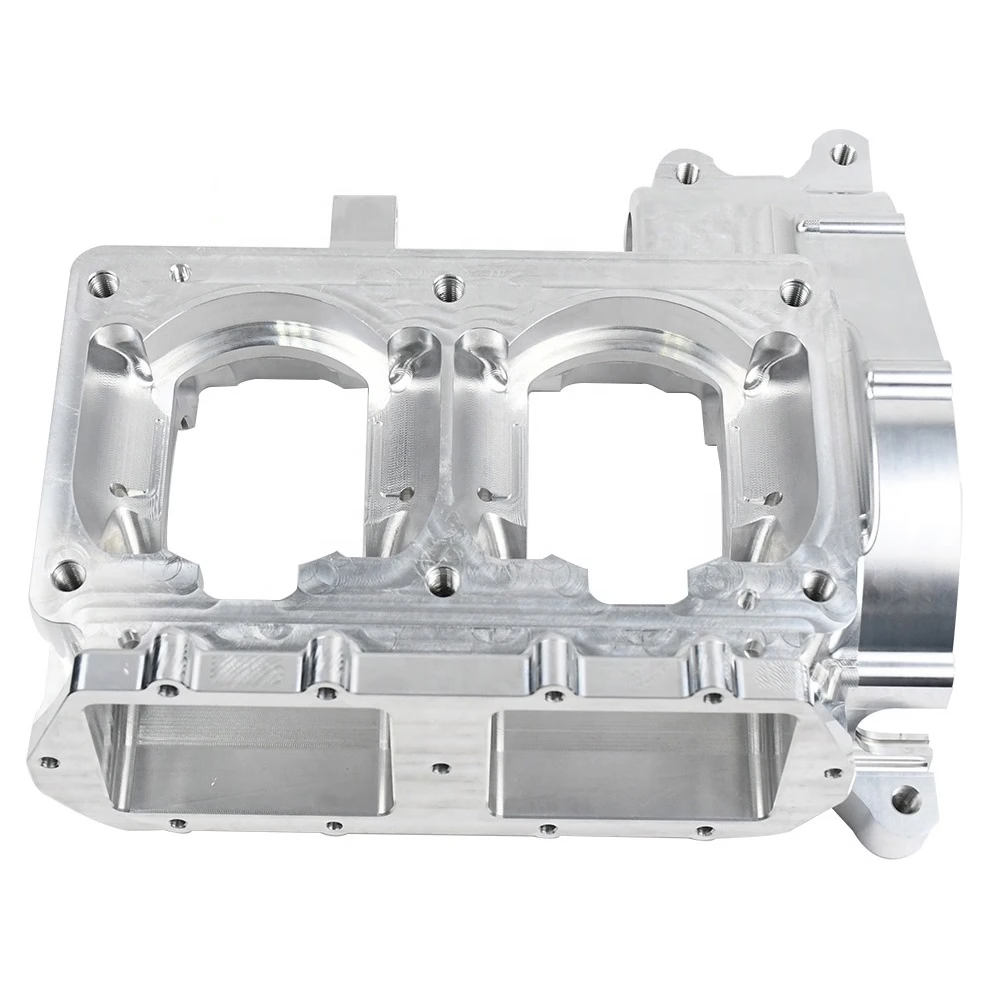
How a CNC Machining Time Estimator Counts Minutes
Every estimator, whether it is a spreadsheet or CAM software, does the same thing. It divides the length of each toolpath by the feed rate, then adds the time the tool spends not cutting. Feed rate comes from spindle speed, chip load and the number of flutes on the cutter. Get any of those three wrong and the total drifts by 20% or more.
The cutting part is easy to picture. A face mill running at 2,000 rpm with a 0.1 mm feed per tooth on a 4-flute cutter moves at 800 mm/min. A 400 mm pass takes 30 seconds. Multiply that by the number of passes and you have the roughing time for that face.
Non-cutting time is what surprises people. Rapid moves, tool changes, spindle ramp-up and probing all sit inside the cycle. On a part with 12 tools and 40 pockets, tool changes alone can add 4 to 6 minutes. A good estimator tracks them separately so you can see where the minutes went.
The honest limit of any calculator is this: it knows the path, not the machine. A 16-tool changer on a five-axis center swaps tools faster than a small three-axis mill. The same NC program produces different cycle times on different machines. That gap is why two shops can quote the same part 30% apart.
Five Inputs That Move the Estimate Most
Material sets the ceiling on cutting speed. Aluminium 6061 cuts fast, often 300 to 600 m/min surface speed with carbide. Stainless 316 and 17-4PH run far slower, closer to 80 to 150 m/min, because they work-harden and hold heat at the edge. Titanium TC4 sits lower still. Same geometry, same tool, three different cycle times.
Feature count drives non-cutting time more than part size. A 90 mm bracket with 30 tapped holes and two tight bores takes longer than a 300 mm plate with one profile cut. Count the features before you count the millimeters. Hole count, thread count and deep pockets are the real drivers.
Tolerance class changes the strategy, not just the last pass. A ±0.005 mm bore usually needs a separate semi-finish and finish pass, a spring pass, and sometimes in-process probing. Each of those adds minutes. Loose-tolerance features can be roughed close to size and finished in one pass.
Tool accessibility decides whether a feature is quick or slow. A deep pocket with a 3:1 depth-to-diameter ratio allows a stiff cutter and a healthy feed. Push that to 8:1 and you must step down to a smaller tool, lower the feed, and accept more passes. Reach is often the single largest multiplier in the estimate.
Setup and fixturing sit outside the cycle but inside the quote. First-article setup on a five-axis center can run 1 to 3 hours. On a repeat order with a dedicated fixture, the same setup drops to minutes. This is why unit price falls as quantity rises, and why a one-off estimate looks expensive.
Why Feed Rate Is Not Simply Speed Divided by Length
Feed per tooth is a chip thickness target, not a constant. When a cutter engages less than half its diameter in the material, the chip thins and the effective chip load drops. Many estimators ignore this and understate the achievable feed. CAM that applies chip thinning can raise the feed by 30 to 50% in those passes.
Radial engagement matters the other way too. A full-width slot cut loads the cutter across its whole diameter, so you slow down. A 25% radial stepover lets you run faster and remove the same volume. The metal removal rate is what you are buying, not the feed number on the screen.
Depth of cut trades against width. A light radial pass at a deep axial cut keeps the tool cool and spreads wear along the flute. This strategy, common on 6061 and POM, shortens roughing time without raising spindle load. It also needs a rigid setup, so it suits a five-axis center more than a benchtop mill.
The practical consequence for an estimate is simple. A calculator fed only with feed and length will overstate time on light-engagement passes and understate it on full-slot cuts. Check that the toolpath strategy behind the number matches the one you intend to run.
Material and Finish Effects on Cycle Time
Hardness and thermal conductivity decide how fast you can cut without wrecking the tool. Aluminium 6061 and 6082 pull heat into the chip, so speeds stay high. Inconel and 17-4PH push heat into the cutting edge, so speeds drop and tool life shortens. Budget for more inserts and more time on those jobs.
Plastics behave by a different rule. POM and ABS cut fast but melt if the feed is too low, so the tool rubs instead of slicing. PEEK needs sharp, polished edges and generous clearance. A short, defined chip is the goal. An estimator tuned for steel will usually overstate time on plastics.
Surface finish adds a predictable tail. As-machined at Ra 1.6–3.2 μm comes straight off the cutter. Moving to Ra 0.8–1.6 μm usually means a finer stepover or a separate finishing tool. Ra 0.2–0.8 μm, or a mirror finish on a sealing face, can double the finishing time for that feature alone.
Deburring is the quiet cost. Sharp internal corners and cross-drilled holes need hand work or a secondary operation. If the drawing calls out a 0.2 mm edge break on every edge, add time. An estimate that stops at the last finishing pass is missing the part of the job that still needs a person.
Where Estimates Drift From the Real Cycle
The first gap is machine dynamics. Acceleration and deceleration on a machine with a Ø400 mm rotary table and a heavy fixture add time on every short move. A program full of 5 mm moves never reaches the commanded feed. The calculator says 12 minutes; the machine takes 18.
The second gap is the human loop. Operators adjust offsets, change a worn insert, and re-probe a feature after a shift in the material. A skilled machinist will shorten this. A poorly maintained machine will lengthen it. Neither shows up in a toolpath-based number.
The third gap is process maturity. A first article on a new design carries learning time: fixture tweaks, program edits, and a check of the first part against the drawing. A repeat order the following month runs the same program with a proven fixture and almost no learning time.
Put together, a toolpath-only estimate is a floor, not a promise. Treat it as the cutting time plus a known allowance for non-cutting moves, setup and inspection. If a quote is far below that floor, ask which assumption changed. That question usually reveals more than the number itself.
What Each Estimator Input Actually Changes
Typical direction of effect, not a shop-specific rate.
| Input | Direction | Why it matters |
|---|---|---|
| Material grade | Slower on stainless, titanium | Sets the surface speed ceiling |
| Feature count | More features, more minutes | Drives tool changes and rapids |
| Tolerance class | Tighter, more passes | Adds semi-finish and probing |
| Tool reach ratio | Deeper, slower feed | Forces smaller cutters |
| Radial engagement | Lighter, faster feed | Chip thinning at low stepover |
| Surface finish | Finer, longer finish | Extra stepover or finish tool |
| Setup and fixture | Fixed cost per order | Falls with repeat quantity |
| Inspection | Fixed cost per order | 100% inspection before shipment |
Which number to trust
Use a toolpath estimate to compare designs and toolpaths, not to book a delivery date. For a real cycle time, ask for a first-article run and a report on the actual minutes.
Common questions
Can a CNC machining time estimator predict cost?
Time is the largest variable in a machining quote, but it is not the whole quote. Material stock, finishing, inspection and setup spread across the order all sit on top. A time estimate gives you the machining portion.
Use it to compare two designs or two toolpath strategies. Do not use it as the final price, because fixture cost and setup are fixed per order and change with quantity.
Why did my part take longer than the CAM estimate?
Check three things first. Whether the program actually reached the commanded feed on short moves, whether the tool ran at the intended chip load, and whether any feature needed a re-cut after inspection.
On a first article, add learning time. Program edits and fixture tweaks are real minutes and rarely appear in the CAM number.
Does a five-axis machine always cut faster?
No. It cuts faster when the part needs work on several faces in one setup, because you remove extra fixturings and re-datums. On a simple two-face part, a three-axis mill with a good fixture can match it.
The gain is largest on parts with angled holes, contoured surfaces, or features that would otherwise need four separate setups.
How do I shorten cycle time without changing the design?
Raise the radial engagement strategy where the setup is rigid, consolidate features into fewer tools, and reduce the number of separate finishing operations. Loosen tolerance only where the function allows it.
Move features to the same face where possible. Every extra setup adds non-cutting time that no feed rate can recover.
Does quantity change the estimated cycle time per part?
The cutting time per part stays roughly the same. The setup, programming and fixturing time is divided across the run, so the per-part total falls quickly at first and then flattens.
A dedicated fixture on a repeat order also removes load and unload time from every cycle, which is a real per-part saving.
What tolerance can you hold on a quoted part?
We machine to ±0.005 mm (±0.0002 in) on critical features, with 100% inspection before shipment and reports on request. Achieving that on a thin wall or a deep bore needs extra passes, and the estimate reflects that.
If a feature only needs a general tolerance, say so. It shortens the cycle and lowers the cost.
Get a cycle time backed by real machines
Send your drawings and we return a quotation with a free DFM analysis within 12 hours.
12-hour quote100% inspectionNo MOQ
More machining notes
We publish setup notes, tooling trials and inspection data from the factory floor.











