
CNC Machining vs Injection Molding: 9 Proven Selection Rules
One process cuts metal or plastic from solid stock. The other fills a tool with molten polymer. The gap between them is not just unit price — it is tooling spend, draft angle, wall thickness, and how long your design stays frozen. This guide gives nine rules for choosing CNC machining vs injection molding, with the thresholds that actually move the break-even point.
In this article
- 1
- 2
- 3
- 4
- 5
- 6
- 7
CNC machining vs injection molding at a glance
Values are typical ranges for plastic and aluminum parts. Your geometry decides where you land.
| Factor | CNC machining | Injection molding |
|---|---|---|
| Tooling cost | Fixtures only, often under $1,000 | Steel mold, $5,000 to $80,000+ |
| Lead time to first part | 3–5 days after DFM | 4–10 weeks after design freeze |
| Tolerance | ±0.005 mm achievable | ±0.05 mm typical, ±0.01 mm hard |
| Unit cost curve | Flat, driven by cycle time | Drops sharply above ~2,000 pcs |
| Geometry freedom | Undercuts and pockets from any angle | Needs draft, uniform walls, no deep undercuts |
| Design changes | Edit the program, recut | Weld or recut the tool, weeks of delay |
| Material range | Metals, engineering plastics, PEEK | Thermoplastics only |
| Best annual volume | 1 to ~1,000 parts | Above ~5,000 parts per year |
Which process fits your part
Read down the left column and pick the row that matches your program.
| Your situation | Choose | Why |
|---|---|---|
| Annual volume under 1,000 pcs | CNC machining | Tooling never pays back at this quantity |
| Design still has open questions | CNC machining | Program edits cost hours, tool edits cost weeks |
| Metal or PEEK part | CNC machining | Molding is limited to thermoplastics |
| Tolerance tighter than ±0.02 mm | CNC machining | Molded dimensions drift with shrink and warp |
| Thin-wall enclosure, frozen design | Injection molding | One shot forms ribs, bosses, and snap fits |
| Cosmetic texture locked in | Injection molding | Mold polish repeats on every part |
| Above 5,000 pcs per year | Injection molding | Unit price drops well below machining |
| Launch in 2 weeks | CNC machining | Mold lead time is 4–10 weeks |
How each process makes a part, and why that sets the cost floor
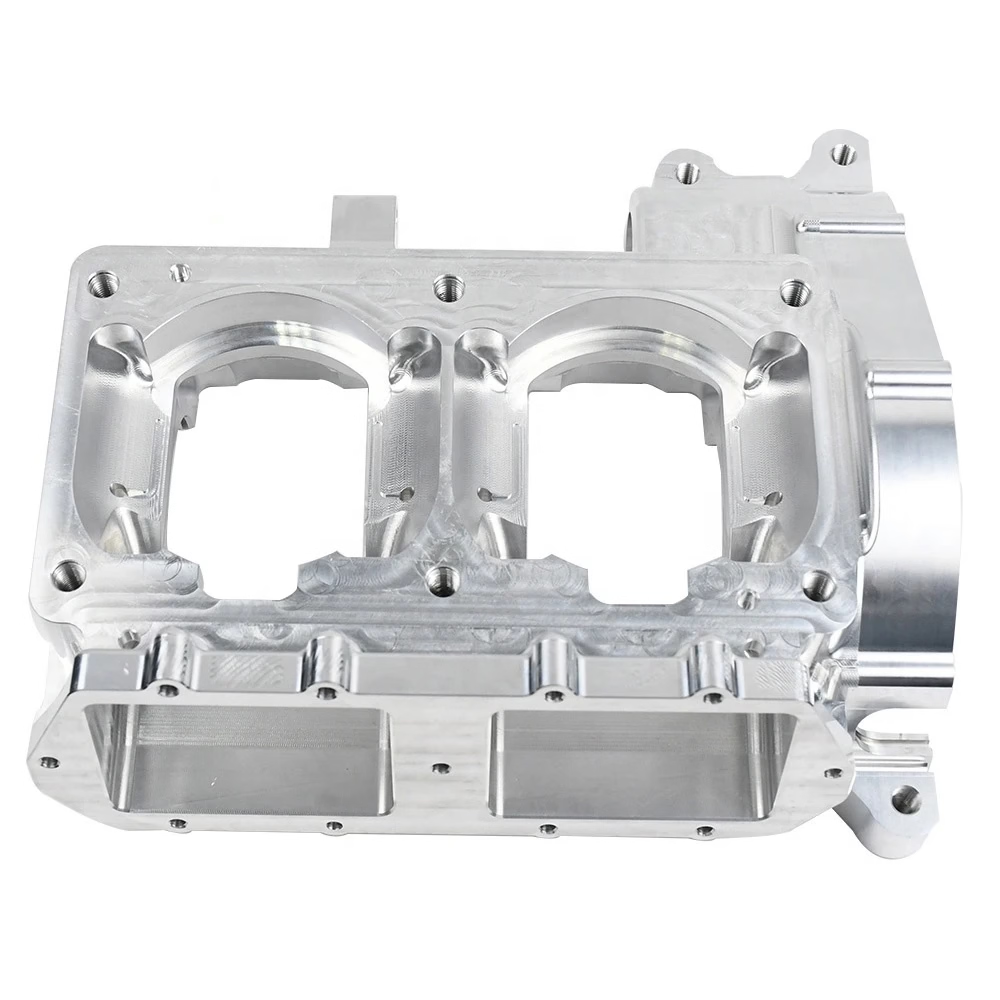
CNC machining starts with a CAD model and a billet. A CAM programmer picks toolpaths, workholding, and cutters, then posts G-code for a 3-axis or 5-axis mill. The finished shape is whatever the tool can reach without colliding with the part or the fixture.
Setup is the first real cost. A simple 3-axis job may need two or three orientations, each with its own fixture and zero point. A 5-axis machine can often reach five faces in one setup, which removes handling time and tightens feature-to-feature accuracy. Simple workholding runs under an hour. A custom tombstone or soft jaws can eat a full shift.
Injection molding removes no material. A toolmaker cuts a cavity and core from steel, then a press injects molten polymer at 200–300 °C and packs it under pressure. The part must release from the tool, so draft, wall thickness, and gate location are fixed before the first shot.
Rule 1: if the geometry cannot be drafted and ejected, molding is off the table regardless of volume. Rule 2: if you need more than one design revision during the program, keep it in CNC. Rule 3: if annual volume is under about 1,000 parts, tooling amortization rarely pays back.
- 1Machining cutsNo draft needed, undercuts are fine, tool reach is the only limit.
- 2Molding formsDraft of 1–2° minimum, uniform walls, gate and ejector marks are permanent.
- 3Cost driverMachining pays for setup and cycle time. Molding pays for tool steel up front.
Tooling cost and the real break-even point for CNC machining vs injection molding
A single-cavity mold for a small bracket commonly lands between $5,000 and $15,000. A multi-cavity tool with lifters, slides, and hot runners can pass $80,000. That money sits on the balance sheet before a single sellable part exists.
The break-even quantity is where the mold cost plus the molded unit price equals the machined unit price times quantity. With a $12,000 tool, a $0.60 molded part, and a $14 machined part, you cross over near 900 pieces. Change the machined price to $6 and the crossover moves past 2,000.
This is why the decision is not about which process is cheaper. It is about where your part sits relative to a number that geometry, tolerance, material, and annual volume all push in different directions. Run the arithmetic with your own quotes before you approve tooling.
Rule 4: build a payback model with real unit prices, not catalog averages. Rule 5: treat any design that is still changing as a CNC part, even if the volume looks like a molding job.
- 1Low tool cost$5,000 to $15,000 for a simple single-cavity tool.
- 2High tool costAbove $40,000 with slides, lifters, and hot runners.
- 3CrossoverUsually between 500 and 2,000 parts for a small enclosure.
Tolerances and surface finish: where each process holds up
CNC machining holds ±0.005 mm on critical features when the setup is rigid and the tool is fresh. That matters for bearing bores, seal grooves, mating faces, and any feature that sets an assembly stack-up. Molding typically holds ±0.05 mm on stable dimensions. Tightening a molded tolerance to ±0.01 mm means tool adjustments, tighter process windows, and higher scrap.
Molded tolerances also drift. Warp, shrink, and gate location move dimensions between shots and between cavities. If your drawing calls out a flatness of 0.05 mm across a 200 mm panel, molding may need a fixture to hold the part during measurement.
Surface finish follows the same split. As-machined finishes land at Ra 1.6–3.2 μm. Fine passes reach Ra 0.2–0.8 μm. A mold can produce a mirror polish from the start, but every texture is locked into the tool steel. Changing it later means pulling the tool.
Rule 6: if a feature controls assembly fit, machine it. Rule 7: if the surface is cosmetic and fixed, molding gives you repeatability at volume.
- 1Machined finishRa 0.8–1.6 μm typical, Ra 0.2–0.8 μm with fine passes.
- 2Molded finishSPI grades from glossy to matte, set by the tool.
- 3RiskMolded dimensions move with shrink and warp between cavities.
Material options and part geometry decide more than price
Machining covers the full material list: 6061 and 7075 aluminum, 303 and 17-4PH stainless, 4140 steel, titanium, Inconel, and engineering plastics from POM to PEEK. If the part needs to be metal, structural, or heat resistant, molding is usually not an option.
Molding works with thermoplastics that flow and freeze: ABS, PC, PMMA, PP, HDPE, and glass-filled grades. Glass fill raises stiffness but wears the tool and changes shrink. Long fibers give strength in one direction and warp in another.
Geometry is where molding wins cleanly. A thin-walled enclosure with snap fits, ribs, and bosses is expensive to machine because every feature costs cycle time. Molded, the whole part forms in one shot. Deep pockets, sharp internal corners, and undercuts push the other way: they need EDM or slides in a mold, and a 5-axis machine handles them without extra tooling.
Rule 8: match the process to the material and the feature list first. Cost is the last filter, not the first.
- 1Metal partsMachining, unless you switch to die casting.
- 2Thin-wall plasticMolding wins above a few thousand parts.
- 3UndercutsFree in machining, slides and cost in molding.
Bridge production and lead time when you are close to the line
Many programs sit in the middle: 2,000 to 8,000 parts a year, a design that is 90% frozen, and a launch date that cannot slip. Machining covers the gap. Parts ship in 3–5 days, and the same program can run from one prototype to a 10,000-part order without a tooling commitment.
That bridge buys time to validate the design in the field, collect real usage data, and only then cut steel. If the design changes after tooling, you pay for welding, recutting, or a new tool. A CNC program change costs a CAM edit and a new setup.
The trade-off is unit price. Bridge parts carry a machined price that never drops. If the annual volume is genuinely above 5,000 parts and the design is stable, that premium becomes hard to defend after the crossover point.
Rule 9: use machining as bridge production when the design is not frozen, then move to molding once the drawing stops changing. Do not order tooling to hit a price target on a part that still has open questions.
- 1Bridge window3–5 day turnaround holds a launch date while tooling is cut.
- 2No MOQOne prototype to 10,000+ parts on the same process.
- 3Watch the priceMachined unit cost stays flat at every quantity.
The call: freeze the design, then cut steel
If your drawing is still moving, your volume is under 1,000 parts, or you need metal and tight tolerances, stay in CNC machining. If the design is frozen, the volume clears 5,000 parts a year, and the part is a moldable thermoplastic, injection molding wins on unit price. Everything between those two points is a payback calculation, not a rule of thumb.
Common questions on CNC machining vs injection molding
At what quantity does injection molding become cheaper than CNC machining?
It depends on the tool cost and both unit prices. For a small enclosure with a $12,000 tool, a $0.60 molded part, and a $14 machined part, the crossover sits near 900 pieces. Raise the machined price or lower the tool cost and the crossover drops.
Run the math with your own quotes. A generic number from a blog will not match your part.
Can machined parts be used as bridge production before tooling?
Yes. Machining needs no mold, so parts ship in 3–5 days while the tool is being cut. The same program can run from one prototype to a 10,000-part order.
The unit price stays flat, so bridge parts cost more per piece than molded parts. That premium buys time to validate the design before steel is committed.
Why does a molded part need draft angle when a machined part does not?
A molded part has to slide out of the cavity without dragging. Draft of 1–2° on vertical walls lets it release cleanly. Textured surfaces need more.
A machined part is cut by a rotating tool, so vertical walls are normal. The only limit is tool reach and collision.
What tolerance can each process hold?
CNC machining holds ±0.005 mm on critical features with a rigid setup. Injection molding typically holds ±0.05 mm, and ±0.01 mm requires tool adjustments and a tighter process window.
Molded tolerances also drift between cavities and between shots because of shrink and warp.
Can the same part be switched from machining to molding later?
Yes, but the drawing changes. Molding needs draft, uniform wall thickness, and a gate location. Sharp internal corners and undercuts that a 5-axis mill handles for free may need slides or lifters in the tool.
Plan the redesign before you cut steel, not after.
What if my volume is between 1,000 and 5,000 parts a year?
That range is the gray zone. Look at design stability first. If the drawing is frozen, get a tool quote and run the payback. If it is not, machine the parts and revisit tooling next quarter.
Geometry also decides. A part with deep pockets and tight tolerances may stay in machining even at higher volume.
Get a process recommendation with your quote
Send your CAD file and target volume. We return a quotation and a free DFM analysis within 12 hours, with a clear recommendation on CNC machining vs injection molding for your part.
12-hour quoteFree DFM analysisNo MOQ100% inspection
More process guides and shop-floor notes
We publish setup notes, tooling trials and inspection data from the factory floor.











