
CNC machining Yorkshire: how buyers judge a supplier
A Yorkshire buyer often starts with a shortlist of local machine shops. This page explains what actually decides part quality, cost and lead time when work is placed overseas instead. Read it to learn which checks separate a capable supplier from a risky one.
In this article
- 1
- 2
- 3
- 4
- 5
- 6
- 7
What CNC machining Yorkshire buyers are really comparing
When an engineer in Sheffield, Leeds or Huddersfield searches for CNC machining Yorkshire, the shortlist usually mixes local machine shops with overseas suppliers. The two are not compared on the same terms. A local shop competes on proximity and small batch convenience. An overseas supplier competes on machine hours available, material range and how fast a quote comes back.
The part itself does not care where it was cut. What decides whether a bracket, housing or manifold fits is tolerance, surface finish, material grade and inspection data. Those four things are the same whether the spindle turns in Yorkshire or in Dongguan.
GreatLight has run CNC machining since 2011, across three wholly owned plants and 7,600 m² of floor space. That scale matters only if it shows up in your parts. So the rest of this page is about the checks that do.
Why 3-axis and 5-axis work are not interchangeable
A three-axis machine moves the tool in X, Y and Z while the part stays still. Every face you need must be reachable from the top, or you flip the part and re-datum it. Each flip adds setup time and a small positional error. For flat plates, pockets and drilled holes, that is fine and it is cheap.
A five-axis machine tilts the tool or the table, so undercuts, angled ports and compound faces can be cut in one setup. The gain is not only speed. Fewer setups mean fewer datum shifts, which is where most dimensional drift comes from on complex parts.
The trade-off is real. Five-axis programming takes longer, and short runs of simple parts do not repay that cost. If your part fits in a vise and every feature points up, ask for three-axis pricing first.
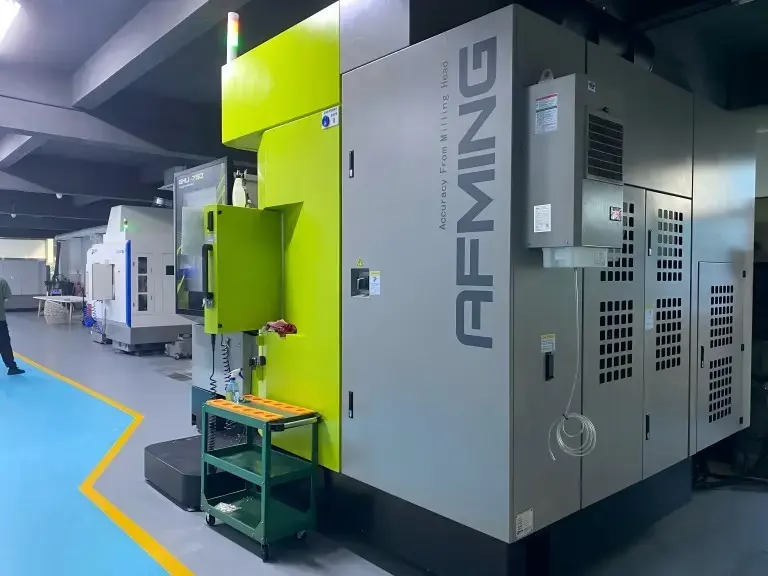
GreatLight runs 16 simultaneous five-axis centers, 12 four-axis mills, 27 three-axis machines and 16 mill-turn centers. Large work goes up to 4,000 mm, with travels of 4,000 × 400 × 150 mm on the long beds and 750 × 1,150 × 550 mm on the medium frames.
What ±0.005 mm actually means on a drawing
Tolerance is a process capability, not a wish. A shop that quotes ±0.005 mm on every dimension is either very good or not reading the drawing. In practice, tight tolerance belongs on the features that mate with something else: bearing bores, dowel holes, sealing faces, spigots.
Ask which dimensions carry the tight callout and how they will be verified. A bore held to ±0.005 mm needs temperature control, a sharp tool and a CMM check. A cosmetic outer profile does not. Splitting the drawing this way lowers cost without touching function.
Surface finish follows the same logic. Ra 0.2–0.8 μm is a fine finish for sealing or sliding contact. Ra 0.8–1.6 μm covers most mating faces. Ra 1.6–3.2 μm as-machined is fine for brackets and covers. Specifying a fine finish everywhere adds polishing time for no benefit.
One more boundary: thin walls. A 0.5 mm wall in aluminium will deflect under cutting force no matter how good the machine is. If the design allows 1.5–2 mm, the part gets cheaper and straighter.
Material choice drives both price and risk
Aluminium 6061-T6 is the default for prototypes and housings. It machines fast, takes anodizing well and holds tolerance. 7075 is stronger but more expensive and less weldable. 2024 machines well and is common in aerospace brackets, though it needs coating because it corrodes.
Stainless 304 and 316L are chosen for corrosion resistance and food or medical contact. They work-harden, so feeds and speeds matter more, and cycle times run longer than aluminium. 17-4PH gives high strength after heat treatment and is used for shafts and valves.
Titanium TC4 (Ti-6Al-4V) and Inconel are for high temperature or high strength-to-weight parts. Both are slow to cut and eat tooling, so expect higher piece prices. They are rarely the right answer for a first prototype unless the service environment demands it.
Plastics behave differently again. POM and PEEK hold tolerance well; ABS and PP move with temperature and clamp pressure. If a plastic part has a tight bore, say so early, because the inspection plan changes.
Inspection and paperwork decide the real risk
A first article that measures correctly proves the setup worked once. It does not prove the run will hold. That is why in-process monitoring matters more than a single final check on a complex part.
GreatLight checks raw material on arrival, monitors dimensions during cutting and inspects 100% of parts before shipment. Reports are available on request. The historical qualification rate is 99.99%.
Certification tells you which systems are audited. ISO 9001:2015 covers general quality management. IATF 16949:2016 is the automotive standard. ISO 13485:2016 applies to medical devices. ISO 27001:2022 covers information security, which matters when you send drawings.
For a Yorkshire buyer, the practical question is simpler. Can the supplier show you the inspection record for your part number, and can they explain any out-of-tolerance reading? If the answer is vague, the price is not the real issue.
Lead time, quantity and confidentiality
Quotation and free DFM analysis come back within 12 hours. Production can start within 24 hours of approval, and parts typically ship in 3–5 days. The historical late-delivery probability is below 2%. Those numbers apply to standard machining work, not to parts waiting on a customer-supplied casting.
There is no minimum order quantity. One prototype and a 10,000-part run go through the same quoting process, though the per-piece price differs a lot. For repeat work, keep the same material lot and setup notes to reduce variation between batches.
Confidentiality is often the sticking point for UK buyers. Uploads are handled as secure and confidential, and an NDA is available on request. If your drawings cannot leave the building without one, ask for it before you send files, not after.
Freight and customs sit outside the machining quote. Build those costs into your landed price comparison rather than comparing ex-works figures against a local invoice.
Which process fits which part
Use this as a first filter before you request a quote.
| Part type | Best process | Typical tolerance | Watch out for |
|---|---|---|---|
| Flat plate, pockets, drilled holes | 3-axis milling | ±0.05 mm | Multiple setups if features face down |
| Angled ports, undercuts, organic shape | 5-axis milling | ±0.005 mm on critical features | Higher programming cost on short runs |
| Shafts, bushes, threaded bodies | CNC turning or mill-turn | ±0.01 mm | Runout if the part is held twice |
| Thin-wall housing | 3-axis with light passes | ±0.05 mm | Wall deflection below 1 mm |
| Titanium or Inconel component | 5-axis, slow feeds | ±0.01 mm | Tool wear and long cycle time |
| Medical or food-contact part | 3 or 5-axis plus passivation | ±0.005 mm | Certification and traceability records |
The short version
If your part is simple and you need it this week, a local Yorkshire shop is usually the faster route. If the geometry is complex, the material is difficult, or the volume is above a few hundred pieces, an overseas supplier with five-axis capacity and documented inspection will cost less per part and hold tolerance better. Decide on geometry and volume first, then on postcode.
Common questions
Can a supplier outside Yorkshire hold ±0.005 mm?
Yes, if the machine, the tooling and the inspection method support it. Tolerance depends on the process, not the postcode. What changes with distance is how quickly you can walk over and check a problem part.
Ask for the inspection report with the shipment and confirm which dimensions carry the tight callout. That covers most of the risk.
How do I compare a local quote with an overseas one fairly?
Compare landed cost, not unit price. Add freight, duty, packing and the cost of your own time managing the order. Then compare against the local ex-works figure.
Also compare what is included. A quote that covers material certification, finishing and inspection reports is not the same as a bare machining price.
Which materials are worth machining rather than casting?
Machining wins when the quantity is low, the tolerance is tight, or the geometry changes between revisions. Casting wins at high volume with a stable design.
For one-off prototypes and bridge parts, machining in 6061 or 304 is usually the fastest path to a working part.
What causes most out-of-tolerance parts?
Setup changes, tool wear and thermal drift. A part held in three different fixtures has three chances to shift datum.
That is why five-axis work often measures better than three-axis work on the same drawing, even when the tolerance callout is identical.
Do I need an NDA before sending drawings?
If the design is not public, yes. An NDA is available on request and takes little time to put in place.
Send the NDA first, then the files. Uploads are treated as secure and confidential either way, but the signed document is what protects you commercially.
How fast can parts ship?
Quotation and free DFM analysis come back within 12 hours. Production can start within 24 hours of approval, and parts typically ship in 3–5 days.
Allow extra time for special material orders, heat treatment or finishing steps that sit outside the machine shop.
Send your drawing and get a real answer
Upload your files and we will return a quote with free DFM feedback within 12 hours, plus a clear note on any feature that is hard to hold.
12-hour quote100% inspectionNo minimum order quantity
More from the shop floor
We publish setup notes, tooling trials and inspection data from the factory floor.











