
CNC Material Selection Guide
How to pick a material that machines cleanly, holds tolerance and does not blow up your budget. Written for engineers and buyers who sign off on the drawing before the chips fly.
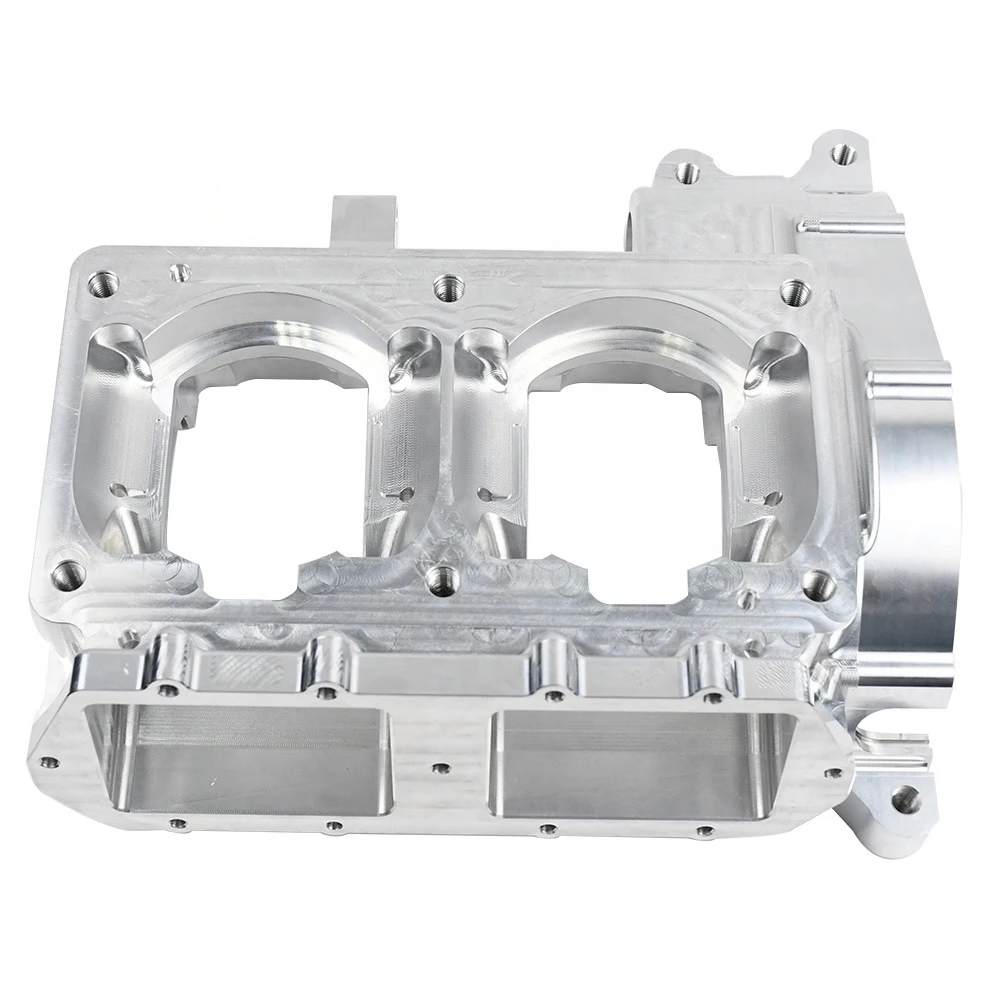
Key takeaways
Material families at a glance
Typical values for machined parts, not handbooks.
| Material | Best for | Watch out for | Relative cost |
|---|---|---|---|
| 6061-T6 aluminium | Brackets, housings, fixtures | Low wear resistance | Low |
| 7075 aluminium | Aerospace ribs, high-load parts | Poor corrosion without coating | Medium |
| 303 stainless | Shafts, fittings, high volume | Not for welding | Medium |
| 316L stainless | Medical, marine, chemical | Gummy at low speed | High |
| 1018 / 1045 steel | Shafts, pins, plates | Rusts fast, needs coating | Low |
| 17-4PH stainless | Valve bodies, high strength | Dimensional shift after aging | High |
| Ti-6Al-4V | Weight-critical aerospace | Tool wear, slow feeds | Very high |
| POM / PEEK | Insulators, seals, bushings | Thermal growth, chuck marks | Low / High |
The short version
Pick the material that meets the one property you cannot compromise on, then let machinability and finish decide the rest. Send the model early and the trade-offs become visible before the quote, not after.
What the part must survive
Material choice starts with the load case, not the catalog. Write down the peak stress, the cycle count, the service temperature and anything the part will touch: salt water, hydraulic fluid, sterilization steam, battery electrolyte. Each of those narrows the list fast. A bracket that only carries a static 200 N load does not need 17-4PH, and a part that sees 120 °C will not hold its fit in POM.
Then look at the failure mode you actually fear. Fatigue cracks start at sharp internal corners, so a high-strength alloy with a fillet radius under 0.5 mm buys you very little. Wear is a surface problem, so a softer core with a hard coating often beats a uniformly hard alloy that is brittle. Corrosion is usually galvanic, meaning the pairing with the mating part matters more than the grade alone.
Strength numbers also depend on section size. A 6061-T6 block quenches to full properties, but a thick 7075 section can carry more residual stress and move after machining. If the drawing calls for ±0.005 mm across a 300 mm face, the shop may need a stress-relief cycle between roughing and finishing. That is a process cost, not a material cost, and it belongs in the quote.
Write the requirement as a short spec: alloy, temper, condition, and the one property that is non-negotiable. Everything else is open for the shop to trade against cost and lead time.
Machinability and how it shows up in the price
Machinability is not one number. It is a mix of cutting speed, chip formation, tool wear and how the material behaves in a thin section. Free-machining grades such as 303 stainless and C36000 brass cut fast and leave a good finish, which is why they dominate high-volume turned parts. They also have limits: 303 is hard to weld, and leaded brass is restricted in some potable water and medical applications.
Aluminium is the default for a reason. 6061-T6 runs at high spindle speeds, holds Ra 0.8–1.6 μm without special tooling, and takes anodizing well. 7075 machines cleanly too but is less forgiving: it is stronger, more expensive, and more prone to stress corrosion if the grain direction is ignored. On a long thin rib, 7075 can deflect and chatter where 6061 would just cut.
Stainless steels are where cycle time climbs. 304 and 316 work-harden, so a light pass with a dull tool hardens the surface and the next pass gets worse. The fix is a rigid setup, constant feed, and never dwelling in the cut. 17-4PH adds a heat treatment step after machining; expect a small dimensional change during aging, so leave stock and finish after.
Titanium and nickel alloys such as Inconel sit at the other end. Cutting speed drops, tool life drops, and the shop may need to plan around tool changes mid-operation. For a one-off prototype this is manageable. For 5,000 parts, it changes the whole process plan.
Tolerance, surface finish and wall thickness
Tolerance and material are linked. Aluminium and brass hold ±0.005 mm more easily than titanium because they cut cooler and deflect less under the same tool pressure. On a 17-4PH or Ti-6Al-4V part, the same callout may need a temperature-controlled room, a finishing pass with a sharp tool, and extra inspection time.
Surface finish follows the same logic. Ra 0.2–0.8 μm is achievable on aluminium, brass and free-machining stainless with a good finishing pass. On gummy or work-hardening grades, chasing that finish can double the cycle. If the drawing only needs Ra 1.6–3.2 μm, say so, because that single number can remove an entire operation.
Wall thickness is the quiet killer. Below 2 mm, cutting forces push the wall away from the tool, so the cutter rubs instead of shearing. Chatter marks appear, and the dimension drifts. Aluminium tolerates this better than steel. Plastics are a separate case: they deflect, melt at the tool tip, and hold chuck marks, so light passes, sharp tools and lower clamping pressure matter more than the grade itself.
If a design needs a 0.8 mm wall in 316L on a 150 mm long part, no alloy swap will save it. The answer is a process change: support the wall with a fixture, machine it in two directions, or split the part.
Post-processing adds its own constraints. Anodizing builds a few micrometres and can round a sharp edge. Electroless nickel is more uniform on complex geometry. Laser marking needs a minimum character height of 1.5 mm to stay legible after coating.
Cost, lead time and order quantity
Bar stock price is only part of the number. Setup, tooling, inspection and post-processing usually decide whether a part is cheap or expensive. A prototype in 6061 with a simple 3-axis setup can ship in days. The same geometry in Inconel may need 5-axis access, special inserts and a longer inspection plan, even for one piece.
Quantity flips the trade-off. For one to fifty parts, pick the material that machines fastest, because setup dominates. For thousands of parts, a slightly harder-to-machine grade can win if it removes a coating step or improves wear life. Die casting and vacuum casting become options once volumes pass a few thousand, but they need different draft and wall rules, so the material conversation changes shape.
Lead time also depends on stock. Common grades such as 6061, 303, 304 and 1018 are widely available. Titanium, Inconel and some beryllium copper grades may need to be ordered, which adds days before the first cut. If the schedule is tight, ask what is on the shelf before you finalize the alloy.
There is no minimum order quantity here, so a single prototype and a 10,000-part run go through the same quoting path. The material advice differs, though. A shop that only quotes the cheapest bar stock for a one-off is not helping you.
How to run a material selection in 6 steps
Run these in order. Each one removes options.
- 1Write the functional specList peak load, cycle count, max temperature, chemical contact and the one non-negotiable property. Keep it to one page.
- 2Cut the list to three candidatesUse the decision table. If you have more than three, you have not decided what the part must do.
- 3Check machinability against geometryLook at wall thickness, aspect ratio and tool reach. Below 2 mm wall, move toward 6061 or 304 and away from 7075 and 17-4PH.
- 4Confirm the tolerance is realistic±0.005 mm is routine on aluminium and brass. On titanium and hardened steel, expect extra passes and inspection time.
- 5Match the finish to the alloyHardcoat anodizing suits 6061 and 7075. Color anodizing on 2024 shows blotches. Electroless nickel is the safer choice on mixed geometry.
- 6Send the model for DFM before quotingAsk the shop to flag thin walls, deep pockets, sharp internal corners and datum conflicts. Fixing these on screen costs nothing.
Material selection questions we get weekly
Is aluminium always cheaper than stainless steel?
Per part, usually yes, but not always. Aluminium cuts three to five times faster, so cycle time drops. That advantage shrinks if the part needs hardcoat anodizing or a tight flatness callout that requires stress relief.
Compare the finished part, not the bar price. A coated aluminium part can cost more than a plain 303 stainless part of the same size.
When should I choose 7075 over 6061?
Choose 7075 when yield strength or fatigue life drives the design and the section is thick enough to resist deflection. Aerospace ribs and high-load brackets are typical.
Stay with 6061 when the part is thin, needs a decorative anodized finish, or will sit in a wet environment without coating. 7075 is more sensitive to stress corrosion and to grain direction.
Can I switch material after the quote without requoting?
Sometimes, but check three things first: tooling, cycle time and finish. Moving from 6061 to 304 stainless changes all three, so the price moves too.
Moving between tempers of the same alloy, such as 6061 to 6061-T6, is usually a smaller change, but heat treatment may be added.
How do I decide between 304 and 316L stainless?
Pick 316L when the part sees chlorides, salt spray, or medical cleaning agents. The molybdenum content resists pitting where 304 will not.
Pick 304 for general industrial parts, brackets and shafts where corrosion is mild. It machines a little better and costs less.
Do plastics need a different design approach?
Yes. Plastics deflect under clamping, hold chuck marks and grow with temperature. PEEK and POM are the common engineering choices, but both need sharp tools, light passes and a support fixture on thin sections.
Tolerance expectations should loosen. On a 100 mm plastic part, ±0.05 mm is often a realistic target rather than ±0.005 mm.
What should I include in the RFQ to get a useful quote?
Send the 3D model, the 2D drawing with datums and tolerances, the material callout with temper, the surface finish, and the quantity. Note any certification the part needs.
If you are unsure about the alloy, say which property matters most. That lets the shop propose a grade and explain the trade-off in the quote.
Send your drawing, get a material opinion with the price
Upload the model and drawing. We return a quotation and a free DFM analysis within 12 hours, with the alloy trade-offs written out.
12-hour quoteFree DFM analysisNo minimum order quantity100% inspection before shipment
More machining notes
We publish setup notes, tooling trials and inspection data from the factory floor.











