
Processing Cost CNC: How to Read a Quote and Cut Unit Price
This guide is for engineers and buyers who receive a machining quote and need to know which lines are fixed and which are negotiable. It breaks processing cost CNC into setup, machine time, material, finishing and inspection, then gives the thresholds we use when quoting a part from one piece to a 10,000-piece run.
In this article
- 1
- 2
- 3
- 4
- 5
- 6
- 7
- 8
Key takeaways
What each cost line covers and how to reduce it
Use this table to see which line of a processing cost CNC quote you can actually influence.
| Cost line | What it covers | Reduce it by |
|---|---|---|
| Programming and CAM | Toolpath strategy, stock model, post-processing | Send a clean STEP file with GD&T already set |
| Fixtures and workholding | Soft jaws, custom plates, tombstone setup | Simplify datums so standard vises work |
| Machine time | Roughing, semi-finish, finish passes | Loosen non-critical surfaces to Ra 3.2 μm |
| Material | Bar stock, plate, billet plus scrap | Pick 6061 or 304 if the load case allows |
| Finishing | Anodizing, plating, bead blasting, laser marking | Mask fewer areas, group parts in one batch |
| Inspection | First article, in-process checks, CMM report | Reserve full reports for critical dimensions |
| Quantity effect | Fixed cost divided by part count | Run a 50-piece lot instead of three 10-piece lots |
Pick the supplier that explains the number
A quote you can break into lines is a quote you can reduce. Ask for the fixed and variable split, freeze the design, and order in one lot.
Where processing cost CNC actually comes from
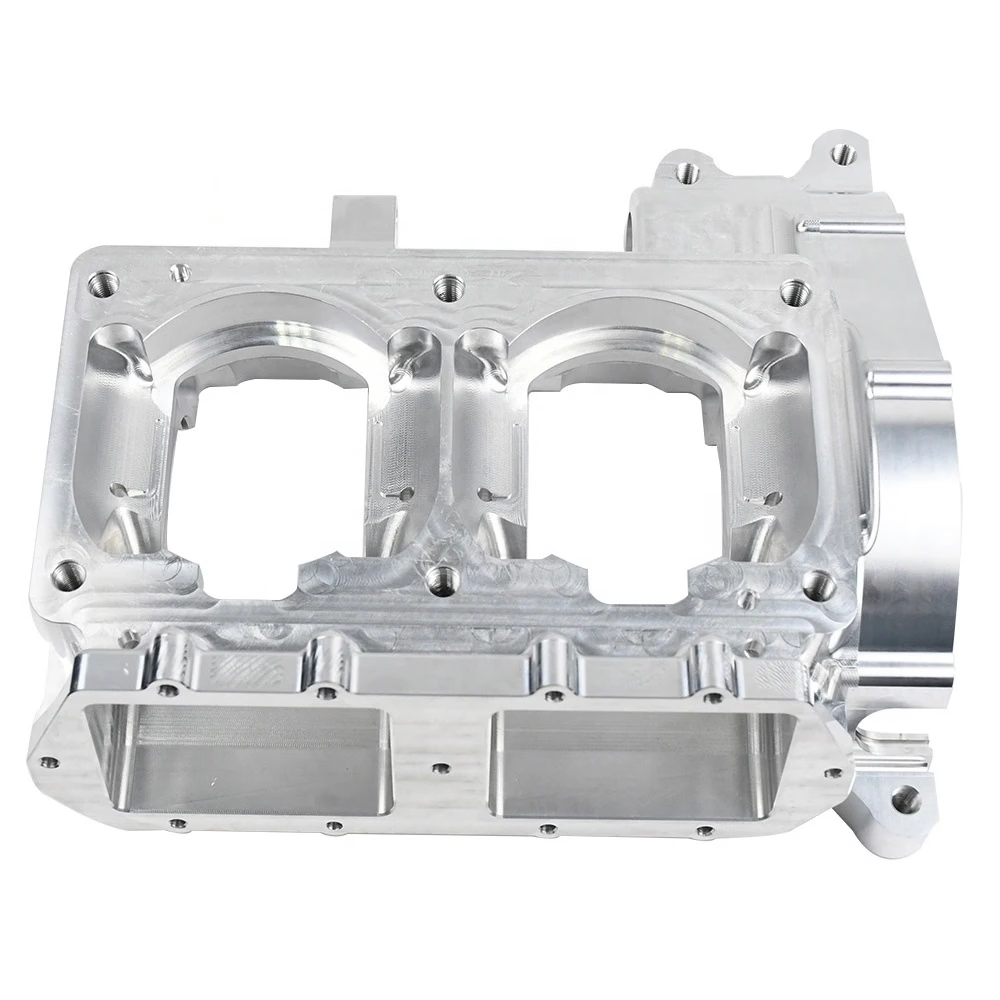
A quote is not one hourly rate multiplied by one number. It is a stack of fixed and variable lines. Programming and CAM sit at the top. Someone has to build the stock model, choose toolpaths, set stepover and verify that the tool reaches every pocket. For a simple bracket that is two hours. For a five-axis impeller with thin walls it can be a full day.
Fixtures come next. A rectangular part with parallel faces can run in a standard vise. A casting with no flat datum needs a custom plate, and that plate has to be dialed in and proven. The cost is real, and it does not shrink when the order is small.
Machine time is the line most buyers focus on, and rightly so. It carries roughing, semi-finishing and finishing. Cycle time depends on material removal rate, which depends on tool material, spindle speed, feed per tooth and stepover. Change any one of those and the number moves.
Then come material, finishing and inspection. Material cost is not just the billet price. It includes the scrap you cut away, plus a cut-off allowance. Finishing is quoted per batch or per part depending on the line. Inspection is the last line and the one most often under-scoped on tight-tolerance work.
- 1Fixed costProgramming, fixturing, setup and first article.
- 2Variable costCycle time, material, consumable tooling and finishing.
- 3Risk costThin walls, deep pockets, hard material, tight tolerance.
How material choice moves the number
Aluminium 6061 is the baseline for most prototypes. It cuts fast, holds a good finish and takes anodizing well. A 100 × 100 × 50 mm block might run in 25 minutes on a three-axis mill. Switch to 304 stainless and the same block can take 90 to 120 minutes. The tool wears faster and you cannot push the same chip load.
Titanium Ti-6Al-4V and Inconel sit at the top. Heat stays in the cut, so spindle speed drops and coolant strategy changes. Expect five to ten times the cycle time of 6061 for the same geometry. If the part does not see high temperature or a corrosive environment, paying that premium is hard to justify.
Plastics are a different story. POM and PEEK cut easily but move with temperature. PEEK is expensive per kilo, so nesting parts on one plate matters more than cycle time. ABS and PC are cheap but gummy, and they need sharp tooling and air blast to avoid a melted finish.
The trap is specifying a material because it sounds stronger. 7075 is not automatically better than 6061. It machines slower, costs more and anodizes to a darker tone. Pick the alloy from the load case, not from habit.
Tolerance bands and their price step
General machining holds ±0.1 mm without drama. Move to ±0.05 mm and you add a semi-finish pass and more frequent tool checks. At ±0.005 mm the process changes: temperature control, sharp tooling, slower feed and a CMM report become normal. Each step roughly doubles the inspection burden.
Surface finish follows the same logic. Ra 1.6–3.2 μm is a standard as-machined result. Ra 0.8–1.6 μm needs a dedicated finish pass with a smaller stepover. Ra 0.2–0.8 μm usually means a fine tool, a light radial cut and sometimes hand polishing on top.
The expensive mistake is calling out a tight tolerance across the whole drawing. Put ±0.005 mm only on the features that mate or locate. A bolt hole pattern at ±0.1 mm and a bearing bore at ±0.005 mm is a normal, sensible mix.
Same with finish. A visible cover face may need Ra 0.8 μm. The internal cavity behind it does not. Marking the finish on one face instead of the whole part can cut a finishing pass out of the cycle.
Why the first piece costs the most
A one-off prototype carries the full fixed load. Programming, fixture build, setup and first-article inspection all land on a single part. That is why a prototype can cost ten times the unit price of a 500-piece run. Nothing is wrong with the quote; the math is simply working against a small denominator.
Between prototype and production there is a useful middle ground. A 50-piece lot spreads the fixed cost while keeping the tooling simple. It also reveals whether the process is stable before you commit to a hard fixture and a longer run.
At higher volume the conversation changes. If the part count passes 10,000 and the geometry allows it, die casting or a dedicated fixture with multi-part nesting can beat pure machining. We quote both when the numbers point that way.
The mistake to avoid is ordering in many small batches. Three separate 10-piece orders pay setup three times. If the design is frozen, order once with a buffer.
How to judge a supplier, not just a price
The lowest number is not always the cheapest path. Ask what is included. Does the quote cover first-article inspection, a material certificate and a dimensional report? If those come as extras later, the initial figure was not the real cost.
Check the machine list against your part. A 4,000 mm travel machine is needed for a long beam. A Ø400 mm rotary table handles round work with cross features. A shop without a five-axis center will quote your undercut part as two setups, and that shows up in the price.
Certifications matter by industry. ISO 9001:2015 is the baseline. IATF 16949:2016 is expected for automotive and EV work. ISO 13485:2016 applies to medical devices. ISO 27001:2022 covers how your drawings and CAD files are handled.
Ask how the shop handles design changes mid-run. A supplier that flags a thin wall in DFM before cutting saves you a scrapped batch. One that quotes and cuts without comment does not.
Seven steps to review a machining quote
Run these checks in order. Each one can remove cost before the first chip is cut.
- 11. Confirm the quantity basisCheck whether the price is for one piece, a lot or a yearly volume. Fixed cost divided by a different denominator changes everything.
- 22. Separate fixed and variable linesAsk for programming, fixture, setup, cycle time and material listed apart. A single blended figure hides where the money sits.
- 33. Audit the tolerance calloutsKeep ±0.005 mm on mating features only. Move non-critical dimensions to ±0.1 mm and expect a visible drop in price.
- 44. Review surface finish per faceRa 1.6–3.2 μm for hidden surfaces, Ra 0.8–1.6 μm where parts are seen or seal. Full-part Ra 0.2–0.8 μm rarely pays off.
- 55. Challenge the material specificationCompare 6061-T6 against 7075 or 304 against 316L on the actual load and environment. Cheaper alloy with a coating often wins.
- 66. Consolidate finishing and markingBatch anodizing and laser marking together. Note that laser marking needs a minimum character height of 1.5 mm to stay legible.
- 77. Ask for a DFM review before cuttingSend the 3D model and drawing for a manufacturability check. Removing one deep pocket or adding a fillet can cut a whole operation.
Questions buyers ask about processing cost
Why is a prototype so much more expensive per piece?
A prototype carries the full fixed cost on one or two parts. Programming, fixture build, setup and first-article inspection all happen once, and there is no production volume to spread them across.
That first payment also proves the process. Once the toolpaths and fixtures are validated, the same setup runs the later production lots at a lower unit price.
What information do you need for an accurate quote?
A 3D CAD model or a fully dimensioned 2D drawing, the material, the quantity, and any finish or inspection requirement. Tolerance and surface finish callouts matter more than a rough sketch.
With those we return a quotation and a free DFM analysis within 12 hours. A rough verbal description can only produce a wide range, not a firm number.
Does a tighter tolerance always cost more?
Yes, and the jump is not linear. General machining holds ±0.1 mm with standard practice. At ±0.005 mm you add a semi-finish pass, temperature awareness and CMM verification, which can double the inspection time.
Apply tight tolerance only where the part mates or locates. A mixed drawing with a few tight features is normal and much cheaper than a fully tight one.
Is there a minimum order quantity?
No. We run from a single prototype to 10,000+ part runs. The unit price falls as quantity rises because the fixed lines spread further, but there is no floor you must clear to place an order.
How do certifications affect the price?
Certification adds documentation and process control, not machining time. ISO 9001:2015 is our baseline. IATF 16949:2016, ISO 13485:2016 and ISO 27001:2022 add traceability, validation records and data handling that regulated industries require.
If your industry does not need them, say so. We will quote to the standard that fits the application.
When is machining the wrong process?
When the geometry is simple, the material is a common casting alloy and the volume is above roughly 10,000 pieces. At that point die casting or another forming route usually beats cutting from solid.
We quote machining and die casting side by side when the part count and geometry point that way, so the comparison is based on numbers rather than assumption.
Send your model, get a line-by-line quote
Upload a STEP file and drawing. We return a quotation and a free DFM analysis within 12 hours, with the cost lines separated so you can see what to change.
12-hour quoteFree DFM analysisNo MOQNDA on request
More machining notes
We publish setup notes, tooling trials and inspection data from the factory floor.











