
CNC Processing in Saudi Arabia: How to Source Parts That Fit
Industrial and energy projects in Saudi Arabia need machined parts that arrive on spec, not just on time. This page explains what to check before you place an order: material certificates, tolerance bands, finishing, and how a supplier outside the Kingdom keeps a project schedule.
In this article
- 1
- 2
- 3
- 4
- 5
- 6
- 7
What matters before you order
What CNC processing covers in this market
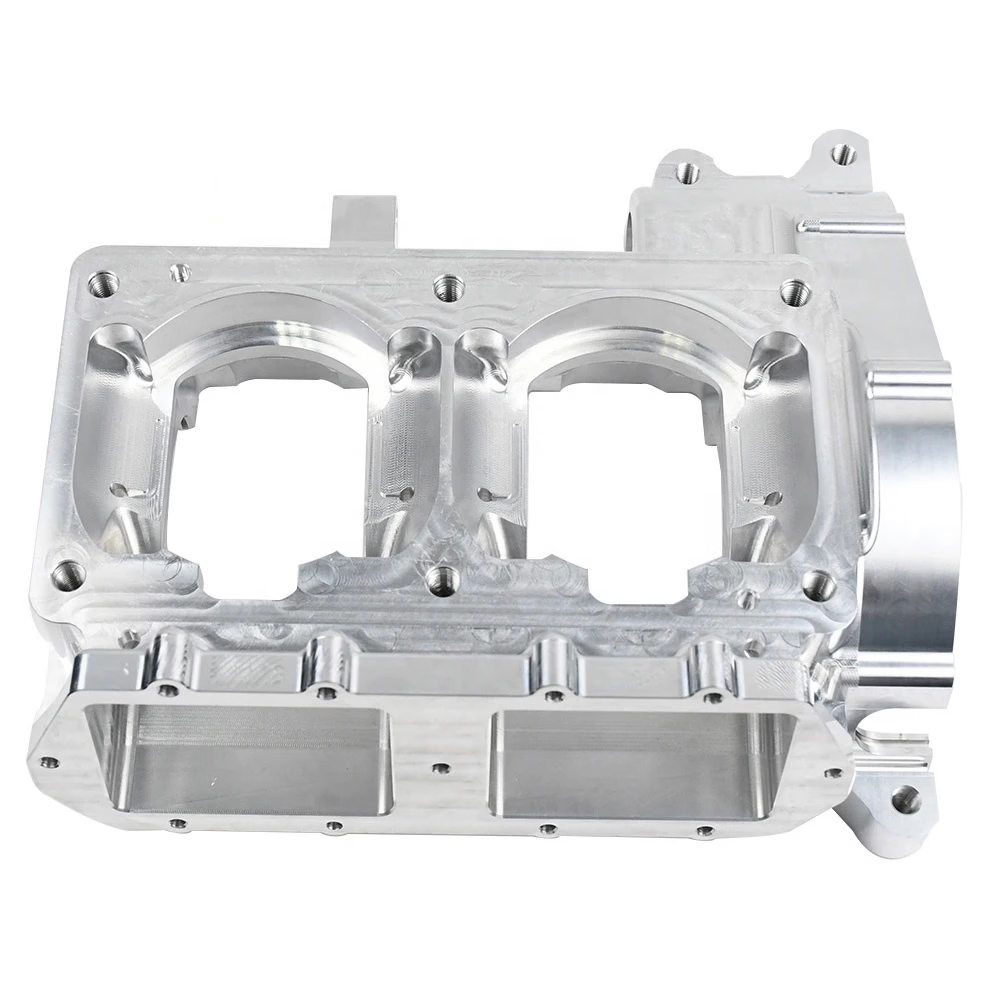
CNC processing is a subtractive process. A computer-controlled tool removes material from a solid block until the geometry matches a CAD model. Milling covers pockets, faces and slots; turning covers shafts, bushings and threaded bodies. Mill-turn centers do both in one setup, which removes a re-clamping error on parts that have a turned bore and a milled flange.
In Saudi Arabia the demand is concentrated in a few shapes. Valve bodies and manifolds for water and process lines. Pump housings and impellers for desalination and petrochemical plants. Brackets, adapters and heat sinks for solar and battery installations. Fixture plates and end-effector parts for automation cells. Most of these are low to medium volume, made from aluminium, stainless steel or a copper alloy such as C36000.
The Kingdom's industrial base is expanding, but the machining capacity for tight-tolerance work is still thin in some regions. Buyers often split the work: simple fabrication locally, complex geometry to a supplier with 5-axis capacity. That split is normal and it works, provided the drawing is unambiguous about which features are critical.
Our own plant runs 127 high-precision CNC machines, including 16 simultaneous 5-axis centers and 16 mill-turn centers. Maximum processing size is 4,000 mm, so large frame and plate work does not need to be split across suppliers.
Matching material to the operating environment
Heat and dust are the two conditions that break parts in this region. Outdoor brackets and enclosures face surface temperatures well above European norms, plus fine airborne sand. Aluminium 6061-T6 handles heat well, but bare aluminium wears quickly where sand contacts a sliding surface. Hardcoat anodizing builds a ceramic layer that resists that abrasion.
For wet or coastal service, stainless 316L is the usual answer. It resists chloride attack in desalination and marine air. The trade-off is machinability: 316L work-hardens, so feeds and speeds need care, and it costs more per kilogram than 304. Use 304 indoors where chlorides are absent.
High-load parts such as pump shafts and valve stems usually go to 17-4PH or 4140. Both take heat treatment to reach strength levels that 6061 cannot. 17-4PH holds corrosion resistance after aging; 4140 needs plating or black oxide. If a part carries both load and salt exposure, 17-4PH is the safer pick.
Plastics have a place too. PEEK and POM appear in insulators, bushings and low-friction guides. They machine cleanly but move with temperature, so tolerance bands need to be wider than the same part in steel.
- 16061-T6General brackets, housings, heat sinks. Anodize for outdoor use.
- 2316L / 17-4PHCoastal, chloride and wet service. Higher cost, better life.
- 34140 / 4340Shafts and stems under load. Requires a protective finish.
- 4C36000 brassValve bodies and fittings. Excellent machinability, moderate corrosion resistance.
Tolerances and finishes that hold up in service
A drawing that calls ±0.005 mm on every dimension will cost more and take longer than one that marks only the functional features. Bearing bores, seal grooves and mating faces need the tight band. Bolt clearance holes and outer profiles usually do not. Sorting the two groups is the single biggest cost lever a buyer controls.
Surface finish follows the same logic. A seal running against a shaft needs Ra 0.2–0.8 μm or it will leak and wear. A machined mounting face at Ra 1.6–3.2 μm is fine. We measure finish on the features named in the drawing and report the values rather than applying a blanket specification.
Inspection is where tight tolerances are proven. We check raw material on arrival, monitor dimensions during the run, and inspect 100% of parts before shipment. Reports are available on request. For a project with an incoming inspection gate in Saudi Arabia, ask for the report format the receiving team uses so the data lines up.
A note on thermal effects. A part measured at 20 °C in our inspection room may measure differently at 45 °C on site. On large aluminium parts, this matters more than the machining tolerance itself. If the part runs hot, specify the reference temperature on the drawing.
Finishing options and when to skip them
Finishing is not decoration. On outdoor and coastal equipment it decides how long the part lasts. Anodizing covers clear, colour, hardcoat and conductive types. Hardcoat is the one to specify for wear surfaces; conductive anodizing is used where the part must still ground electrically.
Electroless nickel gives a uniform coating on complex geometry, including internal bores, which electroplating struggles to reach evenly. Zinc plating suits steel fasteners and brackets on a budget. Powder coating and black oxide cover larger frames and housings.
Mechanical finishes are mostly cosmetic but not always. Bead blasting removes tool marks and gives a uniform matte surface before anodizing. Polishing brings Ra down on optical and seal surfaces. Laser marking handles part numbers and traceability codes; minimum character height is 1.5 mm, so plan the marking field accordingly.
Skip finishing when the part is inside a sealed assembly, when it will be painted on site, or when it is a one-off fixture that never leaves the shop. Every finish adds a step and a day.
Lead time, logistics and documentation
A quotation and a free DFM analysis come back within 12 hours of receiving a drawing. Production can start within 24 hours once the design is released. Parts ship in 3–5 days for standard work. Our historical late-delivery probability is below 2%, which matters when a shutdown window is fixed.
The variable buyers underestimate is not machining. It is freight, customs clearance and inland transport to Riyadh, Dammam or Jeddah. A part that leaves the machine on day four can still sit at a port. Build that leg into the schedule and keep the customs paperwork clean: accurate HS codes, declared material, and a commercial invoice that matches the packing list.
Documentation should travel with the parts. Mill certificates for the raw material, inspection reports for the critical features, and finish certificates where plating or anodizing is specified. If your receiving team uses a specific form, send it with the PO.
Confidentiality is a common concern for defense-adjacent and energy work. Uploads are handled as secure and confidential, and an NDA is available on request before drawings are shared.
Which process fits which part
Use this table to pick a route before requesting a quote.
| Part type | Best route | Why |
|---|---|---|
| Valve body with cross-drilled ports | 5-axis milling | Multiple faces in one setup, no re-clamp error |
| Pump shaft with keyway | Mill-turn | Turning and milling combined, concentricity held |
| Thin-wall housing, 2 mm wall | 3-axis milling | Rigid support, lower tool pressure, less deflection |
| Large frame plate, 1,500 mm | 3-axis or 5-axis | Up to 4,000 mm processing size in one plant |
| Small batch of 5 brackets | 3-axis milling | Setup time low, no fixture investment |
| Prototype before tooling | Rapid prototyping | Proves fit before injection or casting tooling |
| Sealed electronic enclosure | Milling plus anodizing | EMI and corrosion control in one route |
| High-volume simple part | Die casting plus finish | Lower unit cost once volume justifies tooling |
The short version
If the part is complex geometry in low volume, machine it from billet and specify tight tolerance only where it functions. If the part is simple and the volume is high, move to casting or molding once the design is frozen.
Questions buyers ask
Can you ship to Saudi Arabia and handle the paperwork?
Yes. Parts ship in 3–5 days for standard work, and we prepare mill certificates, inspection reports and finish certificates to travel with the shipment.
Customs clearance and inland transport are arranged by your freight forwarder. Give us the HS code and consignee details with the PO so the commercial invoice matches on the first pass.
What is the minimum order quantity?
There is no minimum order quantity. We run from a single prototype to 10,000+ part runs on the same process controls.
For a one-off, the setup cost dominates the price. For a 10,000-piece run, cycle time and material dominate. Both are quoted the same way.
Which tolerance can you actually hold?
±0.005 mm (±0.0002 in) on critical features, measured in a temperature-controlled inspection room.
Not every dimension on a drawing needs that band. Mark the functional features and leave general dimensions at a looser tolerance to control cost.
Do you sign an NDA before I send drawings?
Yes. An NDA is available on request, and uploads are handled as secure and confidential.
For defense-adjacent or proprietary energy work, send the NDA first and share drawings after it is signed.
How do certifications affect my vendor approval?
We hold ISO 9001:2015, IATF 16949:2016, ISO 13485:2016 and ISO 27001:2022. These cover quality management, automotive, medical devices and information security.
If your approval process needs a specific document set, tell us at the quotation stage and we will prepare it before the first run ships.
What happens if a dimension is out of tolerance on arrival?
Contact us with the inspection report and the part number. We review the measurement method first, since thermal expansion and gauge choice cause most disputes on large aluminium parts.
If the part is genuinely out of spec, we remake it. Our historical late-delivery probability is below 2%, and rework is handled inside the same schedule.
Send a drawing, get a manufacturability answer
Upload your CAD file and we return a quotation with free DFM analysis within 12 hours.
12-hour quote100% inspectionNo minimum order
More from the shop floor
We publish setup notes, tooling trials and inspection data from the factory floor.











