
CNC Processing in Spain: A Thriving Industry
Spain has become one of Europe's larger machining markets, with strong aerospace, automotive and medical demand. This page is for engineers and sourcing managers who need to judge whether a Spanish supplier fits their part, and when an Asian partner is the better call.
Four things to settle before you quote
What CNC processing in Spain actually looks like
Spain's machining base grew out of three things: a large automotive supplier network, a machine-tool cluster in the Basque Country, and long-running aerospace programs in Andalusia and Madrid. That mix explains why so many Spanish shops own large gantry mills and 5-axis centers rather than only lathes.
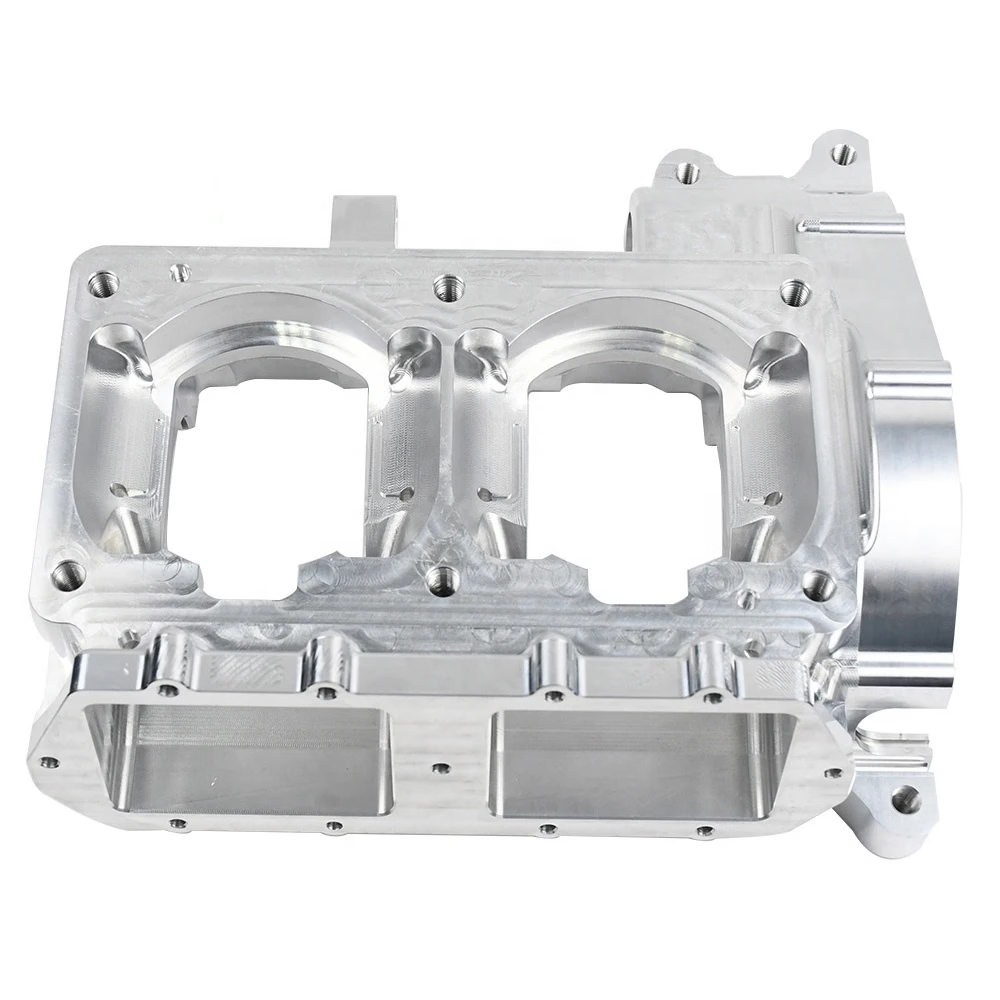
For a buyer, the practical result is a market that is strong on mid-size prismatic parts, tooling and structural components, and thinner on very small, high-volume turned parts. If your part is a 300 mm aluminum housing with tight bores, Spain is a natural fit. If it is an M4 stainless insert at 50,000 pieces a month, look elsewhere first.
Labor is the other factor. Spanish shops carry skilled programmers and setter-operators, and many run two shifts. That depth shows up in setup-heavy work, where a supplier has to build fixtures and prove a process before cutting chips. It does not show up as a cost advantage. Spanish hourly rates sit well above Eastern European and Asian rates.
Regional differences matter more than country averages. A Basque shop with IATF 16949 and a press shop next door behaves differently from a small Catalonian job shop serving packaging machinery. Ask where the part will be made, not where the sales office sits.
- 1Strongest workMid-size housings, brackets, structural plates, tooling and fixtures
- 2Weaker workVery high-volume small turned parts, low-cost commodity hardware
- 3Typical batch rangePrototypes up to a few thousand pieces per year per part number
- 4Main cost driverSetup, fixturing and programming hours, not material
Which parts fit a Spanish machine shop
Start with envelope and axis count. A part that needs one setup on a 5-axis trunnion is easy to place in Spain. A part that needs four setups, a rotary table and hand blending is harder to quote because the supplier has to model the whole sequence before giving a number.
Tolerance is the second filter. Most capable Spanish shops hold ±0.01 mm comfortably on bores and ±0.02 mm on free-form surfaces without special measures. Below ±0.005 mm, the shop needs temperature control, a metrology plan and a clear statement of which features actually carry that tolerance.
Surface finish follows the same logic. As-machined aluminum usually lands around Ra 1.6–3.2 μm. If you need Ra 0.8–1.6 μm, that is a normal request for a finish pass. Ra 0.2–0.8 μm on a large face means lapping or fine boring, and it changes both price and lead time.
Material choice narrows the list further. Aluminum 6061, 6082 and 7075, plus 304 and 316 stainless, are everyday work. Inconel, titanium Ti-6Al-4V and beryllium copper are possible, but only a minority of shops keep the tooling, coolant and tool-life data for them. Ask about tool life before asking about price.
- 1Good fitAluminum and stainless parts within a 750 mm cube, two setups or fewer
- 2Needs reviewInconel or titanium with thin walls under 1 mm
- 3Hard to placeParts needing five or more setups and manual fitting
- 4Ask aboutSpindle hours available in the next four weeks
Certifications, traceability and what to ask for
Aerospace, automotive and medical buyers in Spain are used to certificate requests, and most suppliers can produce them quickly. The trap is scope. A certificate may cover a group headquarters while your part is made at a satellite site that is not on the schedule. Read the scope statement and the site address.
Traceability is the next question. For a medical or aerospace part, you want heat lot numbers on the material certificate, a route card that follows the part through each operation, and inspection records tied to serial numbers. For an industrial bracket, a material certificate and a dimensional report are usually enough.
Inspection practice varies widely. Some shops inspect first-off and final only. Others monitor in-process. Ask which features are checked, with what instrument, and whether the reports come as PDF or as raw CMM data. A supplier that answers this in one email is usually a supplier that has done it before.
When a Spanish shop cannot cover a process, subcontracting appears. Heat treat, anodizing and plating are often sent out. Each outside step adds a handoff, a queue and a chance of damage. Ask which operations are in-house and which are not before you approve the route.
- 1Check scopeCertificate must name the site that machines your part
- 2Check recordsHeat lot, route card, first-off and final inspection
- 3Check subcontracted stepsHeat treat, anodizing, plating, laser marking
- 4Check data formatPDF reports, raw CMM output, or both
Cost, lead time and where Asia fits
Spanish quotations are usually built from setup hours, cycle time and material, with a margin added on top. Setup is the part that hurts on low volumes. A part with six hours of fixturing and programming cannot be cheap at ten pieces, no matter which country you buy from.
Lead time in Spain typically runs from three to six weeks for a first article, shorter for repeat orders where the fixture already exists. That is fast enough for a European production line and slow enough to hurt a development schedule that changes weekly.
Asia competes on a different axis. A Chinese shop with 127 high-precision CNC machines, 16 simultaneous 5-axis centers and a 4,000 mm maximum processing size can absorb setup cost across more work and quote lower unit prices at volume. Shipping adds transit time, so the trade is money for days.
The sensible pattern for many buyers is a split. Keep urgent changes, repair work and small batches with a Spanish supplier who is two hours away by truck. Move stable, repeatable part numbers with clean drawings to an Asian partner and let the savings pay for the extra transit. The drawings have to be frozen first, or the split turns into two sets of scrap.
- 1Spain wins onShort transit, face-to-face engineering, urgent rework
- 2Asia wins onUnit cost at volume, wide material range, large envelope
- 3Break-evenUsually around a few hundred pieces, depending on setup hours
- 4PrerequisiteFrozen drawings and a clear revision control process
Spain versus an Asian partner: which part goes where
Use this as a first filter, not a rule. Setup hours move the break-even point.
| Factor | Spain supplier | Asian partner (GreatLight) |
|---|---|---|
| Typical batch | 10–2,000 pieces | 1 piece to 10,000+ pieces |
| Tolerance | ±0.01 mm routine | ±0.005 mm (±0.0002 in) |
| Surface finish | Ra 0.8–1.6 μm common | Ra 0.2–0.8 μm available |
| Lead time | 3–6 weeks first article | Quote in 12 h, ship in 3–5 days |
| Transit to EU | 1–3 days by truck | Air or sea freight, plan ahead |
| Standards | ISO 9001, IATF 16949 common | ISO 9001, IATF 16949, ISO 13485, ISO 27001 |
| Best for | Changes, rework, small batches | Stable repeat parts at volume |
| Drawings | Local discussion, quick edits | Frozen revision, DFM report first |
Pick the supplier your schedule can survive
If the part is still changing or the line is down, buy in Spain and pay for proximity. If the drawing is frozen and the volume repeats, source from Asia and pay for freight instead.
Questions buyers ask next
Is CNC processing in Spain expensive compared with other European countries?
Rates sit in the middle of Western Europe. Spain is cheaper than Germany or Switzerland on hourly rates, and more expensive than Poland or the Czech Republic.
The gap narrows on complex parts, because a shop that needs fewer setups can beat a cheaper shop that needs more.
What tolerance should I expect from a Spanish machine shop?
±0.01 mm on bores and ±0.02 mm on free-form surfaces is a normal, comfortable range without special measures.
Below ±0.005 mm you should expect questions about temperature control, datum strategy and which features truly need that band.
Can a Spanish supplier handle aerospace and medical parts?
Yes, but check the certificate scope against the site doing the work. Aerospace and medical programs often require AS9100 or ISO 13485 rather than only ISO 9001.
Ask for the inspection plan and the traceability route before the first order, not after.
How do I keep drawings confidential when sourcing overseas?
Send only what the shop needs for the quote, use a controlled transfer method, and sign an NDA before detailed models go out.
GreatLight keeps uploads secure and confidential, and an NDA is available on request.
What is the minimum order quantity for outsourced CNC work?
Many Asian suppliers set a minimum that makes small orders uneconomic. GreatLight has no minimum order quantity, so a single prototype and a 10,000-piece run both go through the same quoting process.
That matters most during development, when you need three parts this week and two thousand next quarter.
How fast can parts ship from Asia to Europe?
Quote and free DFM analysis come back within 12 hours, and production can start within 24 hours of approval.
Parts ship in 3–5 days once production is complete. Freight time to Europe is separate and depends on the shipping method you choose.
Send the drawing and get a real number
Upload your STEP file and get a quotation with a free DFM analysis within 12 hours. No minimum order quantity.
12-hour quote100% inspectionNo MOQNDA on request
More machining notes
We publish setup notes, tooling trials and inspection data from the factory floor.











