
CNC Processing Industry 2023: Trends and Forecasts
This page is written for design engineers and sourcing managers who buy machined metal parts. It covers what actually shifted in the CNC processing industry 2023 and what those shifts mean when you place a job: 5-axis demand, unattended machining, inspection data, and supply chain region choices.
In this article
- 1
- 2
- 3
- 4
- 5
- 6
- 7
- 8
Key takeaways
5-axis capacity became the baseline for complex parts
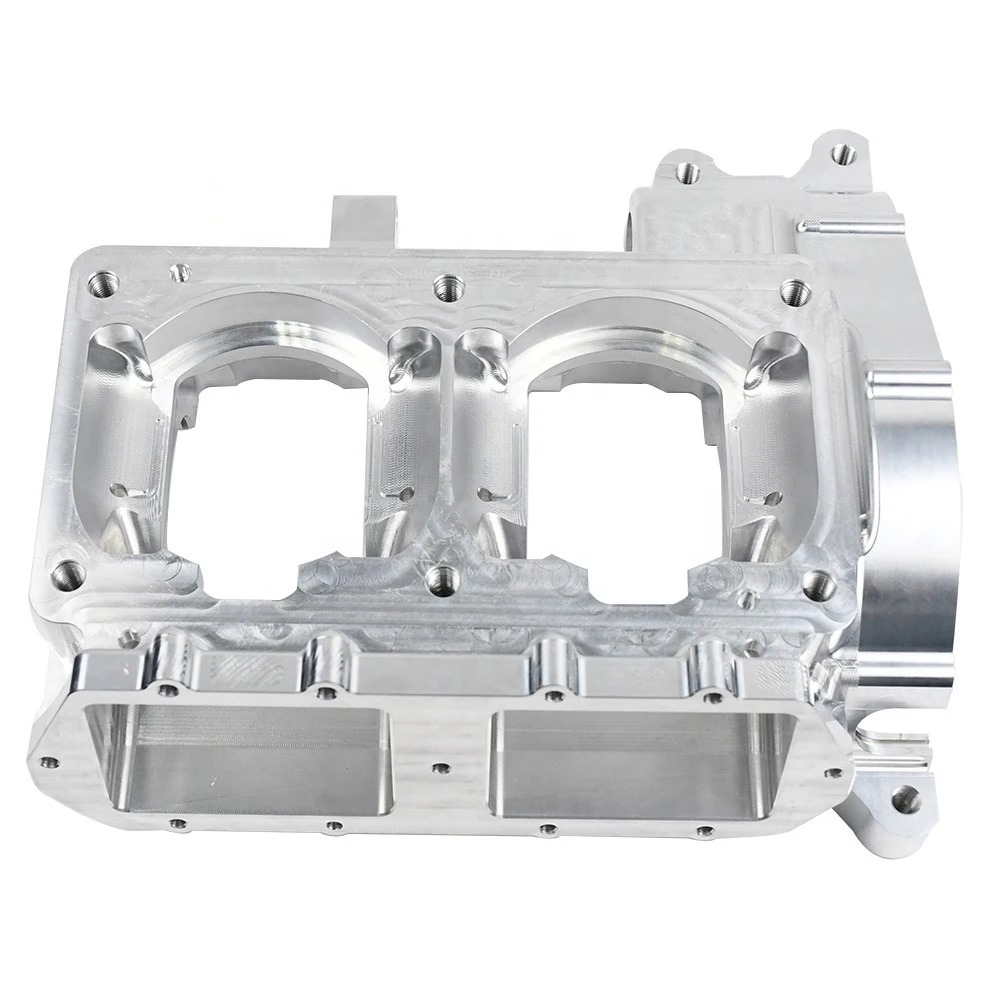
The clearest change in the CNC processing industry 2023 was how quickly 5-axis machining stopped being a premium option. For an engineer, the practical effect is fewer setups. A housing with features on five faces used to need three or four fixtures, and each re-clamp added position error. One simultaneous 5-axis setup holds the datum until the part is finished.
That matters most on parts with tight true position between faces. If a bore on one side must align with a boss on another to within ±0.02 mm, stacking three fixtures is a losing game. Turning the part once and machining all faces keeps the error budget in the machine, not in the fixture stack.
It is not always the right call. On a simple flat plate with holes on one face, 3-axis is faster and cheaper. 5-axis earns its cost when the part is deep, has undercuts, or needs a single datum for every feature.
- 1Good fitImpellers, manifolds, aerospace brackets, medical housings with angled ports.
- 2Poor fitFlat plates, simple shafts, high-volume parts with two-axis symmetry.
- 3What to askHow many setups, and which face is the datum?
Unattended machining shifted how quotes are built
Pallet changers, tool-life monitoring, and lights-out running grew through 2023 because labor availability tightened. From the buying side, this changes what makes a part cheap. A job that runs unattended for six hours is priced differently than one that needs an operator standing at the door.
Geometry drives this. Deep pockets, thin walls, and chatter-prone features force slower feeds and more operator attention, so the unattended hours vanish. Features with good tool access and stable chip evacuation run long and run cheap.
If you want the lower tier of pricing, design for tool access. A 6 mm end mill reaching a 40 mm deep pocket needs a long, thin tool that must run slowly. Widen the pocket corner radius and shorten the reach, and cycle time drops without changing function.
- 1Runs unattended wellParts with open faces, standard corner radii, and short tool reach.
- 2Needs attentionDeep ribs, 0.5 mm walls, interrupted cuts in hardened steel.
Inspection records became part of the deliverable
Buyers in automotive and medical pushed harder on traceability in 2023. A machined part now often ships with a dimensional report, material certificate, and a record of the inspection steps it passed. For regulated programs this is not optional.
The reason is simple. A CMM report catches a drifting process before a whole lot is wrong. If a bore measures 0.008 mm over nominal on the first part of a run, the operator can offset the tool before the second part is cut.
When you write the purchase order, say what you want measured and how. A drawing with a general tolerance block and no critical callouts will get a general report. Call out the three or four features that actually matter and those get measured and recorded.
- 1Ask forFirst article report, material cert, in-process check points.
- 2Worth specifyingWhich features are critical, and the measurement method.
Additive and subtractive work in the same job
Metal printing did not replace machining. It moved upstream of it. In 2023 the common pattern was to print a near-net shape in titanium or Inconel, then machine the sealing faces, bores, and thread forms to final size.
This matters for hard alloys. Removing 80 percent of a titanium block as chips wastes tool life and time. Printing close to shape leaves maybe 0.5 mm of stock on critical surfaces, which a finishing pass removes quickly.
The trade-off is surface condition. As-printed surfaces are rough and often need support removal before machining. A part that is mostly prismatic and has one or two difficult features is usually cheaper to machine from solid than to print and finish.
Supplier choice became a lead-time decision
Freight variability through 2023 pushed buyers to look at response time rather than only hourly rate. A shop that quotes in half a day and starts cutting the next day often beats a cheaper shop that takes a week to confirm an order.
For prototypes and bridge builds, that gap decides the schedule. Engineers who once sent everything overseas now split jobs: urgent revisions to a fast local or regional partner, volume runs where the tooling is settled.
The practical filter is simple. Ask how fast you get a quote, how fast production starts, and what the historical late-delivery rate is. Those three numbers tell you more about schedule risk than a rate card.
- 1Quote turnaroundSame-day or next-day, with DFM feedback attached.
- 2Production startNext working day if material is in stock.
- 3Schedule riskAsk for the shop's own late-delivery history.
What carries into the next buying cycle
Three things look durable rather than cyclical. First, tolerance bands keep tightening on mating features because assemblies are being designed lighter, and lighter parts deflect more. Second, buyers keep asking for shorter runs with more revisions, which favors shops with no minimum order quantity.
Third, sustainability pressure is reaching the shop floor through customer questionnaires. Energy per part, scrap rate, and coolant handling are being asked about directly. A shop that runs lights-out and recycles chips has a real answer.
For engineers, the practical takeaway is to design for the process you can actually get. Give the shop a datum, call out critical features, and leave enough stock on hard alloys. That does more for cost and schedule than any negotiation.
Matching part features to the right process
Use this to decide which machining route to quote.
| Part feature | Best process | Why | Watch out for |
|---|---|---|---|
| Features on 3+ faces | 5-axis, one setup | Datum never changes | Higher hourly rate |
| Flat plate, single face | 3-axis | Fast setup, low cost | None, if tolerances are open |
| Turned shaft with milled flats | Mill-turn | One setup for both ops | Limited milling envelope |
| Deep pocket, 6:1 depth ratio | 3-axis with long tool | Reach is the limit, not axes | Chatter, slow feeds |
| Titanium near-net blank | Print then finish | Saves tool life on hard alloy | Support removal first |
| Thin wall under 1 mm | 5-axis, light passes | Fixturing off the wall | Deflection and vibration |
| High-volume simple part | 3-axis with pallets | Unattended hours cut cost | Tool life monitoring needed |
Which route fits your part
If the part is complex, has features on several faces, or is made of titanium or Inconel, quote 5-axis and expect fewer setups and better positional accuracy. If the part is simple, flat, and runs in volume, quote 3-axis with pallet loading and let unattended hours drive the price down. Do not pay for 5-axis on a plate.
Questions engineers ask about these trends
Does 5-axis always give better accuracy than 3-axis?
No. It gives better positional accuracy between faces because the part is not re-clamped. If all features are on one face, 3-axis can hold the same tolerance with a simpler setup.
The gain shows up on true position between features on different faces, or on angled holes and contoured surfaces.
Why does unattended machining lower the price?
Because machine hours run without an operator at the door. The shop can spread one operator across several machines overnight.
That only works when the geometry allows stable cutting and predictable tool life. Deep pockets and thin walls break the pattern and bring the operator back.
Should I print a metal part or machine it from solid?
Print when the part is large, mostly solid, and made of an expensive hard alloy, so you avoid turning most of the block into chips.
Machine from solid when the part is prismatic and the critical features can be reached with standard tools. Printing adds a support-removal step that you have to plan for.
What tolerance should I put on a drawing?
Put tight tolerances only where the part functions. A general block of ±0.1 mm plus two or three critical callouts at ±0.01 mm is easier to quote and inspect than a drawing where everything is tight.
Shops can hold ±0.005 mm on critical features, but applying that to every dimension adds cost without adding function.
How do I judge schedule risk before placing an order?
Ask three questions: how fast is the quote, how fast does production start, and what is the shop's historical late-delivery rate.
A shop that quotes in half a day and starts within a day is usually better prepared than one that needs a week to confirm.
Does sustainability pressure actually change how parts are made?
It changes scrap rate, coolant handling, and chip recycling more than it changes the cutting process itself.
Buyers now send questionnaires asking for energy per part and scrap figures, so shops track them. For you, the visible effect is a shop that monitors tool wear instead of replacing tools on a fixed schedule.
Send a drawing and get a process route back
Upload your files and we return a quotation with DFM analysis within 12 hours. Parts ship in 3-5 days, from one piece to 10,000+.
12-hour quoteNo MOQ100% inspectionNDA on request
More from the shop floor
We publish setup notes, tooling trials and inspection data from the factory floor.











