
CNC Processing Industry in Oman: A Growing Sector
Oman has spent the last decade moving oil and gas revenue into manufacturing, and machined metal parts sit near the center of that shift. This page explains what the country machines, which parts are a good fit for local and offshore suppliers, and how to judge a shop before you send a drawing.
Key takeaways
What the CNC processing industry in Oman actually machines
Oman's manufacturing base grew out of oil and gas, so the first parts to be machined locally were the ones that keep production running: valve bodies, choke components, pipe flanges, pump housings, and wellhead fittings. Most of these are turned and milled from stainless or low-alloy steel, in batches that repeat every few months rather than every week.
The second wave is downstream. Refineries, petrochemical plants, and the growing port and logistics sector need replacement parts, conveyor hardware, and structural fittings. These jobs are smaller and more varied, which suits 3-axis and 4-axis machining better than a dedicated production line.
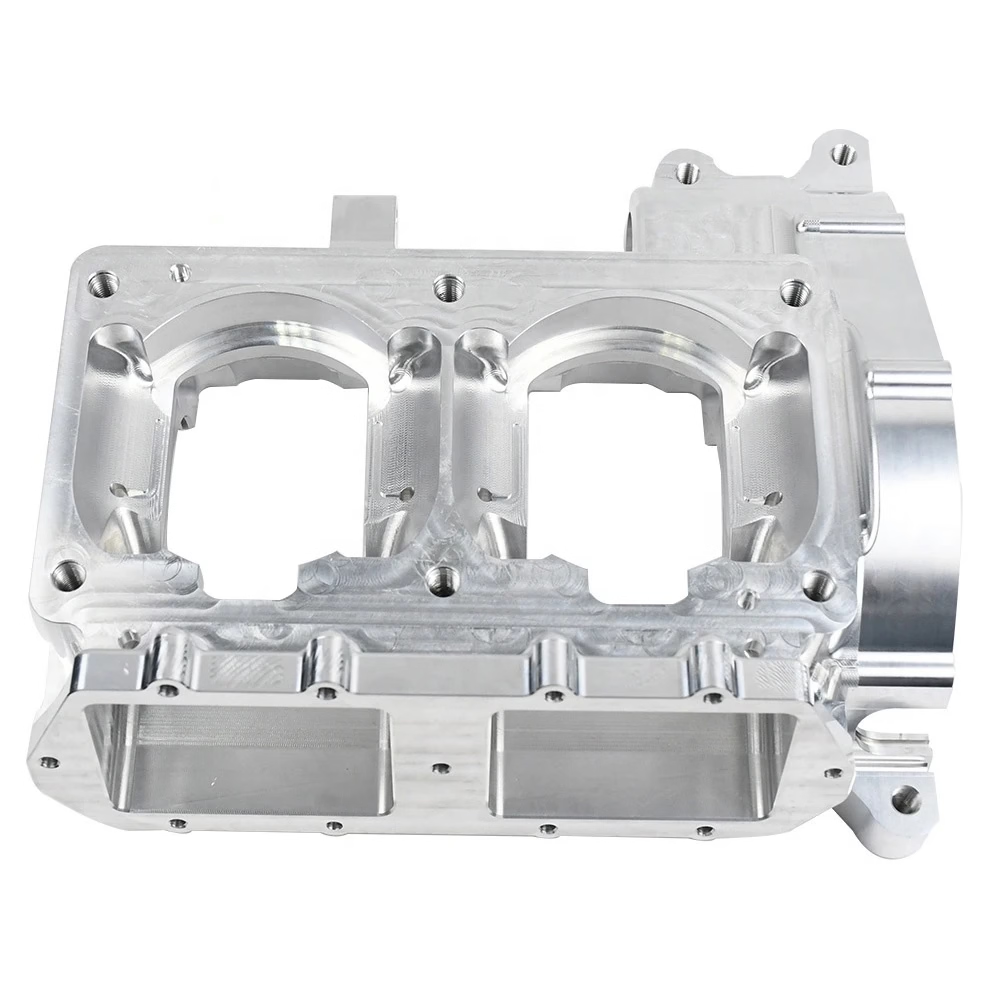
A third group is emerging around energy transition projects and automotive aftermarket work. Brackets, housings, heat-sink parts, and engine components are machined from aluminium and plastics, often as prototypes first. That mix is where a supplier with 5-axis capacity and fast turnaround has an advantage over a shop set up for one long production run.
The practical point for a buyer is that the part family tells you where to source. A large, simple flange can be made almost anywhere. A thin-wall housing with five faces of features and a ±0.005 mm bore is a different sourcing decision.
- 1Oil and gasValve bodies, manifolds, flanges, pump and wellhead parts
- 2Petrochemical and industrialReplacement parts, fittings, conveyor and structural hardware
- 3Energy transitionBrackets, housings, heat sinks, busbar and enclosure parts
- 4Automotive aftermarketEngine components, adapters, and low-volume spare parts
Matching part geometry to the right machine
Machine choice is decided by the number of faces you can reach in one setup. A part that needs work on five sides, with tight position tolerance between them, belongs on a simultaneous 5-axis center. Every extra setup adds a datum shift, and datum shifts are where ±0.005 mm quietly becomes ±0.03 mm.
For parts under roughly 500 mm, a compact 5-axis machine with a Ø400 mm rotary table covers most brackets, housings, and manifolds. Mid-size work up to 750 × 1,150 × 550 mm fits a larger traveling-column machine. Long, slender parts such as rails and beams need a machine with 4,000 mm of X travel, and those are less common, so plan the sourcing earlier.
Turning is a separate decision. Parts that are mostly cylindrical, with a few cross-holes or flats, are usually cheaper on a mill-turn center than on a mill, because the part never leaves the spindle. If a drawing mixes a long turned body with off-axis drilled features, ask the shop which process they would quote and why.
One more check: thin walls. Below about 1.5 mm wall thickness in aluminium, and 1 mm in stainless, deflection during roughing becomes the limiting factor, not the machine. Expect the shop to adjust stepover and use lighter finishing passes rather than promise a number they cannot hold.
- 1One setup, five facesUse 5-axis when position tolerance between faces is tight
- 2Long parts4,000 mm X travel is scarce; book capacity early
- 3Mill-turnCheapest route for mostly cylindrical parts with cross features
- 4Thin wallsBelow 1.5 mm in aluminium, deflection controls the process
Materials that behave well in this region
Humidity and salt air along the coast push most buyers toward 316 and 316L stainless, and sometimes 17-4PH when strength matters more than corrosion resistance. All three machine cleanly with the right feeds. Duplex and super-duplex are harder: they work-harden quickly, so the shop needs rigid tooling and a cutting strategy that keeps the tool engaged.
Aluminium is the easy path. 6061-T6 covers brackets and housings, 7075 is used where strength-to-weight matters, and 5083 shows up in marine and structural work. Surface finish on aluminium is straightforward, and anodizing is usually the final step.
Inconel and titanium are the cost drivers. Both cut slowly, both wear tools, and both need a shop that has run them before. If a part is Inconel 718 and the shop cannot show you previous work in the same alloy, the risk is in the cycle time, not the drawing.
Plastics are a different conversation. POM and PEEK hold tolerance well; ABS and PP move with temperature. For a functional prototype in plastic, expect wider tolerance bands than the metal version of the same part.
- 1Marine and coastal316L, 17-4PH, 5083 aluminium
- 2General industrial6061-T6, 1045, 4140, 303 stainless
- 3High temperatureInconel 718, titanium TC4, tool steel
- 4PrototypesPOM, PEEK, ABS, carbon fibre, PMMA
Judging a supplier before you send the drawing
Start with the certificate, not the price. ISO 9001:2015 tells you a documented quality system exists. IATF 16949:2016 matters for automotive programs, and ISO 13485:2016 for medical work. If a shop quotes an energy-sector part and cannot state which system it runs, the quote is not comparable to one from a certified supplier.
Next, ask how inspection is handled. A supplier that checks 100% before shipment, with raw material verification, in-process monitoring, and a final report, will surface a problem before the parts ship. A supplier that samples may not. For a first order, it is reasonable to ask for the inspection report with the shipment.
Lead time is the third filter. A quotation and DFM feedback within 12 hours, production starting within 24 hours, and parts shipping in 3–5 days is achievable on standard materials. Custom finishes, imported alloys, or a new fixture will push that out. Treat any fixed date promise on a first-article part with caution.
Finally, look at how the shop handles the file. Uploads should be confidential, and an NDA should be available on request. If a supplier is vague about who sees your drawings, that is a signal about how the rest of the program will be run.
- 1CertificatesISO 9001, IATF 16949, ISO 13485, ISO 27001
- 2Inspection100% before shipment, reports on request
- 3Lead time12-hour quote, 3–5 day shipping on standard work
- 4ConfidentialitySecure uploads, NDA on request
Which sourcing route fits your part
Match the part type to the machine, the tolerance, and the expected run size.
| Part type | Best process | Typical tolerance | Where it makes sense |
|---|---|---|---|
| Large flange, simple turning | CNC turning | ±0.05 mm | Local supply, repeat batches |
| Valve body, multi-face | 5-axis milling | ±0.01 mm | One setup, tight face position |
| Thin-wall housing | 5-axis + light finishing | ±0.02 mm | Deflection controls the result |
| Long rail, 2,000 mm+ | Traveling-column mill | ±0.05 mm | Limited machine pool, book early |
| Prototype bracket | 3-axis milling | ±0.05 mm | Fast, low cost, iterate quickly |
| Inconel manifold | 5-axis, rigid tooling | ±0.01 mm | Tool wear and cycle time drive cost |
| Pump shaft | Mill-turn | ±0.005 mm | Cylindrical with cross features |
| Plastic cover | 3-axis milling | ±0.1 mm | Thermal movement sets the band |
The practical call
If your part is a large, simple, repeatable oil and gas component, source it close to the plant. If it is a tight-tolerance, multi-face part in a difficult alloy, send it to a certified shop with 5-axis capacity and a documented inspection routine, even if that means shipping it in.
Questions engineers ask
Can a shop outside Oman quote a part for an Omani plant?
Yes. Machined parts are routinely exported, and the deciding factors are the certificate, the inspection report, and the shipping method rather than the country of origin.
What matters is that the drawing is quoted against a real process, the alloy is traceable, and the final report travels with the parts.
How tight a tolerance is realistic on a 5-axis part?
±0.005 mm is achievable on critical features when the part is rigid, the material is stable, and the shop controls temperature. On thin walls or long unsupported sections, ±0.02 mm is a more honest number.
Ask which specific dimensions the tight tolerance applies to. A drawing that calls ±0.005 mm on every dimension is usually over-specified and will cost more than it needs to.
What run sizes make sense?
There is no minimum order quantity at a shop set up for prototypes, so a single part is fine. The economics change with fixtures: one part pays for setup, 100 parts pay for a soft fixture, 10,000 parts justify hard tooling.
For oil and gas spares, runs of 5 to 50 are common because the parts are consumed slowly and storage is expensive.
Which finishes hold up in coastal conditions?
Anodizing for aluminium and electroless nickel or zinc plating for steel are the usual choices. Hardcoat anodizing adds wear resistance where parts slide against each other.
Powder coating and black oxide are options, but on tight-tolerance bores the coating thickness has to be planned into the drawing, not added afterward.
How fast can a first article ship?
On standard materials, a quotation and DFM analysis can come back within 12 hours, production can start within 24 hours, and parts can ship in 3–5 days.
Custom finishes, imported alloys, or a new fixture add time. Ask for the schedule in writing before the order is released.
What should be in the inspection report?
Raw material certificate, dimensional results for the critical features, surface finish readings where specified, and a note on any deviation. Reports are available on request.
If the part is for a regulated program, confirm the report format before production starts so it matches your quality file.
Send the drawing, get a real process answer
Upload your file and we will return a quotation with DFM feedback within 12 hours. Tolerances, material, and finish are quoted against the actual machine, not a catalog number.
12-hour quote100% inspectionNo MOQ
More from the shop floor
We publish setup notes, tooling trials and inspection data from the factory floor.











